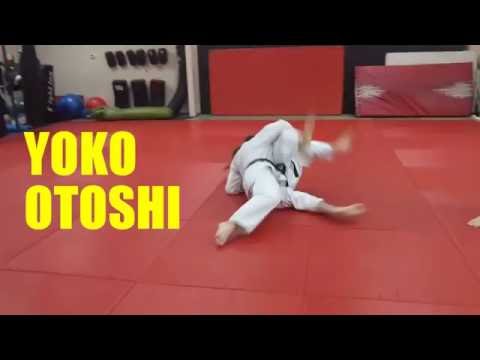
YOKO OTOSHI 3 Variations
0
Yoko Otoshi·welcomematstevescott
Yoko Otoshi (Side Drop) is a popular and effective throw and has a lot of variations. This video presents three effectiv…
Translation: side drop
Yoko Otoshi, the side drop, is a sacrifice throw in which tori drops to one side while extending a leg in front of uke's advance, using a strong lateral pull to bring uke crashing down over tori's outstretched body. [1],[2] The technique relies primarily on timing and the pull of the arms rather than leg sweeping or body contact — tori creates an obstacle with their extended body and uses uke's forward momentum to complete the throw. [2],[3] Yoko otoshi is considered one of the purest expressions of the judo principle of using an opponent's momentum against them. [3]
Yoko otoshi is part of the Kodokan judo yoko-sutemi-waza syllabus. [1]
Yoko otoshi is scored in IJF competition. [1]
No images yet for this technique.
Sign in to suggest an image.
Yoko Otoshi (Side Drop) is a popular and effective throw and has a lot of variations. This video presents three effectiv…
No instructional courses yet for this technique.
Sign in to suggest a course.
Risk of injury to the person this technique is applied to
Yoko-Sutemi-Waza; lateral falling sacrifice; shoulder/rib impact risk
Skill level needed to execute this technique reliably
Whether this technique is allowed under major competition rule sets
Kodokan Judo — Official Nage-waza Classification
Traditional Judo throwing technique terminology (Kodokan Institute)
Official Kodokan ground technique classification system
Standard Japanese martial arts terminology (kanji/hiragana)
Established Japanese martial arts naming convention — native Japanese term (和語/漢語)
Traditional Judo throwing technique terminology (Kodokan Institute)
precise timing, ankle coordination, upper body kuzushi ability
excellent balance and quick reflexes
tibialis anterior, calves, hip rotators, forearms (grip)
Every move, in any martial art, shares a few universal traits. Mix and match below to pinpoint the right tool — or compare equivalents across styles.
Yoko Otoshi and a counter groom can look similar, but Yoko Otoshi uses a slightly different grip approach, such as coming through with a two-on-one grip variation.
Yoko Otoshi, the side drop, is a sacrifice throw in which tori drops to one side while extending a leg in front of uke's advance, using a strong lateral pull to bring uke crashing down over tori's outstretched body. The technique relies primarily on timing and the pull of the arms rather than leg sweeping or body contact — tori creates an obstacle with their extended body and uses uke's forward momentum to complete the throw.
Yoko otoshi is one of the original Kodokan sacrifice throws and appears in the gokyo no waza. The technique exemplifies Jigoro Kano's principle of maximum efficiency with minimum effort, as it requires very little physical strength when timed correctly.
IJF: legal — Legal throwing technique; IBJJF: legal — Legal at all belt levels; UWW: legal — Legal in both freestyle and Greco-Roman; Unified MMA: legal — Legal throwing technique; ADCC: legal — Legal; FIAS Sport Sambo: legal — Legal; FIAS Combat Sambo: legal — Legal
Danger rating 6/10. High — Yoko-Sutemi-Waza; lateral falling sacrifice; shoulder/rib impact risk
The standard setup chain: Grip Setup (Kumi-kata) → Off-Balance (Kuzushi) → Entry (Tsukuri) → Execution (Kake) → Fall (Sutemi).
Standard counters include: Lower Centre of Gravity — bend knees and drop hips to make the throw harder to execute / Lift the Targeted Leg — raise the foot being attacked above the sweeping action / Counter-Throw — exploit the attacker's committed weight to throw them instead / Grip Break — deny the thrower their preferred gripping configuration.
Common variants: Forward sweep (sweeping the foot in the direction the opponent is stepping); Rear sweep (sweeping the foot backward as the opponent retreats); Combination sweep (chaining sweeps to both feet); Counter sweep (timing the sweep as the opponent initiates their own attack).
Yoko otoshi is scored in IJF competition.
Top errors to watch for: Trying to trip or sweep with the legs — yoko otoshi uses no leg techniques; it's all hands / Falling without pulling uke — your body drop alone does nothing unless uke is being pulled / Pulling uke toward you instead of past you — they should go over the space where you just were / Not committing fully to the side fall — a half-drop has no effect.
The Yoko Otoshi is also known as Side Drop, Lateral Drop Throw, Yoko Otoshi.