Mount Position Strategy in Submission-Only Rulesets
Giles explains that submission-only competition encourages opponents to avoid turning their back or turtling, instead staying flat to the mat where submissions are more difficult to achieve from mount. This defensive strategy makes mount position submissions require careful technique selection and execution.
Head and Arm Choke as Primary Mount Submission
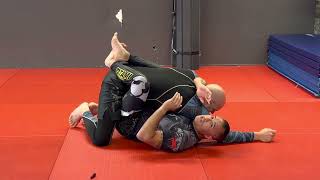
The head and arm choke is presented as one of the most reliable submissions available from mount position, alongside straight armbar attempts. Giles emphasizes the importance of maintaining control of the opponent's arm throughout the technique to prevent escape.
Controlling the Opponent's Arm Position
The attacker must maintain constant control of the opponent's elbow line to prevent them from removing their arm either downward or across the body. Chest and head positioning should block the opponent's ability to bring their arm in front of their body, while maintaining a stable base.
Transitioning to the Choke: Neck Grip Method
Rather than using the same arm to both control and bring the opponent's arm across, Giles recommends wrapping under the head and gripping the neck with body weight leverage. This approach keeps the arm tight while the attacker leans across to bring the opponent's arm into position, making it much more difficult for the opponent to recover their arm.
Body Position: Moving the Arm Across Midline
The attacker should focus on moving the opponent's arm across their centerline rather than moving themselves off-center, as cutting too far outside exposes the position to bridge escapes. A small head movement blocking the arm once it crosses the midline is more efficient than committing full body weight.
Preventing Arm Escape: Head Placement
Positioning the head nearly ear-to-ear blocks the opponent's primary escape route of lifting their arm above their head to roll flat. This head placement is critical to maintaining control, though the attacker must balance it against the need to apply choke pressure across the neck.
Finishing Pressure: Direction and Mechanics
The finishing pressure should not be purely downward but should push the opponent's shoulder under and into the attacker's bicep rather than straight down. Giles demonstrates that guiding the opponent's shoulder while driving underneath creates more effective choke pressure than simple vertical pressure.
Preventing Roll-Away Defense and Hand Positioning
To prevent the opponent from turning away and extending to escape, the attacker should remain relatively close to the opponent's hip rather than walking too wide. The grip can be secured by connecting the attacker's hands around their own forearm or wrist, with rotation helping to drive the arm deeper into position.
Final Control Position and Transition Setup
Once the opponent's arm is above their head, scooping the neck allows the attacker to control both the head and opponent's arm with one grip, creating excellent positional security. This control position also allows the attacker to defend against double underhook attempts while walking their hips to drive the opponent's elbow across their body.
Head and Arm Choke from Mount (Lachlan Giles)
Key Takeaways
- •Mount Position Strategy in Submission-Only Rulesets
- •Head and Arm Choke as Primary Mount Submission
- •Controlling the Opponent's Arm Position
- •Transitioning to the Choke: Neck Grip Method
Lachlan teaches a class on the head and arm choke! To learn from Lachlan head to https://submeta.io
Frequently Asked Questions
What does this video teach about head and arm choke?
This video covers mount position strategy in submission-only rulesets, head and arm choke as primary mount submission, controlling the opponent's arm position. It provides detailed instruction from Absolute MMA St Kilda - Melbourne.
How long does it take to learn head and arm choke?
The basic mechanics can be understood in a single session, but developing reliable execution requires consistent drilling over weeks of practice. This 9-part breakdown helps structure your training by isolating each phase of the technique.
What are the key details for finishing head and arm choke?
To prevent the opponent from turning away and extending to escape, the attacker should remain relatively close to the opponent's hip rather than walking too wide. The grip can be secured by connecting the attacker's hands around their own forearm or wrist, with rotation helping to drive the arm deeper into position.
Related videos
How to Defend: Head-Arm Triangle Choke
fightTIPS
How to : Rolling Arm Triangle from Turtle Part 3
UltimateMMA Plus
Knee on Belly to Arm Triangle!
TeachMeGrappling Coach Brian
Head and arm choke from half guard || The Jiu Jitsu Journal || BJJ Techniques
Prism Jiu Jitsu
Arm Triangle From Closed Guard
Chosen Few BJJ