Arm Triangle Choke Mechanics
The arm triangle choke functions by compressing the opponent's shoulder into the side of the neck while simultaneously cutting off both carotid arteries. The attacker's bicep crushes one side of the neck while the opponent's own shoulder compresses the other side. The finish is achieved by keeping the head down, chest flat to the mat, and gradually inching the body to the side until the opponent taps or loses consciousness.
First Layer of Defense: Preventing Arm Isolation
The primary defensive principle is to prevent the attacker from isolating one arm against the head and neck in the first place. When the opponent begins isolating an arm, the defender should immediately reach over the attacker's head and around the face to free the trapped arm. This preventative action eliminates the choke before it can be fully established, leaving the defender in top side control rather than submitted.
Second Layer: The High Bridge Escape
When the arm triangle is already locked but not yet fully flattened, the defender can use a high bridge escape by creating a C-grip under the attacker's armpit and bridging the hips upward. While bridging, the defender pushes with the framing arm to create space, then drags their trapped arm across the mat and around the attacker's head to escape the choke. This technique works best before the attacker has completely flattened the defender.
Alternative: Knee Grip and Leg Drive
When the defender cannot generate enough hip bridge pressure, an alternative option is to create an S-grip around the knee and kick the leg down to generate space. The leg drive creates distance between the attacker's head and the ground, allowing the trapped arm to be ripped free and around the attacker's head. This method is particularly useful when facing heavy top pressure that prevents a traditional bridge escape.
Last Resort: Thumb Frame Stalling Technique
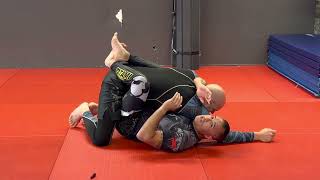
When the arm triangle is fully locked with the attacker's chest on the ground and body inching to the side, the defender's final resort is to dig the thumb into the attacker's elbow to create a small frame. By turning the body to the side using this frame, the defender can create minimal space at the neck to continue breathing. This stalling technique is designed to buy time and potentially cause the attacker to abandon the submission due to fatigue.
Secondary Stalling Option: Knee Grip in Deep Position
An alternative stalling method when locked in a deep arm triangle is to grab both knees and attempt to turn the body to the side, creating space at the neck similar to the thumb frame technique. This method provides another option for maintaining some oxygen flow when other escape methods have failed. Both stalling techniques are designed as last resorts when all prior defensive layers have been breached.
Defensive Summary and Core Principles
The hierarchy of arm triangle defense prioritizes prevention through maintaining arm position and awareness, followed by escapes during the initial lock, and finally stalling techniques in deep positions. The defender must understand that the choke works by cutting off blood flow to the brain via both carotid arteries, making space creation the fundamental goal at every defensive layer. Practitioners should work to prevent the position entirely, as this is always preferable to attempting escapes from deeper, more dangerous positions.
How to Defend: Head-Arm Triangle Choke
Key Takeaways
- •Arm Triangle Choke Mechanics
- •First Layer of Defense: Preventing Arm Isolation
- •Second Layer: The High Bridge Escape
- •Alternative: Knee Grip and Leg Drive
Used in the UFC by Chris Weidman, Randy Couture, and Brock Lesnar, the head-arm (or arm triangle) choke is a fight-finishing submission. Lucky for you, Coach Vince teaches not only how to secure the choke, but also how to defend and escape this position. Vince 'The Anomaly'►https://www.instagram.com/vincetheanomaly Subscribe to FIGHTTIPS►http://bit.ly/1APnzvw FOLLOW: Facebook | http://bit.ly/fightTIPSFacebook Twitter | http://bit.ly/fightTIPSTwitter Instagram | http://bit.ly/fightTIPSInstagram
Frequently Asked Questions
What does this video teach about head and arm choke?
This video covers arm triangle choke mechanics, first layer of defense: preventing arm isolation, second layer: the high bridge escape. It provides detailed instruction from fightTIPS.
How long does it take to learn head and arm choke?
The basic mechanics can be understood in a single session, but developing reliable execution requires consistent drilling over weeks of practice. This 7-part breakdown helps structure your training by isolating each phase of the technique.
What are the key details for finishing head and arm choke?
An alternative stalling method when locked in a deep arm triangle is to grab both knees and attempt to turn the body to the side, creating space at the neck similar to the thumb frame technique. This method provides another option for maintaining some oxygen flow when other escape methods have failed. Both stalling techniques are designed as last resorts when all prior defensive layers have been breached.
Related videos
Head and Arm Choke from Mount (Lachlan Giles)
Absolute MMA St Kilda - Melbourne
How to : Rolling Arm Triangle from Turtle Part 3
UltimateMMA Plus
Knee on Belly to Arm Triangle!
TeachMeGrappling Coach Brian
Head and arm choke from half guard || The Jiu Jitsu Journal || BJJ Techniques
Prism Jiu Jitsu
Arm Triangle From Closed Guard
Chosen Few BJJ