Initial Setup and Hip Positioning
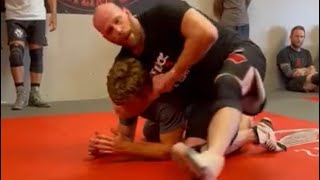
When the opponent shoots, the practitioner lays on their hip while stuffing the opponent's head. The key is positioning the weight on the opponent's head rather than posting heavily, allowing them to maintain control as the opponent attempts to escape.
Foot Placement and Sprawl
After sprawling to create space, the practitioner steps to the outside and touches their foot against the opponent's foot as if setting up a sweep. This foot placement is crucial for directing the opponent's momentum and preventing them from establishing base.
Reading Opponent Responses
The opponent will respond in one of two ways: either continuing to defend the leg or peeling their elbow back. If the elbow peels back, the practitioner transitions immediately to the shoulder trap and Japanese necktie position.
Corner Turn and Tumble Mechanics
The practitioner turns completely around the corner while maintaining hip contact, causing the opponent to tumble forward in a monkey roll over their head. Maintaining weight on the opponent's head throughout this rotation is essential for control and prevents the opponent from posturing up.
Transition Options from Failed Elbow Trap
If the initial elbow trap is missed, the practitioner has multiple follow-up options depending on the opponent's response: mount position if they roll to their back, or transitioning to the Japanese necktie if they turn to their knees.
Setting the Vice Grip
When the opponent turns to their knees, the practitioner punches through and establishes the vice grip with both hands clasped together, elbows tight to the centerline, and thumb positioned on the inside. This grip must be secured immediately and held with serious pressure to prevent escape.
Head Position and Grip Alignment
The opponent's head must be positioned laterally against the practitioner's abdomen, not straight ahead. The vice grip elbows remain closed together, with the practitioner's shoulder touching the mat to prevent rolling past the opponent.
Finishing Hip Motion
The finishing technique requires driving the hip in and then rotating it upward in a scooping motion, rather than simply squeezing inward. This hip rotation combined with the grip pressure creates the final mechanical advantage for the neck crank and choke.
Position and Defense Against Foot Grabs
The practitioner positions themselves far enough back to prevent the opponent from accessing their legs or establishing any defensive grips. Whether on both knees or a single knee, maintaining distance is critical to preventing the opponent from stalling or reversing the position.
Weight Distribution and Commitment
The practitioner must commit fully to the submission with genuine squeezing pressure from the vice grip, treating it as a serious choking threat. This commitment prevents the opponent from stalling and forces them to either tap or be caught by the combined neck crank and choke pressure.
HOW TO do the Japanese Neck Tie (Neck Crank?) in BJJ
Key Takeaways
- •Initial Setup and Hip Positioning
- •Foot Placement and Sprawl
- •Reading Opponent Responses
- •Corner Turn and Tumble Mechanics
This is one of the COOLEST moves in all of Jiu Jitsu. Bmac has some details to help you understand the mechanics of this move. More instructionals available at the website below: http://www.brandonmc.ninja/ Join this channel to get access to Members Only Perks such as: - Weekly Live Classes - Members Only Chat - Exclusive Members Only Videos - Access to the PGF Archive - Custom Badges and Emojis and more! https://www.youtube.com/channel/UCr7VU0Cnef4AhQk7Pe_9nTA/join
Frequently Asked Questions
What does this video teach about standard japanese necktie?
This video covers initial setup and hip positioning, foot placement and sprawl, reading opponent responses. It provides detailed instruction from Brandon Mccaghren.
How long does it take to learn standard japanese necktie?
The basic mechanics can be understood in a single session, but developing reliable execution requires consistent drilling over weeks of practice. This 10-part breakdown helps structure your training by isolating each phase of the technique.
What are the key details for finishing standard japanese necktie?
The practitioner positions themselves far enough back to prevent the opponent from accessing their legs or establishing any defensive grips. Whether on both knees or a single knee, maintaining distance is critical to preventing the opponent from stalling or reversing the position.
Related videos
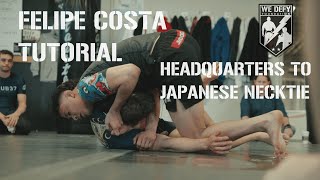
Tutorial: Felipe Costa Demonstrates the Japanese Necktie
We Defy Foundation
High Wrist Guillotine Choke Submission in Turtle. Arm In, High Elbow, Side Control, Mount, Butterfly
Pica Pau Jiu Jitsu & Grappling
HOW TO DO THE REVERSE GUILLOTINE CHOKE EXECUTIONER BJJ JIU JITSU
Redneckjiujitsu
The Peruvian Necktie - Use all 4 limbs to finish this exotic choke
Keenan Cornelius
Catch Wrestling: Front Headlock into 10 Finger Guillotine & Bulldog Choke: Snake Pit U.S.A.
Snake Pit U.S.A. Original No-Gi