Foundation Principles
Effective jiu-jitsu technique requires both efficiency and effectiveness. The instructor emphasizes prioritizing effortless, position-based control over strength-dependent movements.
Headquarters Position Setup
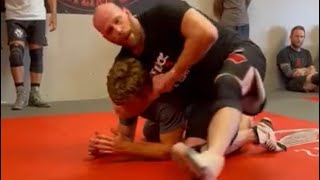
The headquarters position is established with the instructor's leg between the opponent's legs and the opponent's leg between the instructor's legs. The right hand pins the opponent's leg to the ground while the left hand controls either the knee or armpit.
Upper Body Grip Mechanics
The left hand is placed on the opponent's armpit with the thumb facing the chest and forefinger facing the back. This hand placement creates a dominant control position while preventing the opponent from initiating offensive movements.
Lower Body and Head Positioning
The left knee goes behind the opponent's leg while the right leg goes under it. Critical to success is positioning the head to the side of the opponent's body, not on top, which prevents balance disruption and leverage opportunities for the opponent.
Trap and Control Mechanics
The instructor must keep the opponent's foot trapped by maintaining a narrow leg position. When the opponent pushes upward, the instructor uses body weight rather than arm strength to maintain control, demonstrating the principle of effortless positioning.
Countering the Knee Shield Defense
If the opponent establishes a knee shield while the instructor moves laterally, the instructor must create space and transition to the head control. The instructor moves their body and catches the opponent's head while keeping distance initially.
S-Grip Hand Lock
Once the opponent's head is caught, the instructor locks hands using an S-grip with both palms facing upward. The chest should be positioned over the opponent's triceps, and the grip is tightened by crunching the hands together to secure the position.
Grip Placement for Choking Position
The grip placement is positioned on the upper part of the head rather than directly on the neck. This placement prevents the opponent from extending their head to escape, as the arm acts like a knife hand along the crown of the head.
Hip Switch and Body Coverage
When the opponent attempts to push the instructor away with their leg, the instructor switches hips and falls to the side. The body replaces the arm's control function, with the shoulder (not elbow) absorbing the weight while maintaining head control.
Final Leg Control and Submission
During the hip switch, the instructor maintains control of the opponent's bottom leg by keeping one leg between the opponent's legs. Once the leg lock is secured, the instructor walks the hip to apply the final choking pressure, forcing the opponent to submit.
Tutorial: Felipe Costa Demonstrates the Japanese Necktie
Key Takeaways
- •Foundation Principles
- •Headquarters Position Setup
- •Upper Body Grip Mechanics
- •Lower Body and Head Positioning
🔥🥋 Felipe Costa — known around the world as “Laranjinha” (Little Orange) — is an absolute force on the mats! 💪🍊 One of the top-ranked Super Heavy Black Belts in the world, Felipe trains under the legendary Xande Ribeiro and proudly represents Team Six Blades on the global Jiu Jitsu circuit. 🌍🏆 Felipe joined the We Defy Foundation this past April at our Ambassador Summit in Ohio, delivering an unforgettable seminar packed with world-class technique and heart. ❤️ Enjoy these sweet No Gi techniques to slip past your opponent's guard to slick submission. Pay attention to the details! Support the cause and learn more: We Defy Foundation: https://wedefyfoundation.org/ Donate: https://wedefyfoundation.org/donate/ Follow on Instagram: https://www.instagram.com/wedefyfoundation/ If this story resonates, like, comment your thoughts below, and subscribe for more inspiring content!
Frequently Asked Questions
What does this video teach about standard japanese necktie?
This video covers foundation principles, headquarters position setup, upper body grip mechanics. It provides detailed instruction from We Defy Foundation.
How long does it take to learn standard japanese necktie?
The basic mechanics can be understood in a single session, but developing reliable execution requires consistent drilling over weeks of practice. This 10-part breakdown helps structure your training by isolating each phase of the technique.
What are the key details for finishing standard japanese necktie?
When the opponent attempts to push the instructor away with their leg, the instructor switches hips and falls to the side. The body replaces the arm's control function, with the shoulder (not elbow) absorbing the weight while maintaining head control.
Related videos
HOW TO do the Japanese Neck Tie (Neck Crank?) in BJJ
Brandon Mccaghren
High Wrist Guillotine Choke Submission in Turtle. Arm In, High Elbow, Side Control, Mount, Butterfly
Pica Pau Jiu Jitsu & Grappling
HOW TO DO THE REVERSE GUILLOTINE CHOKE EXECUTIONER BJJ JIU JITSU
Redneckjiujitsu
The Peruvian Necktie - Use all 4 limbs to finish this exotic choke
Keenan Cornelius
Catch Wrestling: Front Headlock into 10 Finger Guillotine & Bulldog Choke: Snake Pit U.S.A.
Snake Pit U.S.A. Original No-Gi