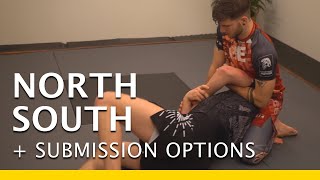
North-South Position Setup
The instructor establishes north-south position with knees on the ground and weight distributed across the opponent's chest. Body positioning can vary from knees grounded to elevated on toes, though maximum weight application is preferred for control. For attacking sequences, one knee remains on the mat while the other leg is free to maneuver.
Securing the Wrist Grip
From north-south, the instructor secures the opponent's wrist with a palm-up grip, pressing it firmly against the chest. The wrist is sandwiched between the gripping hand and the torso to prevent escape. This foundational grip establishes control before transitioning to the Kimura.
Transitioning to Side Control
The free hand moves under the opponent's elbow to lift them onto their side. The instructor uses their leg position to clamp the opponent's body, preventing a roll back to their back. Maintaining the side position is essential before completing the grip transition.
Completing the Kimura Grip
The instructor feeds their free arm under the opponent's arm and clasps their own wrist, creating the complete Kimura grip. The opponent's arm is trapped with the hand positioned toward their back. A knee is placed behind the opponent's back to prevent rolling and maintain side control positioning.
Positioning for the Finish
The instructor transitions to a diagonal top position by switching leg placement—one leg over the head and one leg controlling the hips. The torso lays across the opponent's midsection while the captured arm remains bent. This position maximizes leverage for the final submission.
The Finishing Mechanics
The key to completing the Kimura is bending the opponent's arm and pulling the elbow toward the chest rather than pushing the hand further back. Pushing alone can extend the arm and allow escape, making the elbow pull the critical finishing technique. Consistent pressure on the bent arm combined with chest leverage forces the submission.
Breaking the Grip Defense
When the opponent counters with a strong grip on their gi, the instructor redirects the force laterally before moving the hand behind the back. This lateral movement breaks the defensive grip by changing the angle of attack. Once the initial resistance is defeated, the hand can be repositioned behind the back for the finish.
Complete Sequence Drill
The instructor performs the entire technique in sequence: establishing frames under the opponent's chin and arms, creating the Kimura grip, breaking lateral defenses, placing the elbow on the mat, switching hip position, and finishing with elbow-to-chest pressure. This drilling sequence reinforces proper timing and positioning throughout the submission chain.
BJJ Beginners Tutorial - North South Kimura
Key Takeaways
- •North-South Position Setup
- •Securing the Wrist Grip
- •Transitioning to Side Control
- •Completing the Kimura Grip
Welcome back to our BJJ tutorial series! Today, we're diving deep into the North-South Kimura, an incredibly effective technique that can level up your Brazilian Jiu-Jitsu game. Whether you're a beginner eager to expand your arsenal or a seasoned practitioner seeking refinement, this video is for you. In this tutorial, we'll cover: Understanding the North-South Kimura: Its mechanics and why it's a game-changer. Precise positioning for maximum control and leverage. Step-by-step breakdown of the Kimura grip and lock. Professor Rafa will guide you through each stage, offering clear explanations and live demonstrations. By the end of this tutorial, you'll have a solid grasp of the North-South Kimura and be ready to apply it in your rolls and sparring sessions. This video is part of Chess Club Jiu-Jitsu Beginners Course Curriculum Lesson #14 If you found this tutorial helpful, please hit the like button and subscribe to our channel for more valuable BJJ content. We're always here to help you on your journey to mastering Brazilian Jiu-Jitsu. Have questions or want to see more tutorials on specific BJJ techniques? Leave a comment below, and we'll consider your requests for future videos. Thanks for joining us, and let's keep honing our skills and mastering the North South Kimura together!
Frequently Asked Questions
What does this video teach about kimura grip north-south?
This video covers north-south position setup, securing the wrist grip, transitioning to side control. It provides detailed instruction from Chess Club Jiu-Jitsu.
How long does it take to learn kimura grip north-south?
The basic mechanics can be understood in a single session, but developing reliable execution requires consistent drilling over weeks of practice. This 8-part breakdown helps structure your training by isolating each phase of the technique.
What are the key details for finishing kimura grip north-south?
When the opponent counters with a strong grip on their gi, the instructor redirects the force laterally before moving the hand behind the back. This lateral movement breaks the defensive grip by changing the angle of attack. Once the initial resistance is defeated, the hand can be repositioned behind the back for the finish.