The Underhook's Strategic Value
Underhooks rank among the most versatile grips in grappling, applicable across takedowns, submissions, passing, and sweeping. This grip connects the practitioner to the opponent's torso—either the shoulder or waist—enabling control through destabilization, immobilization, or submission. Understanding underhook positioning is fundamental to controlling both opponent shoulders and hips while protecting one's own.
Underhook Anatomy and Variations
An underhook's effectiveness depends on torso placement: higher positioning controls the shoulder, while lower positioning near the hips—termed a tight waist—controls hip movement. Two underhooks connected create a body lock, which can be positioned toward either the shoulders or waist and secured from front or back. These variations form the foundation for all underhook applications.
Near Side Versus Far Side Underhooks
Near side and far side designations apply only in asymmetrical positions such as half guard or standing, where one side is closer to the opponent than the other. The distinction is simple: a far side underhook requires crossing the opponent's centerline, while a near side underhook does not. Understanding this difference is critical because each variant has specific tactical applications and properties.
Near Side Underhook Applications in Passing
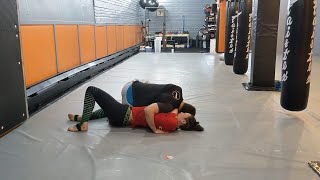
The near side underhook excels in top position for controlling and pinning the bottom player more effectively than a cross face. By securing the near side underhook, the top player prevents the bottom player from creating hip space and keeps their shoulders pinned to the mat. Additionally, this grip nullifies the bottom player's underhook attempts and prevents back control, functioning similarly to knee-on-belly positioning.
Reverse Underhooks and Back Control
A reverse underhook occurs when facing the opponent's hips rather than their shoulders, making it invaluable for back takes and truck entries. Though often overlooked, reverse underhooks demonstrate the underhook's primary function: controlling shoulders or hips. Their practical applications and connection to advanced techniques make them essential for comprehensive grappling systems.
The Shoulder and Hip Battle Framework
Position dominance is determined by control of two distinct battles: shoulders and hips. In positions like octopus guard, pinning the opponent's shoulders to the mat wins the shoulder battle, requiring only hip control victory to improve position. This framework applies universally: practitioners should deliberately take underhooks while preventing opponents from accomplishing their underhook objectives, regardless of whether the opponent understands their own intention.
Strategic Awareness in Grip Exchange
Effective grappling requires deliberate grip selection and intentional prevention of opponent grips. Practitioners can allow underhooks while disrupting their function—for example, permitting half guard underhooks without allowing shoulder pins. This tactical awareness transforms reactive defense into proactive control, enabling practitioners to nullify opponent objectives even when they successfully establish the grip.
A Guide To UNDERHOOKS... Near Side, Far Side, Tight Waist, & Reverse
Key Takeaways
- •The Underhook's Strategic Value
- •Underhook Anatomy and Variations
- •Near Side Versus Far Side Underhooks
- •Near Side Underhook Applications in Passing
👊Thanks to LMNT for sponsoring this video! Head to http://DrinkLMNT.com/JORDANTEACHES to get your free sample pack with any purchase. ✅ BJJ Beginner Course: https://bjjbeginnercourse.com ✅ Jiu-Jitsu Theory Course: https://jiujitsutheorycourse.com 📩 Newsletter: http://jordanteachesjiujitsu.com/newsletter/ ✅ BJJ Games: A Constraints-Led Approach To Grappling: https://playbjjgames.com ✅ Wrestling For BJJ Course: http://wrestlingforbjj.com/ 💥 Kimura Trap Mastery: http://kimuratrapmastery.com ✅ Rides & Escapes Course: https://ridesescapes.com 🏖️ Trinidad & Tobago BJJ Camp: https://www.rollingintobago.com/ 🔥 X-Martial - https://www.xmartial.com/search?q=limitless --- Support my work: ❤️ Patreon: https://www.patreon.com/jordanteachesjiujitsu 👕 Merch: https://limitless-apparel-22.creator-spring.com/ 🥋 BJJ Fanatics: https://bjjfanatics.com/collections/new-releases/products/jordan-teaches-bottom-half-guard-by-jordan-preisinger Social: 💥 Instagram: https://www.instagram.com/jordanteachesjiujitsu/?hl=en 💥 Facebook: https://www.facebook.com/jordanteachesjiujitsu 💥 Facebook group: https://www.facebook.com/groups/jordanteachesjiujitsugroup/ 💥 TikTok: https://www.tiktok.com/@jordanteachesjiujitsu
Related Techniques
Frequently Asked Questions
What does this video teach about underhook side control?
This video covers the underhook's strategic value, underhook anatomy and variations, near side versus far side underhooks. It provides detailed instruction from Jordan Teaches Jiujitsu.
How long does it take to learn underhook side control?
The basic mechanics can be understood in a single session, but developing reliable execution requires consistent drilling over weeks of practice. This 7-part breakdown helps structure your training by isolating each phase of the technique.
What are the key details for finishing underhook side control?
Position dominance is determined by control of two distinct battles: shoulders and hips. In positions like octopus guard, pinning the opponent's shoulders to the mat wins the shoulder battle, requiring only hip control victory to improve position. This framework applies universally: practitioners should deliberately take underhooks while preventing opponents from accomplishing their underhook objectives, regardless of whether the opponent understands their own intention.
Related videos
Setting A Crossface - A Crucial Skill of Half Guard Passing by John Danaher
BJJ Fanatics
The Secret to a World Class Side Control
JonThomasBJJ
How to Make Side Control BRUTAL with the Crossface
Stephan Kesting
BJJ Positioning: Securing Side Control
BJJCANADA.CA: REVIEWS, NEWS, AND MORE.
Side Control - Dealing with Frames and Establishing a Chest to Chest Pin
Fox Den Martial Arts