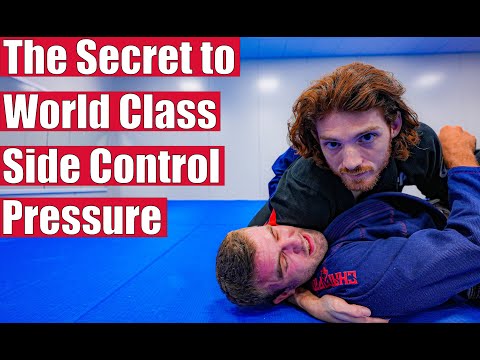
The Secret to a World Class Side Control
0
Crossface Side Control·JonThomasBJJ
This video I overview the key aspects of a strong side control. I focus primarily on the key principle of using your che…
Translation: crossface side control
The Crossface Side Control uses a crossface — driving the forearm across the bottom fighter's face from jaw to shoulder — as the primary upper body control from side control. [1] The crossface turns the bottom fighter's head away, which limits their ability to turn into the top fighter, create frames, or set up escape sequences. [1],[2] Crossface side control is one of the most effective side control configurations because the head control restricts the bottom fighter's options dramatically. [2],[3]
Crossface side control uses a forearm across the opponent's face to control their head and prevent escape. [1]
The crossface is a fundamental control concept in wrestling adapted into BJJ side control. [1]
Crossface side control is widely used in BJJ and MMA competition. [1]
No images yet for this technique.
Sign in to suggest an image.
This video I overview the key aspects of a strong side control. I focus primarily on the key principle of using your che…
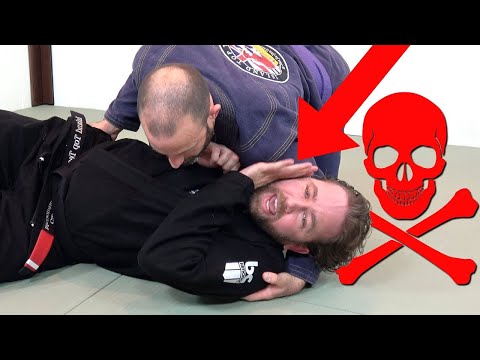
BJJ black belt Cal MacDonald came into the Grapplearts dojo to share the details of the side control crossface for maxim…
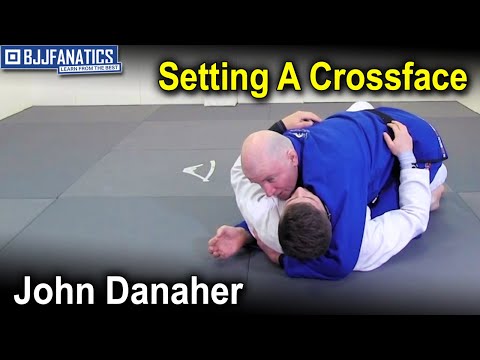
A CRUCIAL SKILL OF HALF GUARD PASSING SETTING A CROSS FACE https://bjjfanatics.com In this BJJ Techniques video, John D…
The crossface side control is a dominant positional technique where the top player controls the opponent's head by wrapping an arm underneath it and hooking into the armpit area, then using their shoulder and body weight to apply pressure and immobilize the bottom player's head and neck. According to Stephan Kesting, the crossface leverages the chin as a fulcrum while the top player's shoulder drives into the jaw; critical to its brutality is full-body engagement—the top player rises onto their toes and drives their hips at an angle to transfer maximal body weight downward rather than relying solely on arm strength. JonThomasBJJ emphasizes that while the crossface is a useful tool, it must be paired with chest pressure to keep the opponent's shoulder blades pinned to the mat; fixating solely on the crossface allows the bottom player to turn onto their side and escape. John Danaher (BJJ Fanatics) stresses precise hand placement, positioning the middle finger in the armpit opening where it meets the rear deltoid, and identifies the true power source as hip movement rather than shoulder drive—the top player should walk their hips as close as possible to their elbow to generate genuine pressure and partial strangulation effect. All three instructors agree the position is highly effective but highlight different mechanical details: Kesting focuses on preventing escape, JonThomasBJJ on integrating chest pressure with the crossface, and Danaher on optimal grip placement and hip engagement for maximum control.
Synthesized from 3 instructors
No instructional courses yet for this technique.
Sign in to suggest a course.
Risk of injury to the person this technique is applied to
Top positions enable pressure and striking; rib compression risk under heavy pressure
Skill level needed to execute this technique reliably
Whether this technique is allowed under major competition rule sets
Brazilian Jiu-Jitsu: Theory and Technique (Renzo Gracie & Royler Gracie, 2001)
Alias sources — [1] Jiu-Jitsu University (Ribeiro, 2008) [2] Mastering Jujitsu (Gracie & Danaher, 2003) [3] UWW Wrestling Rules
Effectiveness sources — [1] Mastering Jujitsu (Gracie & Danaher, 2003)
Mixed Japanese-Western terminology — combines traditional Japanese terms with katakana loanwords
Alias sources — [1] Jiu-Jitsu University (Ribeiro, 2008) [2] Mastering Jujitsu (Gracie & Danaher, 2003) [3] UWW Wrestling Rules
Effectiveness sources — [1] Mastering Jujitsu (Gracie & Danaher, 2003)
chest-to-chest pressure, hip positioning, crossface control
broad chest and shoulders for heavy top pressure
pectorals, deltoids, core, hip extensors
John Danaher emphasizes that you should aim your hand to cover the rear deltoids of your opponent's shoulders, not their neck. Place your middle finger into the armpit where it meets the rear deltoid and lat muscle—this positioning allows your shoulder to exert maximal pressure.
Stephan Kesting recommends getting on your side with your hip facing your opponent and using a frame to create space. Walk your fingers up like you're slicking your hands through your hair to get inside the space and prevent your opponent from fully controlling your head.
Jon Thomas explains that while the crossface is a useful tool, many people fixate too much on it. The core foundation of side control is keeping your opponent's shoulder blades pinned to the mat using chest pressure, which is more important than the crossface alone.
Stephan Kesting emphasizes that staying on your side and basing with your foot to keep your hip facing your opponent prevents him from turning you fully onto your back, which is key to defending against the brutal effects of the crossface.
The Crossface Side Control uses a crossface — driving the forearm across the bottom fighter's face from jaw to shoulder — as the primary upper body control from side control. The crossface turns the bottom fighter's head away, which limits their ability to turn into the top fighter, create frames, or set up escape sequences.
The crossface is a wrestling-derived control technique adopted into BJJ side control, combining the wrestling crossface with BJJ's lateral pinning position. It has become one of the most commonly used side control controls in both BJJ and MMA.
IBJJF: legal — Legal, mount scores 4 points — highest-scoring position; IJF: legal — Legal, osaekomi (pin) — 10-19 seconds scores waza-ari, 20 seconds scores ippon; ADCC: legal — Legal, mount scores 2 points; Unified MMA: legal — Legal dominant position; UWW: legal — Legal, back exposure scores points, pin ends match by fall; FIAS Sport Sambo: legal — Legal, pin scores points
Danger rating 3/10. Moderate — top positions enable pressure and striking; rib compression risk under heavy pressure
The standard setup chain: Pass the Guard → Settle Weight → Control Arms → Threaten Submissions.
Standard counters include: Bridge (Upa) — explosive hip elevation to off-balance the top player / Elbow-Knee Escape (Shrimp) — create space by driving elbow to knee and hip-escaping / Frame — establish forearm frames to prevent the top player from settling weight.
Common variants: Standard side control (crossface and underhook, chest on chest); Kesa gatame (head control with arm trapped, hip facing the opponent); Reverse kesa gatame (facing the opponent's legs with arm control); Modified side control (arm under the head, leg-side arm controlling the hip).
Crossface side control is widely used in BJJ and MMA competition.
Top errors to watch for: Applying the crossface too lightly — the crossface must have significant pressure to control the head / Not driving the chin far enough — the goal is to turn their head completely away from you / Placing the forearm on the neck instead of the jaw — the jaw is the control point for head turning / Not gripping with the crossface hand — the hand should anchor on the far shoulder or mat for stability.
The Crossface Side Control is also known as Kurosufeisu Yoko-shiho, Crossface Side Mount, Crossface Control, Crossface Pin.