Initial Grip and Hand Positioning
The instructor establishes the Tree-Top Finish from a deep elbow position with the hand secured in place. Either hand can slide down the opponent's leg depending on preference, with the grip choice not affecting the fundamental technique's effectiveness.
Controlling the Opponent's Leg
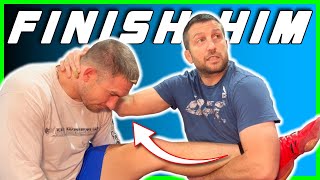
After securing the grip, the instructor pulls the opponent's leg into the armpit while maintaining downward pressure on the shin. Pressure placement is critical—the hand should shoot upward on the shin rather than settling into a comfortable hold, preventing the opponent from rotating out of the position.
Creating Distance and Preventing Counterattacks
As the opponent attempts to stand or resist, the instructor steps back with the rear leg and maintains control. This movement prevents the opponent from closing distance or securing a grip around the torso, allowing the technician to manage the opponent's positioning while avoiding being pulled into a compromised stance.
Grip Placement and Upper Body Control
The instructor secures a grip behind the opponent's shoulder or uses an inner grip to maintain control. This upper-body connection prevents the opponent from using arm grabs to defend against the leg control, ensuring the technician retains positional dominance.
Committing to the Takedown Entry
A decisive step to the side combined with downward pressure and pulling motion is essential to complete the takedown. Without full commitment to this movement, the opponent can maintain hopping mobility and escape the position.
The Shoryuken Finish Integration
From the established Tree-Top position with secured grips, the instructor transitions smoothly into a finishing strike by throwing a right hook while scooping the opponent's leg upward. This coordinated technique creates a visually striking and effective combination that flows naturally from the initial control.
Safety Considerations and Competitive Context
The instructor emphasizes that certain finishing variations involving mid-air transitions carry significant injury risk and should not be attempted in competition. Practitioners should focus on controlled, safe completions that achieve the objective without unnecessary danger.
Tree Top Finish + Shoryuken Finish
Key Takeaways
- •Initial Grip and Hand Positioning
- •Controlling the Opponent's Leg
- •Creating Distance and Preventing Counterattacks
- •Grip Placement and Upper Body Control
How to finish the single leg
Related Techniques
Frequently Asked Questions
What does this video teach about tree-top finish?
This video covers initial grip and hand positioning, controlling the opponent's leg, creating distance and preventing counterattacks. It provides detailed instruction from Still Rolling.
How long does it take to learn tree-top finish?
The basic mechanics can be understood in a single session, but developing reliable execution requires consistent drilling over weeks of practice. This 7-part breakdown helps structure your training by isolating each phase of the technique.
What are the key details for finishing tree-top finish?
From the established Tree-Top position with secured grips, the instructor transitions smoothly into a finishing strike by throwing a right hook while scooping the opponent's leg upward. This coordinated technique creates a visually striking and effective combination that flows naturally from the initial control.
Related videos
Wansu Kata (Dragon Boy/Girl Dumping Form/Strong Arm Form
AncientArts Family Karate/Ju-Jitsu Academy
SLICK Way to BEAT the Whizzer!... LIMP ARM!
TeachMeGrappling Coach Brian
Armdrag to Double to Run the PIPE!
TeachMeGrappling Coach Brian
Inside Trip for BEGINNERS!
TeachMeGrappling Coach Brian
2 EASY Single Leg FINISHES!
TeachMeGrappling Coach Brian