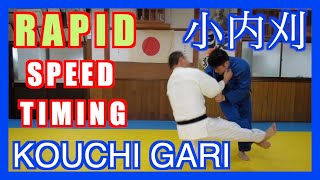
Timing and Weight Transfer Fundamentals
The foundation of Kouchi-Gari execution depends on precise timing and weight management. The optimal moment to execute the technique occurs just as the opponent steps forward, before their weight fully commits to the advancing foot. Practitioners must develop sensitivity to detect this brief window of vulnerability.
Understanding Kouchi-Gari Mechanics
Kouchi-Gari translates to a minor reap targeting the opponent's inner leg. The technique employs a rhythmic entry—counting one, two, three—to establish timing and control. This rhythm synchronizes the practitioner's movement with the opponent's natural stepping pattern.
Entry Strategies: Two Approaches
Practitioners can execute Kouchi-Gari in two distinct ways: stepping into the opponent or evading as they advance. Stepping into the opponent provides superior timing control and consistency. Reactive execution requires precise timing but remains a valuable alternative when the opponent initiates movement.
Grip and Posture Setup
Establish control by pushing the opponent's chest with a straight vertical arm position, maintaining the fist directly in front of the body. Proper positioning requires closing the distance to maximize leverage—staying too far eliminates the technique's mechanical advantage. The first movement is right hand to right foot, creating initial destabilization.
Creating Body Torque and Imbalance
The second movement brings the left hand and left foot into position, forcing the opponent's body to rotate. This double-action creates two forces: backward lean and lateral torque that compromises the opponent's stability. The opponent's natural reaction to lift their leg becomes impossible when proper arm control prevents this defensive response.
Executing the Reap
Transfer weight off the reaping leg and sweep the opponent's foot in the direction their toes point. The objective is positioning the opponent on their heel with maximum torque—not forcing a violent drive. When executed correctly, the opponent relies on the practitioner's grip to prevent falling, indicating proper control.
Preventing Defensive Leg Lift
The natural defensive reaction is for opponents to lift their leg when they sense the reap. Maintaining downward hand pressure on the opponent's arm prevents this escape—if the arm remains pinned down, raising the leg causes the opponent to lose balance. This mechanical principle makes the technique significantly more effective.
Safe Execution and Partner Protection
Maintain close proximity to the opponent during the throw to ensure safe falling mechanics and prevent injury. Distance creates dangerous situations where the opponent's knee or hips contact the practitioner's face or body. Controlled throws executed from close range protect both partners and allow for proper practice repetition.
Practice Drilling for Right and Left Sides
Execute the combination with controlled repetition on both sides of the body, alternating between right-side and left-side entries. The same mechanical principles apply regardless of stance or dominant side—proper timing, grip control, and distance management remain constant. Regular drilling develops the sensitivity necessary for tournament application.
Ko Uchi Gari Fundamentals
Key Takeaways
- •Timing and Weight Transfer Fundamentals
- •Understanding Kouchi-Gari Mechanics
- •Entry Strategies: Two Approaches
- •Grip and Posture Setup
Fundamentals of the Ko Uchi Gari (Minor Inner Reaping) Throw as demonstrated by Sensei's Doug & Travis.
Frequently Asked Questions
What does this video teach about kouchi-gari to ouchi-gari combination?
This video covers timing and weight transfer fundamentals, understanding kouchi-gari mechanics, entry strategies: two approaches. It provides detailed instruction from WINNING.
How long does it take to learn kouchi-gari to ouchi-gari combination?
The basic mechanics can be understood in a single session, but developing reliable execution requires consistent drilling over weeks of practice. This 9-part breakdown helps structure your training by isolating each phase of the technique.
What are the key details for finishing kouchi-gari to ouchi-gari combination?
Maintain close proximity to the opponent during the throw to ensure safe falling mechanics and prevent injury. Distance creates dangerous situations where the opponent's knee or hips contact the practitioner's face or body. Controlled throws executed from close range protect both partners and allow for proper practice repetition.