Position Setup and Control
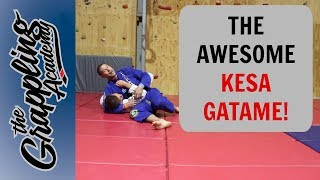
Kesa gatame is established with the attacker controlling the opponent's arm while positioning the knee underneath the shoulder. The controlling arm remains elevated to facilitate attacks rather than transitioning into a headlock variant.
Shoulder Lock from Arm Defense
When the opponent frames with their arm in front, the attacker pushes the arm down and brings the leg inside the opponent's arm to prevent straightening. The attacking leg is extended while generating hip pressure to complete the shoulder lock.
Arm Lock and Kimura Transitions
If the opponent's thumb turns downward, a shoulder lock can be executed by adjusting leg positioning. Further leg extension enables transition to a Kimura grip variation.
Elbow Scoop Submission
The attacker can scoop the opponent's elbow using the wrist blade positioned underneath, similar to a heel hook entry. The attacking leg then drives upward while the upper body drives through to complete a shoulder lock with additional neck tension.
Wrist Lock from Inside Control
When the opponent's arm is wedged defensively, the attacker can snake the hand inside and work gradually toward securing the fingers under the armpit. Leaning forward with shoulder pressure on a bent wrist completes the submission regardless of palm orientation.
Arm Triangle Choke
The attacker pushes the opponent's arm across the body and locks the triangle position before transitioning to a belly-down angle. Squeezing the elbows together while applying weight completes the choke.
Ezekiel from Arm Triangle Defense
When the opponent defends the arm triangle by creating distance and maintaining structural hardness, the attacker can transition to an Ezekiel choke. The wrist blade is repositioned to the carotid artery while the chest drives forward and the knee climbs to transition toward the back.
Kesa Gatame Attacks
Key Takeaways
- •Position Setup and Control
- •Shoulder Lock from Arm Defense
- •Arm Lock and Kimura Transitions
- •Elbow Scoop Submission
In this video we talk about the kesa-gatame. This is a very good control position and has a lot of possibilities for submissions. The equipment I use Canon 80D https://amzn.to/2MBDHSV Zoom H6 https://amzn.to/30yiew3 Rode Videomic Pro https://amzn.to/2SaNgY8 Manfrotto 502 Video Head MVH502AH https://amzn.to/2k2QTm7 Manfrotto 055 Aluminum 3-Section Tripod with Horizontal Column (MT055XPRO3) https://amzn.to/2lqx2xD The Smartphone Gimbal I use. DJI Osmo 2 https://amzn.to/2SPJvYq The mic I use for Gimbal: https://amzn.to/2LMss8P The flashlight I carry - Streamlight Pro-Tac 2L-X 500 lumen https://amzn.to/2jYM1P2
Related Techniques
Frequently Asked Questions
What does this video teach about kesa gatame?
This video covers position setup and control, shoulder lock from arm defense, arm lock and kimura transitions. It provides detailed instruction from Gracie Ohio Jiu-Jitsu Academy.
How long does it take to learn kesa gatame?
The basic mechanics can be understood in a single session, but developing reliable execution requires consistent drilling over weeks of practice. This 7-part breakdown helps structure your training by isolating each phase of the technique.
What are the key details for finishing kesa gatame?
The attacker pushes the opponent's arm across the body and locks the triangle position before transitioning to a belly-down angle. Squeezing the elbows together while applying weight completes the choke.