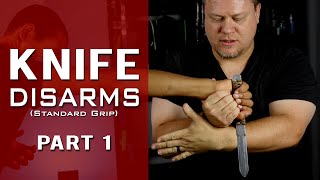
Defensive Posture and Legal Context
When confronted by an armed aggressor, the defender should maintain a protective hand position while creating distance and visibly demonstrating non-combatant intent to witnesses and potential law enforcement. This establishes legal and moral standing for self-defense by showing clear retreat and unwillingness to engage in mutual combat.
Covert Deployment and Throat Attack
A folding knife can be opened and deployed while positioned behind the legs, concealing it from the aggressor's view until the final moment. A flicking wrist motion extends the blade across the throat, targeting the jugular vein, carotid artery, or windpipe to create catastrophic injury and achieve immediate incapacitation through hemorrhagic shock and trauma.
Grip and Blade Control
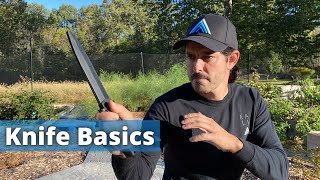
Thumb placement on the knife guard or blade spine provides pitch and angle control essential for directing the blade trajectory. Proper grip prevents hand slippage over a wet or bloody blade edge, a hazard particularly pronounced with knives lacking adequate guards, and allows the operator to adjust angles for striking between ribs or under the sternum.
Reverse Grip and Block Defense
In reverse grip, the blade is held concealed and controlled through thumb positioning, allowing the operator to use the back of the blade to defend against incoming strikes before deploying the edge. This method maintains concealment until deployment becomes necessary, creating a tactical surprise element.
Legal Limitations on Force Escalation
Self-defense law requires cessation of defensive strikes once the aggressor ceases attacking, regardless of prior injuries inflicted. Continued strikes after the threat has stopped transform the defense into criminal assault, placing legal liability on the defender in most jurisdictions.
Anatomical Targeting and Blade Orientation
Effective blade deployment requires understanding target anatomy—ribs run lateral to medial, requiring a specific angle to slip between them, while cardiac attacks demand an upward angle beneath the sternum. Thumb articulation changes blade angle to match anatomical orientation and maximize penetration while minimizing blade resistance.
Justification Standards for Lethal Force
Lethal force with a blade is legally justified only against multiple aggressors, significantly larger opponents capable of lethal force, or when other witnesses would reasonably believe the defender faced imminent death or serious bodily harm. Use of weapons against unarmed or single non-lethal threats creates criminal liability in most jurisdictions.
Non-Lethal Retention and Control Techniques
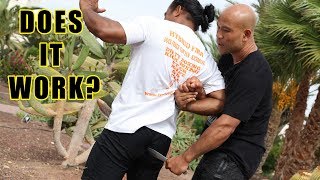
The hilt or flat of the blade can be used for force escalation short of cutting—striking with the handle to create pain compliance and force release from a wrist grab. This approach allows the defender to maintain knife possession and control without inflicting cutting wounds, reducing prosecution risk when the aggressor is unarmed.
Pressure-Point Control without Wounding
The flat of the blade can apply pressure against sensitive areas such as the inner elbow, hand, or wrist, creating pain-based compliance and joint locks without cutting. This technique enables the defender to control larger opponents using mechanical leverage and pressure rather than laceration, preserving legal defensibility when lethality is not reasonably necessary.
Knife Defense Techniques
Key Takeaways
- •Defensive Posture and Legal Context
- •Covert Deployment and Throat Attack
- •Grip and Blade Control
- •Reverse Grip and Block Defense
Expand your educational knowledge with these knife defense techniques that can Increase YOUR Survivability! 0:00 Intro 0:37 Covert Knife Defense 1:50 Forward Knife Grip Defense 1:59 Reverse Knife Grip Defense 2:48 3 Proper ways to hold a Knife for Defense 4:17 Non-lethal Knife Defense 6:03 Dual Knife Grip Defense 8:33 Knife Defense Catastrophic Areas Subscribe to our YouTube Channel⤵️ https://www.youtube.com/c/DetroitThreatManagementCenter ---------------------------------------------------------------- SUBSCRIBE TO GET ADVANCED SELF-DEFENSE KNOWLEDGE & TACTICS⤵️ https://www.youtube.com/channel/UCQa3HrGH-9mjz2Bn01Ve_iQ/join ---------------------------------------------------------------- Check out https://www.detroit-dust.com for merch, supplies, online training, and get your copy of Detroit Urban Survival Chronicles! ---------------------------------------------------------------- FOLLOW: Our Instagram | https://www.instagram.com/detroit_d.u.s.t/?hl=en #selfdefense #safety #survival #selfdefence #knife #knifeselfdefense #knifesurvival
Related Techniques
Frequently Asked Questions
What does this video teach about knife redirect?
This video covers defensive posture and legal context, covert deployment and throat attack, grip and blade control. It provides detailed instruction from Detroit Threat Management Center.
How long does it take to learn knife redirect?
The basic mechanics can be understood in a single session, but developing reliable execution requires consistent drilling over weeks of practice. This 9-part breakdown helps structure your training by isolating each phase of the technique.
What are the key details for finishing knife redirect?
The hilt or flat of the blade can be used for force escalation short of cutting—striking with the handle to create pain compliance and force release from a wrist grab. This approach allows the defender to maintain knife possession and control without inflicting cutting wounds, reducing prosecution risk when the aggressor is unarmed.