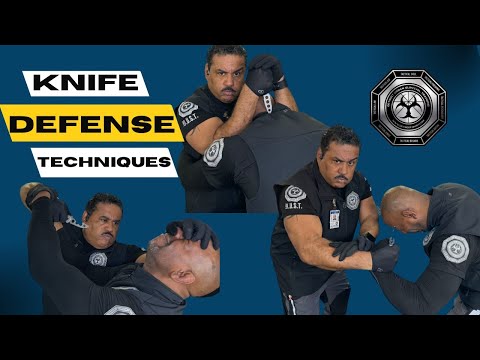
Knife Defense Techniques
0
Knife Redirect·Detroit Threat Management Center
Expand your educational knowledge with these knife defense techniques that can Increase YOUR Survivability! 0:00 Intro…
Translation: knife redirect
The Knife Redirect subfamily covers defensive techniques that redirect the trajectory of a knife attack without attempting an immediate disarm, using hand deflections and body movement to guide the blade past the body. [1] Knife redirects are based on the principle of deflection rather than direct blocking — the defender uses a parrying motion to change the blade's path rather than stopping its force head-on. [1],[2] Redirects are often the first defensive action in a knife defence sequence, followed by control of the weapon hand and either escape or disarm. [2],[3]
Knife redirect techniques are found in Filipino martial arts, Wing Chun, and various self-defence systems, where deflecting a blade's trajectory is preferred over attempting to block or catch it. [1] The concept of redirecting rather than blocking edged weapons has been a principle of weapons-based martial arts for centuries. [2],[3]
Knife redirect techniques deflect the knife attack away from the body. [1]
Knife redirection is taught in Krav Maga and Filipino martial arts. [1]
A self-defence technique. [1]
No images yet for this technique.
Sign in to suggest an image.
Expand your educational knowledge with these knife defense techniques that can Increase YOUR Survivability! 0:00 Intro…
No instructional courses yet for this technique.
Sign in to suggest a course.
Risk of injury to the person this technique is applied to
Weapon defence scenarios involve lethal threats; failure risk is catastrophic
Skill level needed to execute this technique reliably
Whether this technique is allowed under major competition rule sets
Karate-Do Kyohan: The Master Text (Gichin Funakoshi, 1935)
Alias sources — [1] The S.P.E.A.R. System (Blauer, 2003) [2] Complete Guide to Krav Maga (Killebrew, 2007) [3] The Filipino Martial Arts (Inosanto, 1980)
Effectiveness sources — [1] Krav Maga: How to Defend Yourself Against Armed Assault (Lichtenfeld & Yanilov, 2001)
Standard katakana transliteration of Western martial arts terminology (外来語) — used in Japanese MMA, boxing, and BJJ communities
Alias sources — [1] The S.P.E.A.R. System (Blauer, 2003) [2] Complete Guide to Krav Maga (Killebrew, 2007) [3] The Filipino Martial Arts (Inosanto, 1980)
Effectiveness sources — [1] Krav Maga: How to Defend Yourself Against Armed Assault (Lichtenfeld & Yanilov, 2001)
forearm conditioning, reaction speed, structural stability
dense bone structure, strong forearms
forearm flexors/extensors, deltoids, biceps, core (absorbing impact)
Every move, in any martial art, shares a few universal traits. Mix and match below to pinpoint the right tool — or compare equivalents across styles.
Keep your hand up to help protect yourself in case of a rapid attack, even when the attacker is initially just threatening with the knife.
In forward grip, thumb placement gives you pitch and angle control. In reverse grip, you also control pitch and angle with your thumb, and this method keeps the blade more covert for defensive purposes.
Yes—instead of cutting, you can press the bottom (spine) of the knife into an attacker's hand, which is very painful and can make them release you without causing catastrophic injury.
Do not continue to strike or attack an attacker unless they are still actively attacking you; once they stop attacking, you must stop as well.
The Knife Redirect subfamily covers defensive techniques that redirect the trajectory of a knife attack without attempting an immediate disarm, using hand deflections and body movement to guide the blade past the body. Knife redirects are based on the principle of deflection rather than direct blocking — the defender uses a parrying motion to change the blade's path rather than stopping its force head-on.
Knife redirect techniques are found in Filipino martial arts, Wing Chun, and various self-defence systems, where deflecting a blade's trajectory is preferred over attempting to block or catch it. The concept of redirecting rather than blocking edged weapons has been a principle of weapons-based martial arts for centuries.
Unified MMA: legal — Legal defensive technique; IBJJF: legal — Legal; IJF: legal — Legal defensive action; WBC/Boxing: legal — Legal; WKF: legal — Legal; WT: legal — Legal
Danger rating 9/10. Extreme — weapon defence scenarios involve lethal threats; failure risk is catastrophic
The standard setup chain: Anticipate the Attack → Execute Defence → Recover Stance → Counter or Disengage.
Standard counters include: Timing — attack when the defence is recovering or between movements / Feint — use deception to create openings in the defensive structure / Angle Change — attack from an unexpected angle that the defence does not cover.
Common variants: High block (forearm raised above the head to protect against overhead…); Low block (forearm driven downward to deflect kicks or body strikes); Cross block (forearm crosses the body to protect the opposite side); Double forearm block (both forearms together for maximum coverage).
A self-defence technique.
Top errors to watch for: Trying to catch or grab the knife on the initial attack — redirect first, then control; catching a fast thrust is nea… / Redirecting without moving the body offline — the hand redirect alone is insufficient; step off the line of attack / Redirecting toward the inside of the attacker — this puts you in front of their free hand and body / Using too much force on the redirect — the redirect should be a deflection, not a block; you're changing the angle, n….
The Knife Redirect is also known as Naifu Ridairekuto, Blade Redirect, Knife Deflection, Edge Redirect.