Systema: how to disarm a knife?
0
Knife Disarm·Transition CRT
For more information, questions or training requests please contact is on: Facebook: https://www.facebook.com/Transitio…
Translation: knife disarm
The Knife Disarm subfamily covers techniques for removing a knife from an attacker's hand, typically through wrist locks, leverage strips, or impact techniques that force the hand open. [1] Knife disarms are among the most difficult and dangerous techniques in self-defence because they require the defender to maintain control of the weapon hand while executing a precise mechanical action to strip the weapon. [1],[2] All knife disarm techniques accept that the defender may sustain cuts during the engagement, and prioritise securing the weapon hand above all else. [2],[3]
Knife disarm techniques have been practised in martial arts for centuries, with Filipino martial arts, Japanese jujutsu, and Krav Maga offering the most developed systems. [1] Modern military and law enforcement training continues to refine knife disarm methodology through force-on-force testing. [2],[3]
Knife disarms remove the weapon from the attacker's hand using leverage and control techniques. [1]
Knife disarms are taught in Krav Maga and Filipino martial arts. [1]
A self-defence technique. [1]
No images yet for this technique.
Sign in to suggest an image.
For more information, questions or training requests please contact is on: Facebook: https://www.facebook.com/Transitio…
How to disarm a knife in your back! How to disarm a knife and to disarm a knife attack, is essential to learn to disab…
No instructional courses yet for this technique.
Sign in to suggest a course.
Risk of injury to the person this technique is applied to
Weapon defence scenarios involve lethal threats; failure risk is catastrophic
Skill level needed to execute this technique reliably
Whether this technique is allowed under major competition rule sets
Boxing (Edwin Haislet, 1940)
Alias sources — [1] The S.P.E.A.R. System (Blauer, 2003) [2] Complete Guide to Krav Maga (Killebrew, 2007) [3] The Filipino Martial Arts (Inosanto, 1980)
Effectiveness sources — [1] Krav Maga: How to Defend Yourself Against Armed Assault (Lichtenfeld & Yanilov, 2001)
Standard katakana transliteration of Western martial arts terminology (外来語) — used in Japanese MMA, boxing, and BJJ communities
Alias sources — [1] The S.P.E.A.R. System (Blauer, 2003) [2] Complete Guide to Krav Maga (Killebrew, 2007) [3] The Filipino Martial Arts (Inosanto, 1980)
Effectiveness sources — [1] Krav Maga: How to Defend Yourself Against Armed Assault (Lichtenfeld & Yanilov, 2001)
reaction speed, structural body mechanics, defensive awareness
quick reflexes and conditioned defensive surfaces
varies — forearms (blocking), legs (movement), core (stability)
Every move, in any martial art, shares a few universal traits. Mix and match below to pinpoint the right tool — or compare equivalents across styles.
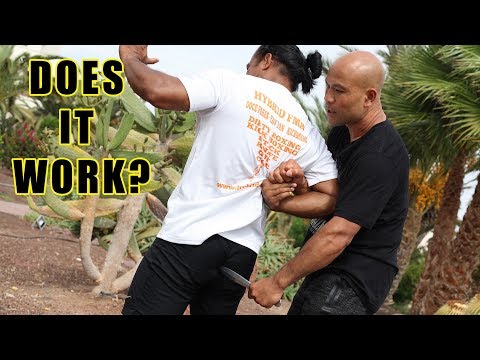
Transition CRT recommends training with a real, sharp knife rather than rubber training knives. While rubber knives are good for speed work, training with a real knife creates the psychological adjustment needed for an actual self-defense situation—using only rubber knives your whole life can create a large psychological gap if you ever face a real blade.
Transition CRT advises placing your hand on the flat side of the blade rather than grabbing the sharp edge, since the flat side is not sharp and won't cut you. You then use lever construction and wrist manipulation to control the knife without pulling directly, allowing you to stroke the weapon out of the attacker's hand.
According to Transition CRT, practice very slowly and very accurately to avoid injuring yourself during training. Safety must come first, since if you injure yourself during practice, you'll be in an even more difficult position if you need to defend yourself in a real situation.
Transition CRT emphasizes that you should try to evade the situation instead of engaging someone who has a knife, with disarming as only a last resort before striking becomes necessary.
The Knife Disarm subfamily covers techniques for removing a knife from an attacker's hand, typically through wrist locks, leverage strips, or impact techniques that force the hand open. Knife disarms are among the most difficult and dangerous techniques in self-defence because they require the defender to maintain control of the weapon hand while executing a precise mechanical action to strip the weapon.
Knife disarm techniques have been practised in martial arts for centuries, with Filipino martial arts, Japanese jujutsu, and Krav Maga offering the most developed systems. Modern military and law enforcement training continues to refine knife disarm methodology through force-on-force testing.
Unified MMA: legal — Legal defensive technique; IBJJF: legal — Legal; IJF: legal — Legal defensive action; WBC/Boxing: legal — Legal; WKF: legal — Legal; WT: legal — Legal
Danger rating 9/10. Extreme — weapon defence scenarios involve lethal threats; failure risk is catastrophic
The standard setup chain: Anticipate the Attack → Execute Defence → Recover Stance → Counter or Disengage.
Standard counters include: Timing — attack when the defence is recovering or between movements / Feint — use deception to create openings in the defensive structure / Angle Change — attack from an unexpected angle that the defence does not cover.
Common variants: Standard defence (primary defensive technique from the most common position); Reactive defence (triggered by the opponent's attack, minimal movement for …); Proactive defence (anticipating the attack and positioning to neutralise it …); Counter defence (using the defensive movement to create an immediate count…).
A self-defence technique.
Top errors to watch for: Attempting to disarm without first securing the weapon hand — the disarm is the final step, not the first / Reaching for the blade instead of the hand — always work the wrist and hand; never touch the blade / Attempting complex disarm techniques under stress — simple, gross-motor disarms work better under adrenaline / Disarming and then losing the weapon — secure the knife or throw it far away; don't fumble it.
The Knife Disarm is also known as Naifu Disuāmu, Blade Disarm, Knife Strip, Edged Weapon Disarm.