Introduction to Rubber Guard Armbar
The rubber guard armbar is a submission technique that utilizes the rubber guard system to set up a devastating arm lock from the guard position. This method is particularly effective in both street defense and MMA scenarios where maintaining control is essential.
Establishing Posture Control
The foundational principle of rubber guard work is maintaining broken posture on the opponent. When the arms are tied up, the practitioner must transition control to the legs, using them to prevent the opponent from recovering their posture and creating distance.
Trapping the Arm on the Mat
Securing the opponent's arm on the mat is critical, as it opens access to numerous submission variations. In MMA, striking combinations can be used to force the hand down; on the street or in submission-only grappling, the zombie technique accomplishes this arm trap.
The Invisible Collar Position
The invisible collar is achieved by clearing the opponent's neck and positioning the body at a precise angle, creating maximum positional dominance. From this position, the opponent loses all ability to posture up, stack, or create defensive space.
Multiple Submission Paths from Invisible Collar
The invisible collar provides access to several high-percentage submissions including the omoplata, gogoplata, and armbar. The practitioner's next move depends on the opponent's arm positioning and defensive adjustments.
Identifying the Armbar Setup
When the opponent's arm is positioned beneath the body at invisible collar, an armbar becomes available. The trapped hand on the mat eliminates any defensive or counter-attacking options, making this the optimal moment to execute the submission.
Technical Execution of the Armbar
The technique begins by using the top leg to secure the opponent's foot, bringing it across the upper body. The practitioner then under-scoops the wrist with the opposite arm, establishing a two-handed grip before shifting hips and extending the arm.
Double Bagging Neck Clear
Double bagging—wrapping both legs around the opponent's torso—provides additional control when clearing the neck and transitioning to invisible collar. This variation reduces the opponent's ability to recover their posture while maintaining submission security.
Pre-Submission Pressure and Timing
Before executing the final armbar, the practitioner should apply sustained pressure to fatigue the opponent and reduce explosive defensive resistance. This methodical approach ensures maximum control and minimizes the opponent's ability to escape during the submission.
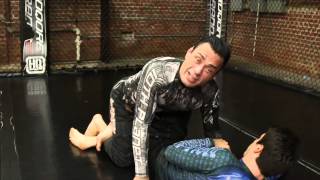
Technique - Eddie Bravo - Armbar From Rubber Guard - JiuJitsuMania
Key Takeaways
- •Introduction to Rubber Guard Armbar
- •Establishing Posture Control
- •Trapping the Arm on the Mat
- •The Invisible Collar Position
Technique - Eddie Bravo - Armbar From Rubber Guard - JiuJitsuMania
Frequently Asked Questions
What does this video teach about invisible croc submission?
This video covers introduction to rubber guard armbar, establishing posture control, trapping the arm on the mat. It provides detailed instruction from JiuJitsuMania.
How long does it take to learn invisible croc submission?
The basic mechanics can be understood in a single session, but developing reliable execution requires consistent drilling over weeks of practice. This 9-part breakdown helps structure your training by isolating each phase of the technique.
What are the key details for finishing invisible croc submission?
Double bagging—wrapping both legs around the opponent's torso—provides additional control when clearing the neck and transitioning to invisible collar. This variation reduces the opponent's ability to recover their posture while maintaining submission security.
Related videos
Rubber Guard 101: Zombie, New York, Chill Dog, Jiu Claw (omoplata)
Submissions101
Ice Pick on the Ground
Kalah UK
The Carni Shoulder Lock From BJJ Z Guard by Richie "Boogeyman" Martinez
Bernardo Faria BJJ Fanatics
Lockdown Half Guard, Part 12: Powder Keg Triangle
Cheat Code Jiu Jitsu
Eddie Bravo Vaporizer From Top Stoner Control
JiuJitsuMag