Introduction & Foundational Principle
Professor Faro emphasizes that successful submissions depend entirely on proper setup rather than technique execution alone. He establishes that progression in belt levels requires practitioners to develop setup skills, as opponents will defend basic techniques without proper positioning.
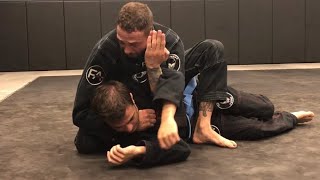
Initial Loop Choke Attack from Mount
From a secure mount position, the instructor initiates the loop choke by establishing proper angle and base before committing to the submission. Quick timing can catch unprepared opponents off-balance during the initial setup phase.
Countering Chin Tuck Defense
When the opponent defends by tucking the chin, the instructor lifts his right knee slightly to create space and expose the opponent's arm. This positional adjustment prevents the need for strikes and maintains control around the head.
Transition to Keylock Setup
After creating arm exposure, the instructor traps the opponent's arm and shifts focus toward a keylock position. He maintains tight positional control without overcommitting before reading the opponent's defensive response.
Seatbelt Control & Choke Options
When the opponent begins rotating to escape, the instructor immediately moves underneath the elbow to establish seatbelt control. From this position, two distinct choke finishes become available depending on opponent positioning.
Adapting to Elbow Defense
If the opponent successfully blocks the elbow hook, the timing window closes for taking the back and applying chokes. Proper execution requires catching this sequence before the opponent resets their defense.
Lapel Grip Choke from Neck Control
When collar access is limited, the instructor walks up and secures the lapel behind the neck with a knife-hand position. Two finish options include cranking with arm pressure or controlling via knee placement on the pants or neck.
Strategic Principle: Setup Integration
The instructor reinforces that combining disparate attacks—arm drags, chokes, and positional shifts—creates unpredictability that prevents opponents from committing fully to any single defense. Effective jiu-jitsu requires timing transitions between multiple threat systems.
Loop choke options from mount. #brazilianjiujitsu #bjj #jiujitsu
Key Takeaways
- •Introduction & Foundational Principle
- •Initial Loop Choke Attack from Mount
- •Countering Chin Tuck Defense
- •Transition to Keylock Setup
Loop choke attempt followed by what I like to do when defended. Thanks to my sponsors Topmount Apparel, Defense soap, Gripslings, and Athens Gyros. Please hit the red subscribe button!! Thank you Instagram: Sickness81 Instagram: Ferroacademybjj6612 Sponsors: Instagram: Defensesoap Defensesoap.com Instagram: topmountapparel https://topmountapparel.com/search?q=... Sickness81 at checkout for money off!! Instagram: Gripsling https://www.gripsling.com/ FERRO20 at checkout
Related Techniques
Frequently Asked Questions
What does this video teach about loop from mount?
This video covers introduction & foundational principle, initial loop choke attack from mount, countering chin tuck defense. It provides detailed instruction from Sickness Ferro.
How long does it take to learn loop from mount?
The basic mechanics can be understood in a single session, but developing reliable execution requires consistent drilling over weeks of practice. This 8-part breakdown helps structure your training by isolating each phase of the technique.
What are the key details for finishing loop from mount?
When collar access is limited, the instructor walks up and secures the lapel behind the neck with a knife-hand position. Two finish options include cranking with arm pressure or controlling via knee placement on the pants or neck.
Related videos
Loop choke options from mount. #brazilianjiujitsu #bjj #jiujitsu
Sickness Ferro
Best Loop Choke Technique (top and bottom)
Matt Arroyo Jiu Jitsu
Loop Choke by Thomas Lisboa - BJJ Techniques
BJJ Fanatics

The Easiest Way to Submit Strong Stalling Opponents
JonThomasBJJ
Lapel Grip in Full Guard for Breaking Posture and Setting Up Submissions
Chewjitsu