Introduction to the Lead Hook to Body
The lead hook to body, commonly called the liver shot, combines the mechanics of the lead hook and lead uppercut. This technique targets the liver, the second largest organ in the body, making it exceptionally effective for orthodox fighters who can strike the right side of the opponent's torso.
Fundamental Stance and Setup
Begin by slipping to the lead hand side while pivoting the rear foot forward. The rear hip and shoulder drive forward simultaneously as weight distributes to the front foot. This positioning creates the foundation for generating power while maintaining balance throughout the strike.
Hip and Shoulder Rotation
Execute the punch by rotating the lead hip toward the rear hand side while keeping weight on the front foot. The rear foot pivots slightly as the rear shoulder rotates back and over, similar to an uppercut motion rather than a lateral movement. This rotation generates force while maintaining proper weight distribution.
Two Striking Variations: Uppercut vs. Hook
The lead hook to body can be thrown as an uppercut-style strike to reach the inside of the opponent's elbow, or as a hook-style strike to reach behind the elbow. The uppercut variation is faster and tighter when thrown from close range, while the hook variation targets a wider area and can be thrown from mid-range with more power.
Close-Range Mechanics
When fighting on the inside, tighten the movement by reducing rear shoulder pullback compared to mid-range throwing. This sacrifice in power is compensated by increased speed and quick delivery, making the technique equally effective despite lower force generation.
Setup Strategy: Lead Hook to Head Entry
Use the lead hook to the head as a setup for the liver shot by stepping simultaneously to the side and slightly forward. This footwork creates the proper angle and distance needed to reach the target area behind the opponent's elbow without overextending the arm.
Angle Cutting Technique
When the direct angle to the liver is blocked by the opponent's elbow, cut a subtle angle rather than a dramatic one. A slight lateral adjustment allows the striker to maintain target acquisition on the liver while avoiding the opponent's defensive positioning.
Double Hook Combination
Execute a double hook to body by throwing the first hook to the outside of the opponent's elbow and the second to the inside as an uppercut. Contact to the opponent's arm on the first strike is acceptable, as it serves to set up the second shot's landing on the target.
Master the Lead Hook to Body + Tricks to Land It
Key Takeaways
- •Introduction to the Lead Hook to Body
- •Fundamental Stance and Setup
- •Hip and Shoulder Rotation
- •Two Striking Variations: Uppercut vs. Hook
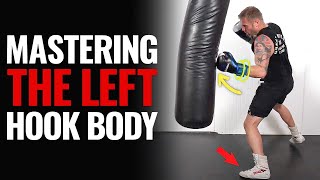
The lead hook to the body is not the same as the lead hook to the head. In this video, I show you the proper ways to throw the lead hook to the body, aka the “liver shot”. Additionally, I teach effective tricks/ways to land it. 00:00 Intro 00:22 Info on the Liver Shot 00:40 How to Throw it 01:24 Demonstration on the Heavy Bag 02:08 Throwing it on the Inside 02:28 Trick to Land it 1 03:24 Trick to Land it 2 03:52 Trick to Land it 3 04:27 Outro You can also check out my tutorial video on the lead hook to the head in this link: https://youtu.be/URJYkNATWjs
Related Techniques
Frequently Asked Questions
What does this video teach about lead hook to body?
This video covers introduction to the lead hook to body, fundamental stance and setup, hip and shoulder rotation. It provides detailed instruction from Coach Pillow Fists.
How long does it take to learn lead hook to body?
The basic mechanics can be understood in a single session, but developing reliable execution requires consistent drilling over weeks of practice. This 8-part breakdown helps structure your training by isolating each phase of the technique.
What are the key details for finishing lead hook to body?
When the direct angle to the liver is blocked by the opponent's elbow, cut a subtle angle rather than a dramatic one. A slight lateral adjustment allows the striker to maintain target acquisition on the liver while avoiding the opponent's defensive positioning.
Related videos
*Secret* Tips For Throwing A Perfect Hook To The Body
Tony Jeffries

LEAD HOOK What Does it do? How to Throw a Lead Hook & When to throw a lead hook punch 🥊 🦅
Valour Strike

TECHNIQUE OF THE SHOVEL HOOK
PRIDE MARTIAL ARTS

Smokin Joe Frazier's Terrifying Hook & Head Movement Explained - Technique Breakdown
The Modern Martial Artist
Smokin Joe Frazier's Terrifying Hook & Head Movement Explained - Technique Breakdown
The Modern Martial Artist