Series Overview and Resources
This instructional series is designed to help practitioners progress through shodan, niran, and sandan examinations through systematic kendo improvement. Supplementary PDF materials are available at KendoGuide.com to complement the video instruction.
Identifying Strike Timing Through Blade Reference Points
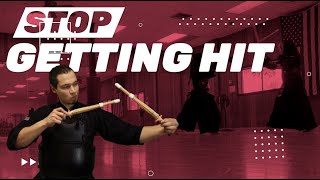
The instructor establishes clear visual markers on the opponent's blade (the first and second joints of the bamboo) to help students recognize when to execute their strike. Practitioners should wait for the opponent's blade to pass these predetermined points before committing to their technique.
Maintaining Nakajime Distance
Rather than advancing aggressively, the student should remain at nakajime distance and allow the opponent to close the gap. This defensive positioning prevents the opponent from easily anticipating and blocking the strike, while maintaining advantage for the practitioner.
Shikake Waza: Creating the Initiative
Shikake waza is the foundational technique where the practitioner waits at ma-ai distance and strikes when the opponent advances into striking range. Understanding when and how to execute shikake waza is essential for developing all advanced offensive techniques and is critical for success at shodan and above levels.
Responding to Opponent Movement: Digashira Men
When the opponent moves forward with the intention to strike, the practitioner who has already established their commitment to strike gains the initiative. For example, if the opponent approaches to strike men, the prepared practitioner executes digashira men by striking first with superior timing.
Transitioning to Debanawaza
Once shikake waza is mastered, practitioners can develop debanawaza by varying their response based on the opponent's approach. From the same ma-ai distance, the practitioner may strike kote if the opponent commits to men, or execute men if the opponent moves toward kote.
Practical Drill Execution
The motodachi partner advances on command while the student maintains composure and waiting position. The student must sense the moment of approach and strike the target cleanly before the opponent arrives, ensuring proper distance and timing are internalized.
Progressive Distance Training
Beginners should start at closer distances with small forward movements from the partner to build confidence and timing awareness. As comfort increases, the distance and movement intensity can gradually expand until the student can execute shikake waza from full ma-ai.
Maintaining Posture and Readiness
The practitioner must remain in a ready position at all times, prepared to strike from any point in the approach. Proper posture should be maintained throughout the advance and retreat, enabling immediate response to the opponent's movement.
Key Training Principles
Students should always confirm readiness with their partner before beginning each repetition and focus on controlled, conscious movement rather than reactive speed. Consistent practice of these fundamentals at the appropriate distance and timing develops the neural pathways necessary for advanced kendo techniques.
Kendo Milestone Series: Understanding Shikake waza
Key Takeaways
- •Series Overview and Resources
- •Identifying Strike Timing Through Blade Reference Points
- •Maintaining Nakajime Distance
- •Shikake Waza: Creating the Initiative
Download a checklist to pass 1 dan, 2 dan and 3 dan at https://www.kendo-guide.com. And you can start the free course, "Kendo Guide for the Intermediate" with me. Shikake waza is the first thing you should learn and study. You need to learn your distance first and then timing. From here, you will be able to develop debana-waza and that leads you to oji-waza. [Reference ] Website: https://www.kendo-guide.com Podcast: http://kendo-podcast.com Kendo for Adults: http://ow.ly/zzF330kTeve Fast Track to Dan Grade: http://ow.ly/ci0S30m6xxX Goods: http://ow.ly/7ZPW30m7h0H Kendo Guide for Beginners: http://ow.ly/f4t230nzS5i Social Media: Facebook: https://www.facebook.com/KendoGuideCom Twitter: https://twitter.com/kendoguide Newsletter: https://www.kendo-guide.com #kendoforlife #kendopodcast ---------Cameras and Gear I Use--------- - VIXIA HF M40 Full HD Camcorder with HD: https://amzn.to/2rNPfoV [As an Amazon Associate I earn from qualifying purchases.] - Professional Wireless Dual Lavalier Microphone: https://amzn.to/2BvW2rO [As an Amazon Associate I earn from qualifying purchases.] - 2-pack Dimmable 160 LED Video Light Kit: https://amzn.to/2BsY3Vt [As an Amazon Associate I earn from qualifying purchases.] - HD .43x Wide Angle Lens: https://amzn.to/2Gtpq7S [As an Amazon Associate I earn from qualifying purchases.] - Blue Yeti USB Microphone - Silver: https://amzn.to/2Wn00g5 [As an Amazon Associate I earn from qualifying purchases.] - Blue Yeti Pop Filter - 6-inch - Eliminates The Thudding From B and P Sounds Hitting The Microphone: https://amzn.to/2TkfQGe [As an Amazon Associate I earn from qualifying purchases.] ---------- What is Kendo-Guide.Com --------- Kendo-Guide.Com shares the knowledge of kendo with kendo beginners and the advanced. The information provided is mainly based on what I learned as a child from the late Juichi Tsurumaru (9-dan), the late Keisuke Murayama (8-dan) and Masayoshi Miyazaki (7-dan). However, all the knowledge acquired from any sensei will be shared here as long as considered to be worth sharing. The main purpose of Kendo-Guide.Com is to help kendo practitioners to enjoy kendo by providing tips to improve kendo techniques backed up by experiences and/or scientific analysis. ---------- Kendo For Life, LLC Video Disclaimer ---------- This video brought to you by Kendo For Life, LLC is offered to the public for information and entertainment purposes only. Any and all information perceived from this video through either visual, verbal, or written means, should be considered the sole opinions of the Producers, the Writers and the Actors involved in the making of this video. The Producers, Writers and Actors of this video have used their best efforts in producing this video but neither Producers, Writers nor Actors of this video make any representation or warranties with respect to the accuracy, applicability, fitness, or completeness of the contents of this video. The information contained in this video is strictly for entertainment and informational purposes. Therefore, if you wish to apply concepts or ideas contained in this video, you are taking full responsibility for your actions. Neither the Producers, Writers or Actors, nor the copyright holder or assigned users of this video shall in any event be held liable to any party for any direct, indirect, implied, punitive, special, incidental or other consequential damages arising directly or indirectly from any use of this material, which is provided as is, and without warranties. As in all cases, viewers should never take any information perceived from this or any other video at face value and should always do their own due diligence on any viewed material to form their own opinions and best judgments. And where applicable, the advice of a competent legal, tax, accounting or other professional should be always sought before taking action of any kind. The author and publisher do not warrant the performance, effectiveness or applicability of any sites listed or linked to in this video. All links are for information purposes only and are not warranted for content, accuracy or any other implied or explicit purpose. This video is copyrighted by Kendo For Life, LLC. and is protected under the US Copyright Act of 1976 and all other applicable international, federal, state and local laws, with ALL rights reserved. No part of this may be copied, or changed in any format, sold, or used in any way other than what is outlined within this under any circumstances without express permission from Kendo For Life, LLC. CONTACT INFORMATION: Kendo For Life, LLC http://www.kendo-guide.com/contact.html
Related Techniques
Frequently Asked Questions
What does this video teach about shikake waza?
This video covers series overview and resources, identifying strike timing through blade reference points, maintaining nakajime distance. It provides detailed instruction from Kendo Guide (Hiro).
How long does it take to learn shikake waza?
The basic mechanics can be understood in a single session, but developing reliable execution requires consistent drilling over weeks of practice. This 10-part breakdown helps structure your training by isolating each phase of the technique.
What are the key details for finishing shikake waza?
The practitioner must remain in a ready position at all times, prepared to strike from any point in the approach. Proper posture should be maintained throughout the advance and retreat, enabling immediate response to the opponent's movement.