Historical Context of Multi-Opponent Defense
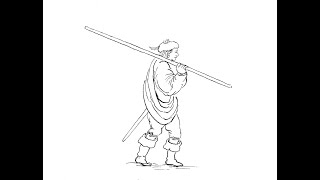
Staff fighting traditions across Europe were historically designed not merely for single combat but for defending against multiple opponents simultaneously. The Portuguese Jogo de Pau and the famous 17th-century account of an English soldier repelling three Spanish soldiers with a makeshift quarterstaff demonstrate this practical application. 18th-century manuals by figures like Archibald McGregor document the quarterstaff's use for crowd control and maintaining order, as employed by Edinburgh town guards and referees in prize fights.
Foundational Solo Drills: Cross-Cutting
Practitioners should begin with basic cross-cutting patterns using cuts one and two, mirroring techniques from Scottish two-handed sword training. These movements clear space in front of the defender while allowing dynamic angle changes from high to low lines. The drills can be performed in both forward and backward motions to build spatial awareness.
Progressive Directional Defense
Once cross-cutting is mastered, practitioners advance to defending both sides simultaneously using full traverse footwork—rotating completely from one side to the other. These techniques should then be practiced in 360-degree defensive patterns, performed slowly to ensure proper coordination and prevent confusion.
Thrust Integration and Combination Work
Thrusts should be introduced in various hand positions following Zachary Wilde's methods, beginning with single-side practice before advancing to alternating sides. Practitioners combine thrusting with turning motions and striking patterns to develop fluid transitions. Both half-staff and long-grip variations should be explored, incorporating butt strikes and short darts similar to bayonet offensive techniques.
Advanced Solo Training Methods
Controlled whirling exercises develop precision and staff manipulation without excessive force. One-handed thrusts, executed with careful control and proper turning mechanics, provide extended reach while maintaining impact. Solo practitioners should maintain continuous flowing movement while mentally visualizing opponent positions and reactions.
Partner Drills and Progressive Resistance
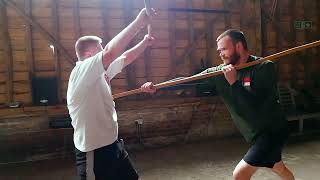
With limited training partners, practitioners can use heavy bags or dummies to simulate multiple targets while the partner provides single-opponent resistance. Training begins slowly with simple engagements, gradually increasing partner movement and complexity. Partners may be armed with various weapons—sword, dagger, or empty-handed—to develop adaptable responses.
Safe Equipment for Full-Speed Training
Contact scenarios require proper protective gear; hardwood staffs must never be used in sparring. Soft foam training staffs, available through martial arts suppliers, provide sufficient impact feedback while allowing full-force, full-speed practice without injury risk. These tools remain lighter than authentic weapons but permit realistic application of technical principles.
Close-Quarter Vulnerabilities and Mitigation
The primary danger in staff fighting occurs when improper distance judgment results in the weapon being seized, allowing opponents to gain close-quarter advantage. Practitioners must continually vary attack levels and quickly retract the staff following thrusts, similar to pike or bayonet technique. Grip transitions allowing unexpected reach extensions and angle changes provide critical defensive options when opponents close distance rapidly.
Quarterstaff: Lesson 10
Key Takeaways
- •Historical Context of Multi-Opponent Defense
- •Foundational Solo Drills: Cross-Cutting
- •Progressive Directional Defense
- •Thrust Integration and Combination Work
In this lesson we will talk about fighting against multiple opponents. See the mentioned story about Richard Peeke, the english soldier who fought three Spainards with his Quarterstaff here: https://www.militaryheritage.com/cadiz_and_quarterstaff.htm Please train under the guidance of an experienced instructor, check your medical condition before you start training, stay safe, protect yourself and your training partners at all times. This is for information only, we do not take any responsiblity for any physical, mental or material harm. If you are interested in joining our free online apprenticeship program, check out for details at our homepage: https://cateransociety.wordpress.com/ Visit us on Facebook: https://www.facebook.com/DragonSysXIII/ If you find some value in our videos and want to support our work, maybe you like to become a Patron and get access to additional material: https://www.patreon.com/HighlandBroadsword Or you can do a one off donation on Paypal: https://www.paypal.com/cgi-bin/webscr?cmd=_s-xclick&hosted_button_id=AWP6X9XHCLPFL&source=url
Frequently Asked Questions
What does this video teach about standard quarterstaff technique?
This video covers historical context of multi-opponent defense, foundational solo drills: cross-cutting, progressive directional defense. It provides detailed instruction from Triskelion Combat.
How long does it take to learn standard quarterstaff technique?
The basic mechanics can be understood in a single session, but developing reliable execution requires consistent drilling over weeks of practice. This 8-part breakdown helps structure your training by isolating each phase of the technique.
What are the key details for finishing standard quarterstaff technique?
Contact scenarios require proper protective gear; hardwood staffs must never be used in sparring. Soft foam training staffs, available through martial arts suppliers, provide sufficient impact feedback while allowing full-force, full-speed practice without injury risk. These tools remain lighter than authentic weapons but permit realistic application of technical principles.