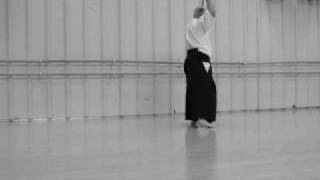
Inside Guard Stance
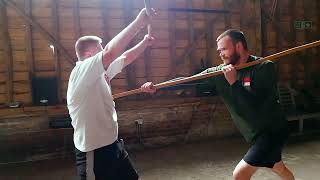
The inside guard with the quarterstaff mirrors broadsword technique, with the weapon held in the rear hand while the forward hand is positioned to protect the inner line. This angled guard protects against attacks targeting the forearm and hand.
Defending Against Quick Forearm Cuts
When an opponent executes a quick chopping blow to the forearm or hand, the defender can respond by using the back edge of the quarterstaff to deflect the strike to the side. This deflection can be performed either from a stationary position or while lunging forward.
Maintaining Bind While Defending
An alternative defense involves sliding down the outside of the opponent's staff while maintaining contact, which prevents counterattacks such as thrusts. This tactile connection allows the defender to sense the opponent's intentions.
Counterattacking After Deflection
After deflecting an attack, the defender can counter with a triangular step or inside traverse, striking either the opponent's head or hand before following up to the head. This combination maintains offensive momentum while remaining protected.
Defense Against Wide Cutting Attacks
When facing a full wide cut, the defender steps forward into a wide stance and performs a downside deflection while adjusting body position to prevent the opponent's staff from sliding down toward the hand. A slight deflecting parry maintains control of the bind.
Response to Strong Binding Pressure
If the opponent's strike proves too strong and breaks the parry, the defender should disengage using a traverse and counter with a forward thrust if recognized early enough. This escape prevents being trapped on the opponent's inside line.
Riding the Opponent's Force
When the opponent strikes with significant force, the defender can redirect that energy forward toward the opponent's head while remaining protected by inside drop positioning. This technique is especially effective when the defender maintains a half-step stance with the back hand along the forearm.
Thrusting During Strong Binds
If a strong bind develops after the initial parry and the opponent does not immediately retreat, the defender can maintain contact and advance with a counter-thrust. This works best when the defender clearly recognizes the binding position and the opponent's commitment to the strike.
The Quarterstaff: Lesson 1
Key Takeaways
- •Inside Guard Stance
- •Defending Against Quick Forearm Cuts
- •Maintaining Bind While Defending
- •Counterattacking After Deflection
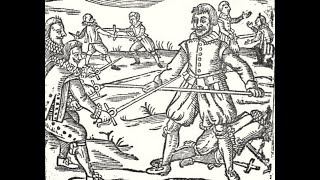
Lesson 1 of our approach on the Quarterstaff based on and inspired mostly by Zachary Wylde (1711). We also use the little material provided by Donald McBane (1728) and Archibald MacGregor (1791). Especially for sparring, because we use lighter Rattan staffs for safety reasons, we will look a little into the victorian and edwardian combat sport of Quarterstaff according to Thomas McCarthy (18823) and R.G. Allanson-Winn (1905). Basing on some interpretations of George Silver´s and Joseph Swetnam´s Quarterstaff material, we also adopt the fundamentals and techniques on the Lochaber-Axe and Galloglass Sparth-Axe as well as the Scottish Twohanded Sword according to the MacGregor Method. Please train under the guidance of an experienced instructor, check your medical condition before you start training, stay safe, protect yourself and your training partners at all times. This is for information only, we do not take any responsiblity for any physical, mental or material harm. If you are interested in joining our free online apprenticeship program, check out for details at our homepage: https://cateransociety.wordpress.com/ Visit us on Facebook: https://www.facebook.com/DragonSysXIII/ If you find some value in our videos and want to support our work, maybe you like to become a Patron and get access to additional material: https://www.patreon.com/HighlandBroadsword Or you can do a one off donation on Paypal: https://www.paypal.com/cgi-bin/webscr?cmd=_s-xclick&hosted_button_id=AWP6X9XHCLPFL&source=url
Frequently Asked Questions
What does this video teach about standard quarterstaff?
This video covers inside guard stance, defending against quick forearm cuts, maintaining bind while defending. It provides detailed instruction from Triskelion Combat.
How long does it take to learn standard quarterstaff?
The basic mechanics can be understood in a single session, but developing reliable execution requires consistent drilling over weeks of practice. This 8-part breakdown helps structure your training by isolating each phase of the technique.
What are the key details for finishing standard quarterstaff?
When the opponent strikes with significant force, the defender can redirect that energy forward toward the opponent's head while remaining protected by inside drop positioning. This technique is especially effective when the defender maintains a half-step stance with the back hand along the forearm.