Sword Forms (kata) of Filipino Martial Arts
0
Standard Quarterstaff Technique·Kali Center
Get the NEW Kali Apex training course here: https://www.kaliapex.com/ For 1 on 1 Kali Coaching go here: https://www.pat…
Translation: standard quarterstaff technique
Fundamental quarterstaff technique combining half-staff grip, overhead strikes, low sweeps, and thrust-based attacks.
The standard quarterstaff technique represents the fundamental fighting method preserved in English and continental European sources. [1] Silver's system emphasises the 'true fight' with the staff: maintaining distance, using the thrust as the primary attack, and employing the butt end for close-range strikes. [2] Swetnam's 1617 manual provides complementary instruction on guards, parries, and the use of feints. [3] Modern HEMA practitioners have reconstructed these methods through close study of the period sources, with quarterstaff now a regular competition category at HEMA tournaments. [1]
Standard quarterstaff techniques include strikes, thrusts, blocks, and sweeps using both ends of the staff, providing 360-degree coverage. [1]
Quarterstaff techniques were transmitted through English and German staff-fighting traditions documented in historical manuals. [1]
Standard quarterstaff techniques are practised and competed at HEMA events. [1]
No images yet for this technique.
Sign in to suggest an image.
Get the NEW Kali Apex training course here: https://www.kaliapex.com/ For 1 on 1 Kali Coaching go here: https://www.pat…
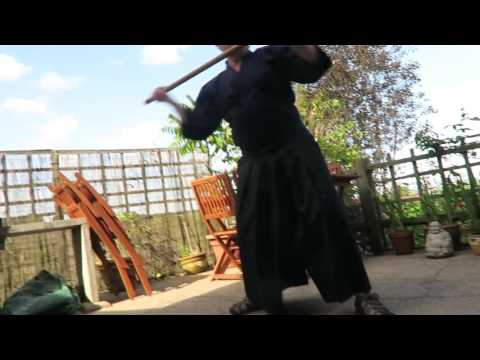
A series of movements with the Japanese "Jo" or short staff made up of the basic Jo suburi found in most schools... It's…
In this lesson we will talk about fighting against multiple opponents. See the mentioned story about Richard Peeke, the …
Standard quarterstaff technique encompasses both solo and partner training methods designed to build foundational control and adaptability. Triskelion Combat provides the most substantive pedagogical framework, emphasizing progression from basic cuts and cross-cutting patterns—executed from high to low lines—through turning motions and 360-degree defensive footwork. The instruction incorporates thrusts in multiple hand positions, half-staff grips enabling butt strikes and short darts, and controlled one-handed thrusts for extended reach. Triskelion Combat stresses gradual partner-drill escalation, beginning with stationary movements before introducing mobile opponents, and advocates soft-weapon training for safety during full-speed practice. The curriculum addresses multi-opponent scenarios historically documented in 17th–18th century European martial traditions, noting parallels with two-handed sword mechanics and emphasizing constant level variation to prevent close-quarters disarmament. Tony Wagstaffe's instructional content focuses on rhythmic striking patterns and head awareness during overhead movements, though the transcript lacks detailed technical nomenclature. Kali Center's contribution addresses form training and tactical retention across Filipino systems rather than quarterstaff specifically, discussing how structured kata develop technical precision and strategic intent. Triskelion Combat stands alone in providing comprehensive, sequential quarterstaff methodology grounded in historical European manuals and practical defensive applications.
Synthesized from 3 instructors
No instructional courses yet for this technique.
Sign in to suggest a course.
Risk of injury to the person this technique is applied to
Staff/bo/jo weapons generate significant blunt force; fracture risk
Skill level needed to execute this technique reliably
Whether this technique is allowed under major competition rule sets
The Art of Combat (Joachim Meyer, 1570)
Alias sources — [1] The Medieval Art of Swordsmanship (Tobler, 2010) [2] Old Sword-Play (Hutton, 1892) [3] Old Sword-Play (Hutton, 1892)
History sources — [1] Anglo, S., The Martial Arts of Renaissance Europe (Yale University Press, 2000) [2] Silver, G., Paradoxes of Defence (1599) [3] Swetnam, J., The Schoole of the Noble and Worthy Science of Defence (1617)
Standard katakana transliteration of Western martial arts terminology (外来語) — used in Japanese MMA, boxing, and BJJ communities
Alias sources — [1] The Medieval Art of Swordsmanship (Tobler, 2010) [2] Old Sword-Play (Hutton, 1892) [3] Old Sword-Play (Hutton, 1892)
History sources — [1] Anglo, S., The Martial Arts of Renaissance Europe (Yale University Press, 2000) [2] Silver, G., Paradoxes of Defence (1599) [3] Swetnam, J., The Schoole of the Noble and Worthy Science of Defence (1617)
wrist snap speed, sliding grip coordination, hip rotation
long reach and strong wrists for staff manipulation
forearms, wrist rotators, core rotators, shoulders
The quarterstaff was historically designed not only for one-on-one dueling but for defending against multiple opponents. You can progress from defending against opponents in front of you or to one side, then to both sides, and finally to a 360-degree defense where you're completely surrounded—though this is the worst-case scenario.
Use turning motions with a full traverse in your footwork, turning completely from one side to another to defend both sides equally. You can then progress to 360-degree defense, but start slowly to avoid confusion.
Constantly change the levels of your attacks and pull your staff back very quickly after thrusting. You can also change your grip so that the butt end becomes unexpectedly longer, adding variety to your offense.
Fundamental quarterstaff technique combining half-staff grip, overhead strikes, low sweeps, and thrust-based attacks.
The standard quarterstaff technique represents the fundamental fighting method preserved in English and continental European sources. Silver's system emphasises the 'true fight' with the staff: maintaining distance, using the thrust as the primary attack, and employing the butt end for close-range strikes.
Traditional martial arts: legal — Practiced in traditional kata/forms and weapon-specific competition under var…; IWUF: legal — Legal in wushu taolu if applicable; HEMA: legal — Legal in applicable historical weapon categories
Danger rating 7/10. Very High — staff/bo/jo weapons generate significant blunt force; fracture risk
The standard setup chain: Grip and Stance → Chamber → Strike → Recovery.
Standard counters include: Beat Parry — deflect the blade with a sharp lateral beat before it reaches target / Displacement — move the body off the line while threatening with the point / Counter-Thrust — extend into the attacker's line during their advance.
Common variants: Overhead strike (bringing the staff down from above in a vertical arc); Lateral strike (horizontal sweep targeting the ribs or head); Thrust (straight thrust with the end of the staff); Butt-end strike (striking with the rear end of the staff at close range).
Standard quarterstaff techniques are practised and competed at HEMA events.
Top errors to watch for: Not fully extending on the thrust — the sliding grip should extend the staff to its maximum reach / Pausing between the thrust and the cross-strike — the retraction and cross-strike must be one continuous motion / Not retracting the thrust before the cross-strike — the staff must return before it can strike from a different angle / Aiming the thrust vaguely — precise targeting (face, throat, sternum) forces a specific defensive response.
The Standard Quarterstaff Technique is also known as Sutandādo Kwōtā Sutaffu Waza, Basic Quarterstaff Play, Staff Fighting — English, Standard Staff Technique.