Foundation: Guard Retention Principles
Guard retention is one of jiu-jitsu's most challenging skills. According to Greg Sodders, the guard player's objective is to establish and maintain connection with the opponent while managing distance and destabilizing their structure. This video addresses the primary difficulty: achieving initial connection in the dynamic open guard environment.
Progressive Learning: Half Guard to Open Guard
Guard retention concepts are best learned in the static environment of half guard before transitioning to the more dynamic open guard position. This structured progression allows practitioners to master fundamental principles before applying them in high-mobility scenarios. The same conceptual framework applies to both positions.
Arm Responsibilities in Half Guard
In half guard, the far arm's primary responsibility is framing—preventing the opponent from pinning the guard player flat to the mat by maintaining elbow-to-ribs alignment. The near arm establishes initial connection with the opponent's upper or lower body. Once the lower body frame is secured, the far arm can transition from framing to robust connection.
Lower Body Frame Integration
When the guard player establishes a structured lower body frame, they gain freedom to use the far arm for connection rather than framing. Conversely, if the opponent passes the lower body frames, disciplined far arm framing becomes critical to prevent being flattened. This hierarchy prioritizes positional security before advancing connection techniques.
Self-Framing in Open Guard
Open guard presents a mobility challenge: the opponent often remains too distant for effective far arm framing. The guard player addresses this through self-framing—using their own arm to support leg structure rather than framing against the opponent. When hips are square, symmetrical self-frames on both sides are appropriate; once positioned on one hip, asymmetrical self-framing supports the established far and near arm positions.
Connection Priority Over Far Arm Engagement
When the opponent controls the ankle, attempting far arm connection is risky and often leads to deep guard passes. The guard player should maintain the far arm as a structural frame while the near arm establishes initial connection. Only after securing lower body positioning should the far arm transition from framing to robust connection.
Lower Body Positioning: Low Leg Strategy
Good lower body positioning frees the far arm to engage in connection. One primary positioning strategy is the low leg—bringing the near leg to the opponent's lead hip. As the guard player's foot approaches this position, they can safely transition the far arm from framing to connection. When the opponent counters by stuffing the foot down, the far arm returns to framing duty.
A SIMPLE tip for ADVANCED Guard Retention - BJJ Analysis
Key Takeaways
- •Foundation: Guard Retention Principles
- •Progressive Learning: Half Guard to Open Guard
- •Arm Responsibilities in Half Guard
- •Lower Body Frame Integration
Link to Outlier DB: https://outlierdb.com/ Link to Study this YouTube Video on Outlier DB: https://outlierdb.com/resource/66e5dc0b1c7649ed30cf14b8 Membership includes the first ever BJJ Chat Bot, my instructional on passing half guard ($97 value) and access to the discord with over 1,000 jiu jitsu nerds just like you. Additional Guard Retention Study: https://youtu.be/I6OjETqRmwI Instagram: https://www.instagram.com/limibjj/ 0:00-1:09 - Why Guard Retention is Difficult 1:10-3:18 - Half Guard Order of Operations 3:19-5:42 - Make Connection from Open Guard 5:43-8:15 - How to Use our Legs from Open Guard 8:16-9:23 - Make Connection with your Far Arm 9:24-11:44 - Open Guard Order of Operations Levi Jones Leary displayed beautiful guard retention in his performance at CJI. In this video we dive in to see what we can learn from guard player like Levi to improve our guard retention. CLOTHING 👕👕👕 Shirt and Rash Guard: https://www.xmartial.com/products/outlier-database-bjj-rash-guard?ref=lessimpressed&variant=46080584351908 15% off Coupon Code: "lessimpressed" BJJ CONTENT 🤓🤓🤓 Lachlan Giles's SUBMETA (Discount Code "LIMI16" for $16 OFF): https://submeta.io/
Frequently Asked Questions
What does this video teach about standard inversion recovery?
This video covers foundation: guard retention principles, progressive learning: half guard to open guard, arm responsibilities in half guard. It provides detailed instruction from Less Impressed More Involved BJJ.
How long does it take to learn standard inversion recovery?
The basic mechanics can be understood in a single session, but developing reliable execution requires consistent drilling over weeks of practice. This 7-part breakdown helps structure your training by isolating each phase of the technique.
What are the key details for finishing standard inversion recovery?
When the opponent controls the ankle, attempting far arm connection is risky and often leads to deep guard passes. The guard player should maintain the far arm as a structural frame while the near arm establishes initial connection. Only after securing lower body positioning should the far arm transition from framing to robust connection.
Related videos
3 Arm Positions // 3 Submissions from Cross-Side (No Gi BJJ)
Brian Glick
11 Guard Recovery Drills in Learn How to Make your Guard Unbeatable.
Northwest Fighting Arts
BJJ Fundamentals Warm Up - Reverse Shrimp
Otomi Martial Arts | Caio Terra Association
How To Shrimp In BJJ (A.K.A. Elbow Escape)
Michael Foley's Academy of Martial Arts
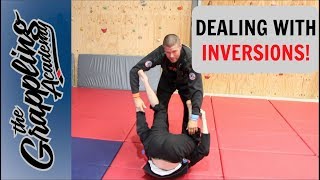
Dealing With Inversion!
The Grappling Academy