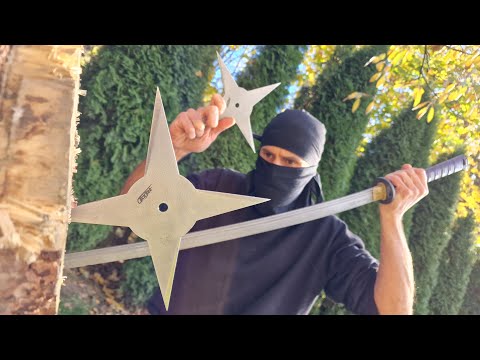
5 WAYS to Throw NINJA Star (Shuriken Tutorial)
0
Hira-Shuriken — Star·Adam Celadin
5 WAYS to Throw NINJA Star (Shuriken Tutorial) In this video i am going to show you 5 ways how to throw a Ninja Star als…
Translation: Flat Shuriken
Flat, multi-pointed throwing blades designed to be thrown with a spinning release for slashing impact.
Hira-shuriken (flat throwing blades) are the iconic star-shaped throwing weapons popularly associated with ninja, though they were used across various koryu schools, not exclusively by shinobi. [1] These multi-pointed flat blades — typically with 3 to 8 points — were designed to strike point-first regardless of rotational angle, making them easier to throw casually but less accurate and penetrating than bo-shuriken. [2] Historically, hira-shuriken were secondary weapons used for distraction, and their elaborate shapes often served as school identifiers — different ryu used distinctively shaped shuriken as a form of heraldry. [1],[3]
Hira-shuriken (flat/star shuriken) are multi-pointed throwing weapons designed to stick point-first regardless of rotation, providing more forgiving accuracy at the cost of reduced penetration. [1]
Hira-shuriken were developed in feudal Japan, with numerous koryū schools developing distinctive shapes and throwing methods. [1]
Hira-shuriken throwing is demonstrated at Japanese budo events and koryū embu. [1]
No images yet for this technique.
Sign in to suggest an image.
5 WAYS to Throw NINJA Star (Shuriken Tutorial) In this video i am going to show you 5 ways how to throw a Ninja Star als…
No instructional courses yet for this technique.
Sign in to suggest a course.
Risk of injury to the person this technique is applied to
Projectile weapons including shuriken, throwing knives; high penetration risk
Skill level needed to execute this technique reliably
Whether this technique is allowed under major competition rule sets
Bubishi: The Classic Manual of Combat (Patrick McCarthy, 2008)
History sources — [1] Draeger, D., Classical Bujutsu (Weatherhill, 1973) [2] Ratti, O. & Westbrook, A., Secrets of the Samurai (Tuttle, 1973) [3] Shirakami, E., Shuriken-Do: My Study of the Way of Shuriken (2001)
Alias sources — [1] Shirakami, E., Shuriken-Do: My Study of the Way of Shuriken (2001) [2] Draeger, D., Classical Bujutsu (Weatherhill, 1973)
Established Japanese martial arts naming convention — native Japanese term (和語/漢語)
History sources — [1] Draeger, D., Classical Bujutsu (Weatherhill, 1973) [2] Ratti, O. & Westbrook, A., Secrets of the Samurai (Tuttle, 1973) [3] Shirakami, E., Shuriken-Do: My Study of the Way of Shuriken (2001)
Alias sources — [1] Shirakami, E., Shuriken-Do: My Study of the Way of Shuriken (2001) [2] Draeger, D., Classical Bujutsu (Weatherhill, 1973)
precision, wrist snap, hand-eye coordination
strong wrists and forearms, excellent proprioception
forearm extensors, wrist flexors, deltoids, core
Every move, in any martial art, shares a few universal traits. Mix and match below to pinpoint the right tool — or compare equivalents across styles.
The backhand throw is performed by throwing the star behind your back, useful when fleeing from a target. The underhand throw, which Adam Celadin describes as his personal favorite, involves pulling your arm back and using a whipping motion to generate force and rotation into the target.
Pull your arm further back before executing the throw—the more you pull your arm back, the more advantage and force you'll generate, allowing you to whip the star very effectively into the target.
Flat, multi-pointed throwing blades designed to be thrown with a spinning release for slashing impact.
Hira-shuriken (flat throwing blades) are the iconic star-shaped throwing weapons popularly associated with ninja, though they were used across various koryu schools, not exclusively by shinobi. These multi-pointed flat blades — typically with 3 to 8 points — were designed to strike point-first regardless of rotational angle, making them easier to throw casually but less accurate and penetrating than bo-shuriken.
Traditional martial arts: legal — Practiced in traditional kata/forms and weapon-specific competition under var…; IWUF: legal — Legal in wushu taolu if applicable; HEMA: legal — Legal in applicable historical weapon categories
Danger rating 8/10. Very High — projectile weapons including shuriken, throwing knives; high penetration risk
The standard setup chain: Ready Position → Distance Control → Execute Technique → Return to Guard.
Standard counters include: Guard Position — return to a defensive ready stance / Distance Management — control the measure to avoid being in range / Counter-Attack — strike during the opponent's recovery or between movements.
Common variants: Standard technique (primary execution from the most common grip and stance); Competition variation (adapted for sport-specific rules and scoring); Traditional variation (classical execution as taught in the traditional art); Combination variation (chained with preceding or following techniques in a flow).
Hira-shuriken throwing is demonstrated at Japanese budo events and koryū embu.
Top errors to watch for: Throwing with an overhead motion — hira-shuriken are thrown with a horizontal or sidearm release, not overhand / Expecting deep penetration — the flat design limits penetration; hira-shuriken are tactical distractors, not fight-en… / Gripping too many points at once — hold one point between the fingers and let the shuriken spin off the palm cleanly / Throwing too hard — excessive force causes wobble in flight; the throw should be controlled and smooth.
The Hira-Shuriken — Star is also known as Hira-Shuriken, Shaken, Throwing Star, Ninja Star, Senban Shuriken (four-pointed type).