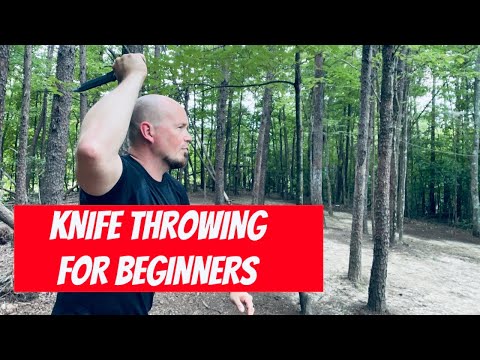
Knife Throwing Tutorial for Beginners
0
Standard Knife Throwing·411 Outdoors LLC
In this video I share an intro to knife throwing as well as basics in half spin, full spin and no spin throwing. #knife…
Translation: standard knife throwing
Core knife throwing techniques including rotational (full-spin) and no-spin methods at various distances.
The standard knife throwing subfamily covers the fundamental rotational throwing method in which the knife spins end-over-end during flight, requiring the thrower to calibrate distance precisely so the blade arrives point-first at the target. [1] This rotational technique is documented across European, American frontier, and African throwing traditions. [2] The no-spin throwing method, an alternative approach associated with Japanese and some modern competitive systems, eliminates rotation but demands more precise wrist control. [1],[2]
Standard knife throwing involves releasing the blade at a specific distance to achieve rotation and point-first impact on the target. [1]
Standard knife throwing technique was codified by competitive throwing organisations in the 20th century. [1]
Standard knife throwing is competed at IKTHOF events and other throwing competitions worldwide. [1]
No images yet for this technique.
Sign in to suggest an image.
In this video I share an intro to knife throwing as well as basics in half spin, full spin and no spin throwing. #knife…
No instructional courses yet for this technique.
Sign in to suggest a course.
Risk of injury to the person this technique is applied to
Projectile weapons including shuriken, throwing knives; high penetration risk
Skill level needed to execute this technique reliably
Whether this technique is allowed under major competition rule sets
Bubishi: The Classic Manual of Combat (Patrick McCarthy, 2008)
Alias sources — [1] Hoplology (Burton, 1884) [2] Hoplology (Burton, 1884) [3] Hoplology (Burton, 1884)
History sources — [1] Draeger, D. & Smith, R., Comprehensive Asian Fighting Arts (Kodansha, 1969) [2] Anglo, S., The Martial Arts of Renaissance Europe (Yale University Press, 2000)
Mixed Japanese-Western terminology — combines traditional Japanese terms with katakana loanwords
Alias sources — [1] Hoplology (Burton, 1884) [2] Hoplology (Burton, 1884) [3] Hoplology (Burton, 1884)
History sources — [1] Draeger, D. & Smith, R., Comprehensive Asian Fighting Arts (Kodansha, 1969) [2] Anglo, S., The Martial Arts of Renaissance Europe (Yale University Press, 2000)
close-range reflexes, wrist dexterity, grip transitions
quick hands, strong wrists for grip changes
forearm flexors, wrist rotators, deltoids, core
Every move, in any martial art, shares a few universal traits. Mix and match below to pinpoint the right tool — or compare equivalents across styles.
You want to have a grip on the knife but stay relaxed. For half spin throwing, the knife comes up as you come down and let go on the way down, like a slicing motion, keeping the knife on a smooth, straight pattern.
Half spin and no spin are two main techniques. Half spin is foundational for beginners, while no spin throwing has limitations—it works effectively only within about seven to eight feet maximum range.
Knives come in different weights on the lighter, medium, and heavy end of the spectrum. If you want something big and heavy, Cold Steel makes the Perfect Balance Thrower, which is a bowie knife weighing almost a pound.
Yes—think about what motivates you, whether that's competition, the combative or tactical side, or recreational practice, as this will guide your equipment and training choices.
Core knife throwing techniques including rotational (full-spin) and no-spin methods at various distances.
The standard knife throwing subfamily covers the fundamental rotational throwing method in which the knife spins end-over-end during flight, requiring the thrower to calibrate distance precisely so the blade arrives point-first at the target. This rotational technique is documented across European, American frontier, and African throwing traditions.
Traditional martial arts: legal — Practiced in traditional kata/forms and weapon-specific competition under var…; IWUF: legal — Legal in wushu taolu if applicable; HEMA: legal — Legal in applicable historical weapon categories
Danger rating 8/10. Very High — projectile weapons including shuriken, throwing knives; high penetration risk
The standard setup chain: Ready Position → Distance Control → Execute Technique → Return to Guard.
Standard counters include: Guard Position — return to a defensive ready stance / Distance Management — control the measure to avoid being in range / Counter-Attack — strike during the opponent's recovery or between movements.
Common variants: Forward grip slash (cutting with the blade in a forward (hammer) grip); Reverse grip stab (thrusting with the blade in an icepick (reverse) grip); Forward grip thrust (straight thrust targeting the body or limbs); Defensive cut (slashing the opponent's attacking limb to disable it).
Standard knife throwing is competed at IKTHOF events and other throwing competitions worldwide.
Top errors to watch for: Changing the release point between throws — the release must occur at exactly the same point in the arm's arc every time / Gripping too tightly — a tight grip delays the release and causes the knife to release inconsistently / Snapping the wrist at release — the wrist should remain neutral; wrist snap adds unpredictable rotation / Stepping to the side instead of forward — the step must be directly toward the target for consistent alignment.
The Standard Knife Throwing is also known as Sutandādo Naifu Nage, Sport Throwing Technique, Rotational Throw, Blade Throwing Method.