Introduction and Disclaimers
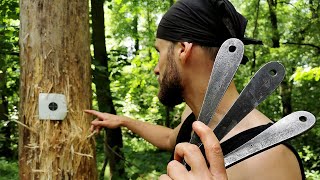
The instructor addresses safety concerns inherent to knife throwing, particularly the risk of blade bounce-back toward the thrower. He emphasizes that knife throwing carries inherent dangers and should be practiced at the participant's own risk. The tutorial is framed as one approach among many valid methods, not a definitive standard.
Knife Selection and Weight Considerations
Effective throwing knives should possess adequate weight and substance; excessively light or flimsy blades impede skill development. The instructor recommends the Cold Steel TruFlight Thrower (12-13 ounces, approximately $22-23) as an optimal entry-level option, balancing affordability with functional performance. Three knife categories are presented: lightweight options (Smith & Wesson, ~5 ounces), mid-weight balanced throwers (TruFlight, 12-13 ounces), and heavy specialty knives (Perfect Balance Thrower, approaching one pound).
Throwing Style Categories
Three primary throwing methodologies exist: half spin, full spin, and no spin techniques. Rotational throws (half and full spin) are significantly governed by distance from target, whereas no spin throwing demonstrates less distance dependency. Each style requires different grip positions and release mechanics.
Half Spin Throwing Fundamentals
Half spin throwing involves holding the blade end and utilizing either a dominant-leg-forward or dominant-leg-back stance, with the former increasingly preferred by competitive practitioners. The release should be relaxed rather than tension-gripped, allowing the knife to exit the hand naturally during a downward slicing motion. The knife rotates approximately half a revolution before striking the target.
Release Mechanics and Motion Pattern
The throwing motion should employ a downward slicing trajectory rather than an overhand baseball throw, which causes blade twisting and instability. Proper release timing occurs as the arm moves downward, with the knife following a smooth, straight rotational path. This controlled descent ensures predictable spin and accurate target contact.
Knife Throwing Tutorial for Beginners
Key Takeaways
- •Introduction and Disclaimers
- •Knife Selection and Weight Considerations
- •Throwing Style Categories
- •Half Spin Throwing Fundamentals
In this video I share an intro to knife throwing as well as basics in half spin, full spin and no spin throwing. #knifethrowing #tutorial Links to throwing knives True Flight Thrower https://www.amazon.com/Cold-Steel-80TFTC-True-Flight/dp/B000BSY9AI/ref=mp_s_a_1_3?crid=7Y0N0AGSZ6Z9&keywords=true+flight+thrower&qid=1661533242&sprefix=true+flight+%2Caps%2C81&sr=8-3 Perfect balance thrower https://www.amazon.com/Cold-Steel-Perfect-Balance-Thrower/dp/B0030DHIOK/ref=mp_s_a_1_3?crid=1DR3XGNXVQ68J&keywords=perfect+balance+thrower&qid=1661533334&sprefix=perfect+balance+thrower%2Caps%2C54&sr=8-3 Great knife throwers and channels to learn from Pro Knife Thrower/Jason Johnson https://youtube.com/user/bushido9840 Adam Celadin https://youtube.com/c/AdamCeladin Full Tang Clan https://youtube.com/user/fulltangclan
Frequently Asked Questions
What does this video teach about standard knife throwing?
This video covers introduction and disclaimers, knife selection and weight considerations, throwing style categories. It provides detailed instruction from 411 Outdoors LLC.
How long does it take to learn standard knife throwing?
The basic mechanics can be understood in a single session, but developing reliable execution requires consistent drilling over weeks of practice. This 5-part breakdown helps structure your training by isolating each phase of the technique.
What are the key details for finishing standard knife throwing?
Half spin throwing involves holding the blade end and utilizing either a dominant-leg-forward or dominant-leg-back stance, with the former increasingly preferred by competitive practitioners. The release should be relaxed rather than tension-gripped, allowing the knife to exit the hand naturally during a downward slicing motion. The knife rotates approximately half a revolution before striking the target.