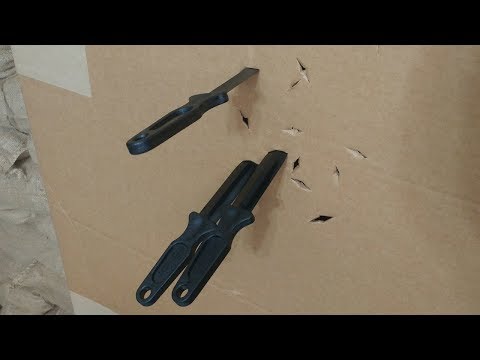
Knife Throwing in your house
0
Knife Throwing·John Hickok
The knife in the video is called the Executive Letter Opener II Please visit the Hickok45.com website and check out wha…
Translation: knife throwing
The sport and combat discipline of throwing knives at targets, practiced in competitive circuits and military training.
Knife throwing as a deliberate combat and performance skill has roots in multiple cultural traditions. In Africa, throwing knives with complex multi-bladed designs were used by Central African warriors for centuries, with the Kpinga of the Zande people being among the most sophisticated. [1] In Europe, throwing daggers are mentioned in medieval fight manuals, and knife throwing became a popular circus and variety performance art in the 19th century. [2] As a martial art, knife throwing has been practised in various Filipino, African, and Japanese traditions, though it was rarely a primary combat method. [1] Modern competitive knife throwing is governed by organisations such as the International Knife Throwers Hall of Fame (founded 2003) and follows standardised distance and target rules. [2]
Knife throwing is primarily a skill sport and demonstration art, with limited practical combat application due to the loss of the weapon after a single throw. [1]
Knife throwing exists as both a combat technique in some traditions and a competitive skill sport, with modern throwing standardised by organisations like the IKTHOF. [1]
Competitive knife throwing is governed by the International Knife Throwing Hall of Fame (IKTHOF) and other organisations, with standardised distance and target events. [1]
No images yet for this technique.
Sign in to suggest an image.
The knife in the video is called the Executive Letter Opener II Please visit the Hickok45.com website and check out wha…
No instructional courses yet for this technique.
Sign in to suggest a course.
Risk of injury to the person this technique is applied to
Projectile weapons including shuriken, throwing knives; high penetration risk
Skill level needed to execute this technique reliably
Whether this technique is allowed under major competition rule sets
Bubishi: The Classic Manual of Combat (Patrick McCarthy, 2008)
Alias sources — [1] MMA Instruction Manual (UFC, 2008) [2] MMA Instruction Manual (UFC, 2008) [3] MMA Instruction Manual (UFC, 2008)
History sources — [1] Draeger, D. & Smith, R., Comprehensive Asian Fighting Arts (Kodansha, 1969) [2] Anglo, S., The Martial Arts of Renaissance Europe (Yale University Press, 2000)
Mixed Japanese-Western terminology — combines traditional Japanese terms with katakana loanwords
Alias sources — [1] MMA Instruction Manual (UFC, 2008) [2] MMA Instruction Manual (UFC, 2008) [3] MMA Instruction Manual (UFC, 2008)
History sources — [1] Draeger, D. & Smith, R., Comprehensive Asian Fighting Arts (Kodansha, 1969) [2] Anglo, S., The Martial Arts of Renaissance Europe (Yale University Press, 2000)
close-range reflexes, wrist dexterity, grip transitions
quick hands, strong wrists for grip changes
forearm flexors, wrist rotators, deltoids, core
Every move, in any martial art, shares a few universal traits. Mix and match below to pinpoint the right tool — or compare equivalents across styles.
Knife throwing appears in 265 passages across 20 books. A skill crossing military, survival, sport, and entertainment contexts. Modern competitive knife throwing uses standardized distances and targets. (20 books; throwing arts texts)
Weight balance is the most important factor—as long as the weight is balanced, the knife will be easy to hold and control during the throw.
The sport and combat discipline of throwing knives at targets, practiced in competitive circuits and military training.
Knife throwing as a deliberate combat and performance skill has roots in multiple cultural traditions. In Africa, throwing knives with complex multi-bladed designs were used by Central African warriors for centuries, with the Kpinga of the Zande people being among the most sophisticated.
Traditional martial arts: legal — Practiced in traditional kata/forms and weapon-specific competition under var…; IWUF: legal — Legal in wushu taolu if applicable; HEMA: legal — Legal in applicable historical weapon categories
Danger rating 8/10. Very High — projectile weapons including shuriken, throwing knives; high penetration risk
The standard setup chain: Ready Position → Distance Control → Execute Technique → Return to Guard.
Standard counters include: Guard Position — return to a defensive ready stance / Distance Management — control the measure to avoid being in range / Counter-Attack — strike during the opponent's recovery or between movements.
Common variants: Forward grip slash (cutting with the blade in a forward (hammer) grip); Reverse grip stab (thrusting with the blade in an icepick (reverse) grip); Forward grip thrust (straight thrust targeting the body or limbs); Defensive cut (slashing the opponent's attacking limb to disable it).
Competitive knife throwing is governed by the International Knife Throwing Hall of Fame (IKTHOF) and other organisations, with standardised distance and target events.
Top errors to watch for: Throwing at inconsistent distances — each distance requires a different rotation count; pick a distance and master it… / Gripping the knife differently between throws — consistency in grip is essential; the same grip must be used every time / Using excessive force — knife throwing is about technique and release timing, not power; a hard throw amplifies errors / Not following through — the follow-through determines the knife's trajectory; stopping the hand abruptly ruins accuracy.
The Knife Throwing is also known as Naifu Nage, Sport Knife Throwing, Combat Knife Throwing, Blade Throwing.