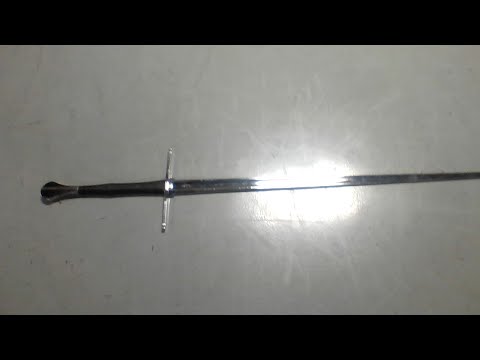
Can You Use a Single-Handed Sword with TWO Hands?
0
Standard Military Sabre Cut·Skallagrim
If you're tired of bad posture at your regular old desk, try an adjustable electric model from Anthrodesk: https://www.a…
Translation: standard military sabre cut
The Standard Military Sabre Cut delivers the curved blade's edge in a powerful slashing arc, typically targeting the opponent's head, shoulder, or sword arm, generated by a combination of arm extension, wrist rotation, and body rotation from the saddle or standing position. [1] The curved blade geometry ensures that the cut draws across the target, increasing cutting efficiency compared to a straight blade. [1],[2] Military sabre cuts are classified by direction — horizontal, diagonal descending, diagonal ascending, and vertical — with each direction corresponding to a numbered cut in period manuals. [2],[3]
Standard military sabre cuts were codified in European cavalry manuals, with Alfred Hutton's Cold Steel (1889) providing one of the most systematic treatments for both mounted and dismounted application. [1] The numbered cutting system was standardised across armies for efficient training of cavalry troopers. [2],[3]
The standard military sabre cut is a fundamental downward or diagonal cutting action designed for combat effectiveness. [1]
Standard military sabre cutting technique was taught in European military academies from the 18th century onward. [1]
Standard military sabre cuts are practised in HEMA military sabre competition events. [1]
No images yet for this technique.
Sign in to suggest an image.
If you're tired of bad posture at your regular old desk, try an adjustable electric model from Anthrodesk: https://www.a…
A scan of this famous treatise is now available freely on our website - http://swordfight.uk/resources/ Henry Angelo'…
The Standard Military Sabre Cut represents the foundational cutting technique codified in nineteenth-century European military sword practice. Academy of Historical Fencing documents the formal systematization of sabre cuts through Henry Angelo the Younger's 1817 Infantry Sword Exercise Manual, the first officially accepted British military standard for infantry swordsmanship on foot. Angelo's system, which remained the regulatory standard until the 1890s, employed numbered cuts and corresponding numbered parries for defensive responses, organizing cuts by position and providing structured training protocols—military instructors trained six hours daily for six weeks to master the system. The cuts themselves remained largely consistent with earlier Napoleonic period techniques popularized by Angelo's father's 1799 posters, though the 1817 manual introduced refined terminology and improved body mechanics instruction. Skallagrim's analysis emphasizes the biomechanical principles underlying sabre cuts: two-handed grip provides superior speed, precision in edge alignment, and enhanced directional control compared to single-handed execution, achieved through opposing hand pressures that enable rapid deceleration and redirection. Historical Weapons Guild's longsword instruction, while addressing a longer blade, reinforces core cutting principles applicable to sabre work: handshake grip positioning, vertical pulling mechanics driven by latissimus engagement rather than arm muscles, hip rotation for horizontal cuts, and the critical tactical concept of maintaining continuous motion through successive actions rather than committing to isolated cuts. Collectively, these instructors establish that military sabre cuts derive their effectiveness from structured body mechanics, grip discipline, and the integration of defensive positioning within offensive motion.
Synthesized from 3 instructors
No instructional courses yet for this technique.
Sign in to suggest a course.
Risk of injury to the person this technique is applied to
Edged weapons cause fatal lacerations; historical battlefield mortality rates >30% (Amberger 1999)
Skill level needed to execute this technique reliably
Whether this technique is allowed under major competition rule sets
The Art of Fencing (Luigi Barbasetti, 1932)
Alias sources — [1] Cold Steel (Hutton, 1889) [2] Hoplology (Burton, 1884) [3] Hoplology (Burton, 1884)
Effectiveness sources — [1] The Martial Arts of Renaissance Europe (Anglo, 2000)
Mixed Japanese-Western terminology — combines traditional Japanese terms with katakana loanwords
Alias sources — [1] Cold Steel (Hutton, 1889) [2] Hoplology (Burton, 1884) [3] Hoplology (Burton, 1884)
Effectiveness sources — [1] The Martial Arts of Renaissance Europe (Anglo, 2000)
wrist control for edge alignment, grip endurance, footwork precision
quick wrists, strong forearms, good posture
forearm extensors/flexors, deltoids, core, calves
According to Skallagrim, using two hands gives you more power and speed in your cuts, and provides a sturdier defense when parrying—if an opponent's attack is too strong to block with one hand alone, the supporting hand prevents your guard from collapsing.
Skallagrim emphasizes that you significantly shorten your effective reach; with two-hand support, you must position both hands close enough that you lose the distance you'd have with a single-handed grip, potentially missing targets your opponent can still evade.
According to the Historical Weapons Guild, when stepping forward to cut, your arms must go first and be powered and structured to move through everything else; your feet follow after, establishing the proper tempo and timing for an effective strike.
The Historical Weapons Guild explains that for vertical cuts, you move your shoulders and engage your back; for horizontal cuts, you keep your arms straight and move purely from your hips, and when combining both actions, everything works together from your core.
The Standard Military Sabre Cut delivers the curved blade's edge in a powerful slashing arc, typically targeting the opponent's head, shoulder, or sword arm, generated by a combination of arm extension, wrist rotation, and body rotation from the saddle or standing position. The curved blade geometry ensures that the cut draws across the target, increasing cutting efficiency compared to a straight blade.
Standard military sabre cuts were codified in European cavalry manuals, with Alfred Hutton's Cold Steel (1889) providing one of the most systematic treatments for both mounted and dismounted application. The numbered cutting system was standardised across armies for efficient training of cavalry troopers.
FIE: legal — Legal fencing technique — governed by FIE rules for foil, épée, and sabre; HEMA: legal — Legal in historical fencing competition
Danger rating 9/10. Extreme — edged weapons cause fatal lacerations; historical battlefield mortality rates >30% (Amberger 1999)
The standard setup chain: Assume Guard (Kamae/Hut) → Measure Distance (Ma-ai) → Initiate Cut/Thrust → Follow Through (Zanshin).
Standard counters include: Parry (Absetzen) — deflect the incoming blade with a counter-displacement / Void (Step Back) — withdraw from measure to avoid the cutting arc / Counter-Cut (Nachreisen) — strike into the opponent's opening during their attack.
Common variants: Standard cut (primary cutting angle from the ready stance); Thrust (tsuki) (straight thrust targeting the throat, chest, or face); Rising cut (kiri-age) (upward diagonal cut from low to high); Diagonal cut (kesa-giri) (downward diagonal cut following the kimono line).
Standard military sabre cuts are practised in HEMA military sabre competition events.
Top errors to watch for: Not initiating with the moulinet — the circular preparation builds the momentum needed for effective cutting / Cutting without stepping — the step provides power and closes distance / Extending the arm before rotating the hips — the hip rotation leads the cut; the arm follows / Not drawing the blade through the target — the curved blade requires the pulling action for cutting efficiency.
The Standard Military Sabre Cut is also known as Sutandādo Guntō Kiri, Molinello, Standard Cavalry Slash, Basic Sabre Cut.