How to Cut With a Rapier - Learning Sword Fighting
0
Standard Rapier Cut·Blood and Iron HEMA
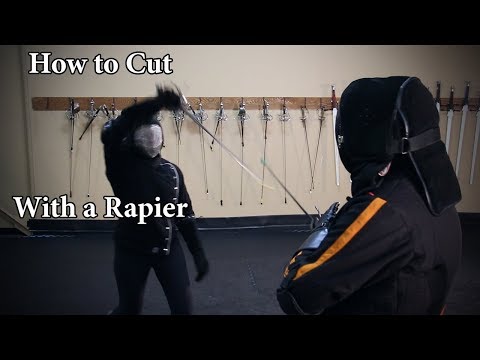
Cutting with a rapier is quite different than say a longsword or a broadsword. It requires a slicing component, which re…
Translation: standard rapier cut
The Standard Rapier Cut delivers the rapier's edge in a drawing or slashing motion against the opponent's exposed target, most commonly the hand, wrist, or forearm. [1] Unlike the heavy cuts of a longsword, rapier cuts rely on the drawing action of the edge across the target rather than impact force, making them most effective against unprotected extremities. [1],[2] The standard rapier cut is often used as a preparatory action to disturb the opponent's guard before delivering a decisive thrust. [2],[3]
The standard rapier cut is a supplementary cutting action used to set up thrusts or target exposed areas like the hands and forearms. [1]
Standard rapier cutting technique was taught alongside thrusting as part of Renaissance swordsmanship. [1]
Standard rapier cuts are used in HEMA rapier competition. [1]
No images yet for this technique.
Sign in to suggest an image.
Cutting with a rapier is quite different than say a longsword or a broadsword. It requires a slicing component, which re…
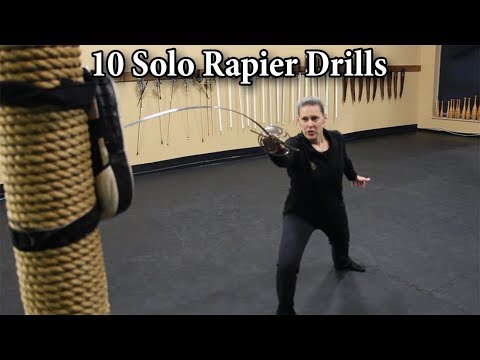
Sometimes it can be difficult to find the time to work with a group, so here are 10 solo drills you can do with a Rapier…
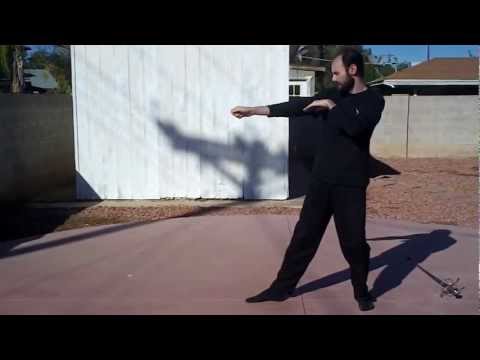
Basic 17th century rapier foot-work from the Phoenix Society of Historical Swordsmanship. Our favorite manual is Nicolet…
The standard rapier cut is a slicing technique employed when a thrust becomes impractical due to the opponent's point being driven offline, allowing the fencer to maintain initiative while regaining attacking position. Blood and Iron HEMA instructors Nicole Smith and Jillian Schutze emphasize that rapier cutting differs fundamentally from longsword hewing—it relies on drawing motion through the target rather than percussive impact. The cut is initiated by rolling the elbow while relaxing grip pressure, then re-engaging grip as the blade enters the cutting plane to execute the slice. Proper measure is critical; cutters must position themselves approximately one-third down the blade from the opponent, considerably closer than thrusting distance, requiring careful footwork such as pivot steps to avoid binding. Recommended targets include the head, neck, arms, and legs, avoiding the torso due to insufficient material for effective damage. The true edge is favored; false-edge cuts present alignment difficulties and deliver less power despite requiring significant percussive force and travel time. Smith's solo drill progression begins with stationary cuts from first guard, incorporating advance-and-draw mechanics, then combines cutting with thrusting sequences. Swordpals' Rich provides complementary context on stance and guard positioning from Italian 17th-century sources, though does not extensively detail cutting mechanics. All instructors stress that rapier cutting demands dedicated practice separate from other weapons systems to develop proper slicing mechanics and muscle memory.
Synthesized from 3 instructors
No instructional courses yet for this technique.
Sign in to suggest a course.
Risk of injury to the person this technique is applied to
Edged weapons cause fatal lacerations; historical battlefield mortality rates >30% (Amberger 1999)
Skill level needed to execute this technique reliably
Whether this technique is allowed under major competition rule sets
The Art of Fencing (Luigi Barbasetti, 1932)
Alias sources — [1] The Sword and the Centuries (Castle, 1901) [2] Classical Fencing (Rogers, 2014) [3] Classical Fencing (Rogers, 2014)
Effectiveness sources — [1] The Martial Arts of Renaissance Europe (Anglo, 2000)
Mixed Japanese-Western terminology — combines traditional Japanese terms with katakana loanwords
Alias sources — [1] The Sword and the Centuries (Castle, 1901) [2] Classical Fencing (Rogers, 2014) [3] Classical Fencing (Rogers, 2014)
Effectiveness sources — [1] The Martial Arts of Renaissance Europe (Anglo, 2000)
wrist control for edge alignment, grip endurance, footwork precision
quick wrists, strong forearms, good posture
forearm extensors/flexors, deltoids, core, calves
Stepping can help maintain edge alignment, but Blood and Iron HEMA recommends pivoting around your opponent's leg and drawing through rather than stepping forward and pulling back, which creates awkward mechanics.
False edge cuts are inherently weaker because it's harder to keep consistent pressure throughout the cut, though enough percussive force and travel time can still make them effective.
Stay level and avoid bouncing as you advance—push your front foot forward and retreat while keeping your stance ready, according to swordpals.
The Standard Rapier Cut delivers the rapier's edge in a drawing or slashing motion against the opponent's exposed target, most commonly the hand, wrist, or forearm. Unlike the heavy cuts of a longsword, rapier cuts rely on the drawing action of the edge across the target rather than impact force, making them most effective against unprotected extremities.
Rapier cutting technique is documented in Italian manuals from the sixteenth century onward, with the Bolognese school maintaining the most extensive cutting repertoire. Fabris describes cuts as useful for specific tactical situations but secondary to the thrust in overall importance.
FIE Sabre: legal — Legal cutting technique to upper body target area; FIK Kendo: legal — Legal if targeting valid area with correct form; WEKAF: legal — Legal striking technique; HEMA: legal — Legal in applicable weapon categories
Danger rating 9/10. Extreme — edged weapons cause fatal lacerations; historical battlefield mortality rates >30% (Amberger 1999)
The standard setup chain: Assume Guard (Kamae/Hut) → Measure Distance (Ma-ai) → Initiate Cut/Thrust → Follow Through (Zanshin).
Standard counters include: Parry (Absetzen) — deflect the incoming blade with a counter-displacement / Void (Step Back) — withdraw from measure to avoid the cutting arc / Counter-Cut (Nachreisen) — strike into the opponent's opening during their attack.
Common variants: Standard cut (primary cutting angle from the ready stance); Thrust (tsuki) (straight thrust targeting the throat, chest, or face); Rising cut (kiri-age) (upward diagonal cut from low to high); Diagonal cut (kesa-giri) (downward diagonal cut following the kimono line).
Standard rapier cuts are used in HEMA rapier competition.
Top errors to watch for: Using arm or shoulder power for the cut — the rapier cut is wrist-driven for speed and control / Cutting with the middle or forte of the blade — the last third (foible) is the cutting section / Chopping instead of slicing — the rapier cut draws through the target / Not recovering to guard after the cut — the recovery must be immediate.
The Standard Rapier Cut is also known as Sutandādo Reipia Kiri, Fendente, Mandritto, Standard Rapier Slash.