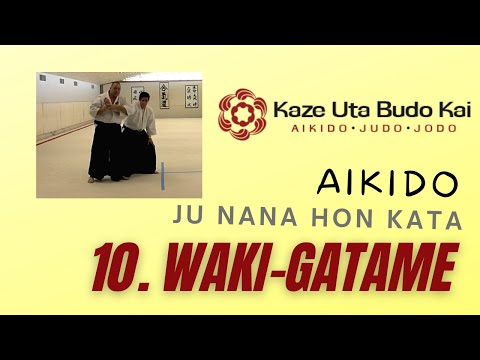
Aikido: Ju Nana Hon Kata - 10. Waki Gatame
0
Waki Gamae·Kaze Uta Budo Kai / Windsong Dojo
17 Basic Techniques: 10. Waki Gatame — side of chest arm lock As tori pushes through in the balance break, uke’s elbow n…
Translation: Side Stance
Waki-gamae (side guard) conceals the sword behind the body with the blade pointing rearward, hiding the weapon's length and the wielder's intent from the opponent. [1] This deceptive guard denies the opponent information about the sword's position, making it difficult to judge distance or predict the line of attack. [1],[2] Waki-gamae is associated with the element of wind (fū) in the five-element system and is considered a highly tactical guard used to lure opponents into committed attacks. [2],[3]
Waki gamae (side guard) conceals the shinai behind the body to hide its length and angle from the opponent. [1] It is primarily a psychological stance designed to provoke uncertainty about the attacker's intended target and timing. [2] Like hasso, it is used mainly in kendo kata rather than in modern free sparring. [2]
Waki gamae conceals the sword behind the body, hiding the blade length from the opponent. It is a classical kenjutsu guard used in kata practice. [1]
Waki gamae is practised in kendo kata but is not used in modern kendo competition (shiai) due to its impracticality with a shinai. [1]
No images yet for this technique.
Sign in to suggest an image.
17 Basic Techniques: 10. Waki Gatame — side of chest arm lock As tori pushes through in the balance break, uke’s elbow n…
Nick Lowry of Windsong dojo (http://www.windsongdojo.com) demonstrates how to use Hasso-waki-gamae. This is part of the …
black belt Hall presents: the art of sword of the samurai in the famous Wizard Masayuki Simabukuro (Masayuki Shimabuku…
Waki gamae is a foundational sword stance in Japanese kenjutsu and koryu swordsmanship characterized by a lowered guard position with the blade held at mid-body level. According to Kaze Uta Budo Kai's instruction on Koryu Dai San Kata, waki gamae functions as a defensive posture paired with hasso (an elevated mouth-level guard) in sword-on-sword exchanges, where the practitioner withdraws the knee and replaces it with the sword to defend against leg cuts while maintaining center-line control against incoming thrusts. The stance teaches principles of positional fading and luring opponents into overcommitment before executing lateral counter-strikes. Masayuki Shimabukuro's instruction (via 34r4k1) emphasizes that waki gamae exposes the knee as a primary target area, making it tactically relevant in kumitachi (two-person drills) and batojutsu cutting practice. The instructors agree that waki gamae represents a lower, more compact guard suitable for responding to close-range attacks and teaches timing-based defensive principles. Kaze Uta Bodo Kai provides detailed tactical sequencing of the stance's application in live exchange, while Shimabukuro contextualizes it within broader target nomenclature and cutting methodology in samurai swordsmanship.
Synthesized from 3 instructors
No instructional courses yet for this technique.
Sign in to suggest a course.
Risk of injury to the person this technique is applied to
Edged weapons cause fatal lacerations; historical battlefield mortality rates >30% (Amberger 1999)
Skill level needed to execute this technique reliably
Whether this technique is allowed under major competition rule sets
The Book of Five Rings (Miyamoto Musashi, 1645)
Alias sources — [1] Japanese Swordsmanship (Warner & Draeger, 1982) [2] The Book of Five Rings (Musashi, trans. Harris, 1974) [3] Secrets of the Samurai (Ratti & Westbrook, 1973)
Effectiveness sources — [1] All Japan Kendo Federation, Kendo Official Manual (AJKF) [2] Warner, G. & Draeger, D., Japanese Swordsmanship: Technique and Practice (Weatherhill, 1982)
Established Japanese martial arts naming convention — native Japanese term (和語/漢語)
Alias sources — [1] Japanese Swordsmanship (Warner & Draeger, 1982) [2] The Book of Five Rings (Musashi, trans. Harris, 1974) [3] Secrets of the Samurai (Ratti & Westbrook, 1973)
Effectiveness sources — [1] All Japan Kendo Federation, Kendo Official Manual (AJKF) [2] Warner, G. & Draeger, D., Japanese Swordsmanship: Technique and Practice (Weatherhill, 1982)
wrist control for edge alignment, grip endurance, footwork precision
quick wrists, strong forearms, good posture
forearm extensors/flexors, deltoids, core, calves
Control is the fundamental element you're looking for in waki gamae. According to Kaze Uta Budo Kai, the key is 'control, control, control'—and you should practice as many different ways to achieve it as possible, including variations like stretching your opponent out with no hands.
You want to keep your hands at least an inch to an inch and a half away from the hand guard (suba), and grip from the top rather than from the sides—your thumbs should not be on top of the sword. This proper hand placement is essential for effective technique.
Waki-gamae (side guard) conceals the sword behind the body with the blade pointing rearward, hiding the weapon's length and the wielder's intent from the opponent. This deceptive guard denies the opponent information about the sword's position, making it difficult to judge distance or predict the line of attack.
Waki-gamae is one of the five classical kamae described in koryū kenjutsu traditions, corresponding to the wind element, which represents deception and adaptability. Musashi discusses the hidden guard's tactical value in the Book of Five Rings.
FIK Kendo: legal — Legal, valid strike requires correct form (datotsu-bu), spirit (kiai), and fo…
Danger rating 9/10. Extreme — edged weapons cause fatal lacerations; historical battlefield mortality rates >30% (Amberger 1999)
The standard setup chain: Assume Guard (Kamae/Hut) → Measure Distance (Ma-ai) → Initiate Cut/Thrust → Follow Through (Zanshin).
Standard counters include: Parry (Absetzen) — deflect the incoming blade with a counter-displacement / Void (Step Back) — withdraw from measure to avoid the cutting arc / Counter-Cut (Nachreisen) — strike into the opponent's opening during their attack.
Common variants: Standard cut (primary cutting angle from the ready stance); Thrust (tsuki) (straight thrust targeting the throat, chest, or face); Rising cut (kiri-age) (upward diagonal cut from low to high); Diagonal cut (kesa-giri) (downward diagonal cut following the kimono line).
Waki gamae is practised in kendo kata but is not used in modern kendo competition (shiai) due to its impracticality with a shinai.
Top errors to watch for: Hiding the sword too far behind the body — the sword must be accessible for quick deployment / Not concealing the blade effectively — the point should not be visible to the opponent / Holding Waki Gamae without intent to attack — the hidden sword must be deployed; holding it indefinitely reveals the … / Using Waki Gamae without understanding the timing — the attack from Waki Gamae must be launched at the correct moment.
The Waki Gamae is also known as Waki, Side-Concealed Stance, Hidden Sword Guard.
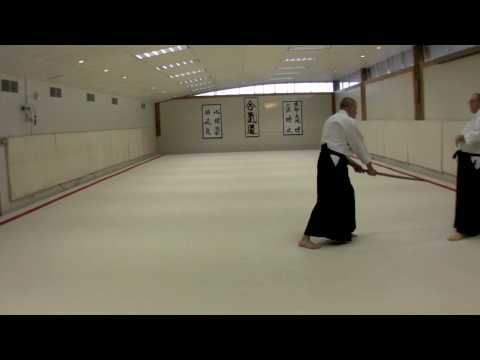
![Masayuki Shimabukuro Samurai Swordsmanship: The Basics [1/11] CD1](https://img.youtube.com/vi/lddhRjqmcSg/hqdefault.jpg)