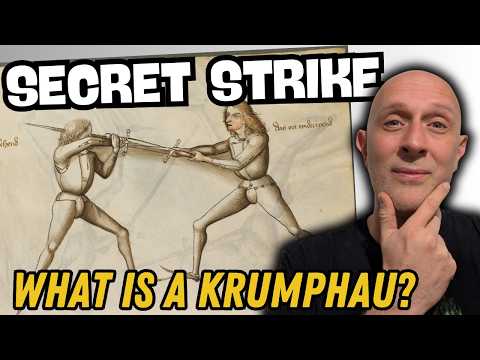
SECRET ATTACKS of Medieval German Longsword - Krumphau class with @forteswordplay
0
Krumphau·scholagladiatoria
With Jeff Tsay of @forteswordplay looking at one of the Master Strokes from the Liechtenauer tradition of medieval swor…
Translation: krumphau (crooked cut)
The Crooked Cut, delivered with crossed wrists to strike with the short edge, used to break the opponent's Ochs guard.
The Krumphau (Crooked Cut) is one of the five Meisterhäue (master cuts) in the Liechtenauer tradition, the foundational German longsword system dating to the 14th century. [1] Johannes Liechtenauer's Zettel (verse mnemonic) identifies the Krumphau as the specific counter to the Ochs (Ox) guard, teaching that the crossed-wrist cutting action simultaneously displaces the defender's blade while striking at their hands. [2] Sigmund Ringeck's gloss (c. 1440) provides detailed technical instruction on the Krumphau's execution, and the technique appears in virtually all subsequent Liechtenauer-tradition manuals, including those of Peter von Danzig and Jud Lew. [1],[2] The Krumphau has been extensively reconstructed by modern HEMA practitioners and is a staple technique in competitive longsword fencing. [1]
The Krumphau (Crooked Cut) is a diagonal cut delivered with crossed hands or with the blade angled to strike at the opponent's hands or flat of their blade. [1] It is specifically designed to counter the Ochs guard by striking at the fencer's hands and simultaneously displacing their blade. [2] The crossed-hand mechanics create an unusual trajectory that is difficult for the opponent to anticipate. [2]
The Krumphau (crooked cut) is one of the five Meisterhäue used in HEMA competition, specifically designed to counter the Ochs guard by cutting across with crossed hands. [1]
No images yet for this technique.
Sign in to suggest an image.
With Jeff Tsay of @forteswordplay looking at one of the Master Strokes from the Liechtenauer tradition of medieval swor…
...or Changing Through with the Crooked Cut. Short video recapping our weekly Longsword lesson. Lesson pulled from the…
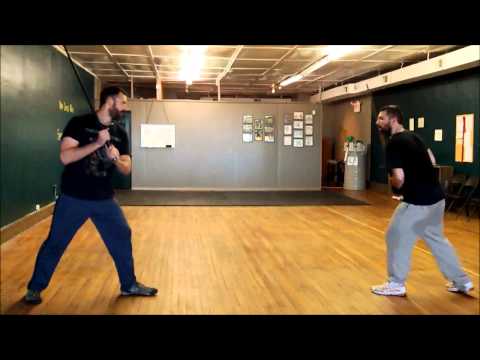
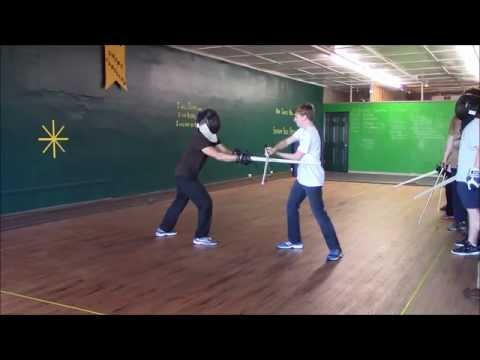
This is a clip of a drill we used during a recent class on the Krumphau. To watch this class and so much more, please…
The Krumphau is a master cut (Meisterhau) of the Liechtenauer longsword tradition characterized by a crooked or bent trajectory that defends efficiently while immediately pivoting to offensive advantage. According to scholagladiatoria and Sword Carolina instructors, the technique's name derives from medieval German roots suggesting curvature or crumbling rather than straightness. Mechanically, the Krumphau involves stepping offline while cutting from an unexpected angle—notably, cutting from the opposite side of the body (e.g., cutting left while in right stance)—to bring one's edge against the opponent's blade flat, disrupting their committed attack. scholagladiatoria emphasizes the edge-on-flat contact creates significant mechanical advantage by dissipating incoming force as the cut progresses from the opponent's weak (foible) to strong (forte). A critical follow-up action involves a downward beat or push that further neutralizes the threat by leveraging the shoulder's natural pivot. Tactically, the Krumphau addresses multiple scenarios: direct sword-on-sword contact, hand-led attacks (by simply redirecting the same motion to intercept the hands instead), and varied angles of incoming cuts. When faced with more vertical attacks, practitioners may transition into shield cuts instead. Sword Carolina demonstrates the technique as part of combination sequences, particularly in Durchwechseln (passing through), where the Krumphau sets up subsequent thrusts or cuts. Both instructors stress the Krumphau functions as a dynamic cutting pattern generating continuous offensive-defensive flow rather than an isolated technique, with immediate follow-up actions determining success in combat application.
Synthesized from 3 instructors
No instructional courses yet for this technique.
Sign in to suggest a course.
Risk of injury to the person this technique is applied to
Edged weapons cause fatal lacerations; historical battlefield mortality rates >30% (Amberger 1999)
Skill level needed to execute this technique reliably
Whether this technique is allowed under major competition rule sets
The Art of Combat (Joachim Meyer, 1570)
Alias sources — [1] Sigmund Ringeck's Knightly Arts of Combat [2] Sigmund Ringeck's Knightly Arts of Combat [3] Sigmund Ringeck's Knightly Arts of Combat
Effectiveness sources — [1] Forgeng, J., The Art of Combat (Palgrave Macmillan, 2003) [2] Tobler, C., Fighting with the German Longsword (Freelance Academy Press, 2004)
Standard katakana transliteration of Western martial arts terminology (外来語) — used in Japanese MMA, boxing, and BJJ communities
Alias sources — [1] Sigmund Ringeck's Knightly Arts of Combat [2] Sigmund Ringeck's Knightly Arts of Combat [3] Sigmund Ringeck's Knightly Arts of Combat
Effectiveness sources — [1] Forgeng, J., The Art of Combat (Palgrave Macmillan, 2003) [2] Tobler, C., Fighting with the German Longsword (Freelance Academy Press, 2004)
wrist control for edge alignment, grip endurance, footwork precision
quick wrists, strong forearms, good posture
forearm extensors/flexors, deltoids, core, calves
Instead of meeting a cut with a flat-on-flat block in the same plane (which risks a double hit), the Krumphau uses your edge to strike against the flat of the opponent's blade while angling your cut differently. This creates pressure that beats the blade down and away from you, as explained by Schola Gladiatoria.
The Krumphau efficiently transitions from defense into immediate offense—you start in a defensive position but can pivot quickly into an attacking follow-up depending on your opponent's response. This dual functionality makes it one of the bread-and-butter techniques that define the German longsword system, per Schola Gladiatoria.
Rather than automatically targeting the sword or hands, focus on controlling the center line. You're clearing the area in front of you regardless of whether the blade or hands occupy that space, and your follow-up options (thrust, cut, or slice) depend on the range and your opponent's response, as demonstrated by Sword Carolina.
The Krumphau is interconnected with other master cuts and techniques like the Shield—they can flow organically from one to another depending on your opponent's defense. Understanding what comes next after your Krumphau is essential rather than treating it as an isolated technique, per Schola Gladiatoria.
The Crooked Cut, delivered with crossed wrists to strike with the short edge, used to break the opponent's Ochs guard.
The Krumphau (Crooked Cut) is one of the five Meisterhäue (master cuts) in the Liechtenauer tradition, the foundational German longsword system dating to the 14th century. Johannes Liechtenauer's Zettel (verse mnemonic) identifies the Krumphau as the specific counter to the Ochs (Ox) guard, teaching that the crossed-wrist cutting action simultaneously displaces the defender's blade while striking at their hands.
Traditional martial arts: legal — Practiced in traditional kata/forms and weapon-specific competition under var…; IWUF: legal — Legal in wushu taolu if applicable; HEMA: legal — Legal in applicable historical weapon categories
Danger rating 9/10. Extreme — edged weapons cause fatal lacerations; historical battlefield mortality rates >30% (Amberger 1999)
The standard setup chain: Ready Position → Distance Control → Execute Technique → Return to Guard.
Standard counters include: Parry (Absetzen) — deflect the incoming blade with a counter-displacement / Void (Step Back) — withdraw from measure to avoid the cutting arc / Counter-Cut (Nachreisen) — strike into the opponent's opening during their attack.
Common variants: Standard cut (primary cutting angle from the ready stance); Thrust (tsuki) (straight thrust targeting the throat, chest, or face); Rising cut (kiri-age) (upward diagonal cut from low to high); Diagonal cut (kesa-giri) (downward diagonal cut following the kimono line).
The Krumphau (crooked cut) is one of the five Meisterhäue used in HEMA competition, specifically designed to counter the Ochs guard by cutting across with crossed hands.
Top errors to watch for: Cutting at the body with the Krumphau instead of the hands/sword — the primary target is the opponent's hands or blade / Making the cut too wide and losing control — the Krumphau must be controlled to allow immediate follow-up / Not using the crooked angle — the Krumphau's effectiveness comes from its unusual trajectory; a straight cut is not a… / Attempting the Krumphau from too far — the technique requires close enough range to reach the hands.
The Krumphau is also known as Kurumpuhau, Crooked Cut, Krump-Haw, Bent Strike.