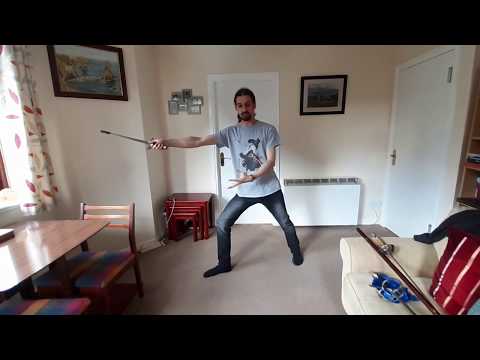
Renaissance Fencing Tutorial 2 Stoccata Thrust
0
Time Thrust·Edinburgh Renaissance Fencing Academy
The second ERFA online tutorial video - now with better resolution! This time we look at how to practise the stoccata th…
Translation: Counter-time thrust
The Time Thrust (Arrêt) is a stop-hit delivered into the opponent's attack, exploiting a tempo where the attacker is committed but has not yet reached the target. [1] It requires precise timing and courage to thrust into an incoming attack. [1] In épée, the time thrust is one of the highest-percentage tactical actions. [1]
The Time Thrust remains a core technique in modern competitive fencing and historical swordsmanship. [1]
Used in FIE international fencing competition
No images yet for this technique.
Sign in to suggest an image.
The second ERFA online tutorial video - now with better resolution! This time we look at how to practise the stoccata th…
No instructional courses yet for this technique.
Sign in to suggest a course.
Risk of injury to the person this technique is applied to
Sport fencing with protective equipment; historically lethal with sharp weapons
Skill level needed to execute this technique reliably
Whether this technique is allowed under major competition rule sets
Fencing (Pollock, Grove & Prevost, 1902)
description, historyOrigin: sourced from Pollock, W
description, historyOrigin: sourced from Pollock, W
Requires good arm extension
Quick reflexes
Balance and footwork
The time thrust (stop thrust / counter-time) is an attack made into the opponent's preparation — the defender attacks before the attacker's action is completed. Requires perfect timing and is one of the most difficult fencing actions. (Fencing technique manuals; Biomechanics of Human Motion)
Your movements should be smooth and controlled, stretching and contracting in a manner similar to a resistance band. Think of an elasticated, springy movement rather than sharp and jagged motions when judging whether you're executing the body movements correctly.
In the 16th century style, you push out with the weapon first and expand the body before taking a step forward, keeping your limbs relaxed and unlocked throughout. This differs from later period lunges which have a different sequencing and mechanics.
The Time Thrust (Arrêt) is a stop-hit delivered into the opponent's attack, exploiting a tempo where the attacker is committed but has not yet reached the target. It requires precise timing and courage to thrust into an incoming attack.
The Time Thrust was codified in European fencing treatises from the 16th century onward. Italian and French schools developed the technique into its modern form through centuries of refinement.
FIE: legal — Legal fencing technique — governed by FIE rules for foil, épée, and sabre; HEMA: legal — Legal in historical fencing competition
Danger rating 3/10. Sport fencing with protective equipment; historically lethal with sharp weapons
The standard setup chain: En garde → Preparation → Time Thrust → Recovery.
Standard counters include: Counter-parry / Distance management / Stop-hit.
Common variants: Direct time thrust; Indirect time thrust; Compound time thrust.
Used in FIE international fencing competition
Top errors to watch for: Over-extending / Telegraphing the action / Poor recovery.
The Time Thrust is also known as Taimu Surasuto, Time Thrust, Stop Thrust, Arrêt, Contre-Temps.