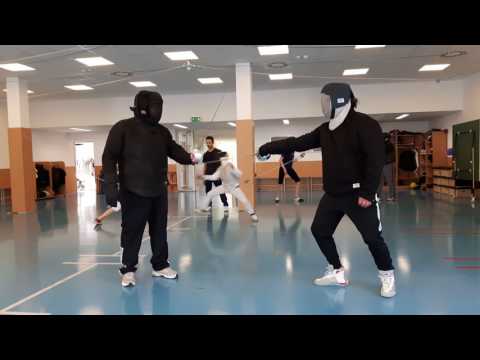
FIE 8 May Sabre Remise after tierce and quinte parry; line
0
Remise·Anton Lundqvist
Translation: Renewal
The Remise is a renewal of the attack in the same line without withdrawing the arm, delivered when the opponent's parry or riposte is late or fails. [1] It exploits the gap between a failed parry and the opponent's recovery. [1] The remise is a key tactical tool in épée fencing where right-of-way rules do not apply. [1]
The Remise remains a core technique in modern competitive fencing and historical swordsmanship. [1]
Used in FIE international fencing competition
No images yet for this technique.
Sign in to suggest an image.
No instructional courses yet for this technique.
Sign in to suggest a course.
Risk of injury to the person this technique is applied to
Sport fencing with protective equipment; historically lethal with sharp weapons
Skill level needed to execute this technique reliably
Whether this technique is allowed under major competition rule sets
Fencing (Pollock, Grove & Prevost, 1902)
description, historyOrigin: sourced from Pollock, W
description, historyOrigin: sourced from Pollock, W
Requires good arm extension
Quick reflexes
Balance and footwork
The remise appears in 188 passages across our corpus. An immediate second attack in the same line after the first attack fails — without withdrawing the arm. In fencing, the remise does not have right-of-way priority, so in foil and sabre it only scores if the opponent fails to riposte. (Biomechanics of Human Motion; FIE rules)
The Remise is a renewal of the attack in the same line without withdrawing the arm, delivered when the opponent's parry or riposte is late or fails. It exploits the gap between a failed parry and the opponent's recovery.
The Remise was codified in European fencing treatises from the 16th century onward. Italian and French schools developed the technique into its modern form through centuries of refinement.
FIE: legal — Legal fencing technique — governed by FIE rules for foil, épée, and sabre; HEMA: legal — Legal in historical fencing competition
Danger rating 3/10. Sport fencing with protective equipment; historically lethal with sharp weapons
The standard setup chain: En garde → Preparation → Remise → Recovery.
Standard counters include: Counter-parry / Distance management / Stop-hit.
Common variants: Direct remise; Indirect remise; Compound remise.
Used in FIE international fencing competition
Top errors to watch for: Over-extending / Telegraphing the action / Poor recovery.
The Remise is also known as Rumīzu, Remise, Replacement, Renewal of Attack.