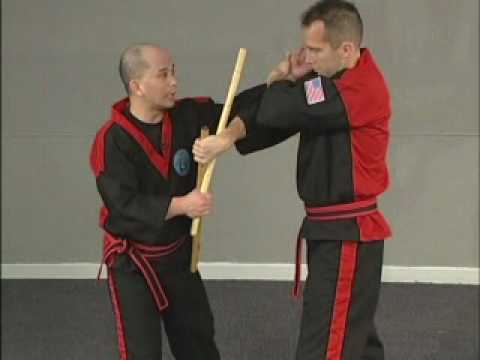
Bruce Chiu Teaching Backhand Traps and Locks from Modern Arnis
0
Backhand Cut·Black and Blue Video
This is from Bruce Chiu's Instructional DVD Backhand Strikes of Modern Arnis Bruce Chiu Teaching Backhand Traps and Lock…
Translation: backhand cut
The Backhand Cut is a knife cutting action delivered from the outside inward using the back of the hand to drive the blade edge across the target. [1] In Filipino martial arts this corresponds to the even-numbered angles of attack (angles 2, 4, 6 in many systems), travelling from the practitioner's non-dominant side. [1],[2] The backhand cut is often used as a follow-up to a forehand cut, creating a continuous figure-eight cutting pattern. [2],[3]
Backhand cutting was developed in classical kenjutsu schools as part of the multi-directional cutting curriculum. [1]
Backhand cuts are performed in tameshigiri competitions and koryū demonstrations. [1]
No images yet for this technique.
Sign in to suggest an image.
This is from Bruce Chiu's Instructional DVD Backhand Strikes of Modern Arnis Bruce Chiu Teaching Backhand Traps and Lock…
Find out how you can learn directly from the Sean Elders through his Training Courses, Online Classes, Online University…
Today we try some zero distance tameshigiri, where we cut from an incredibly close distance to the target with no drawin…
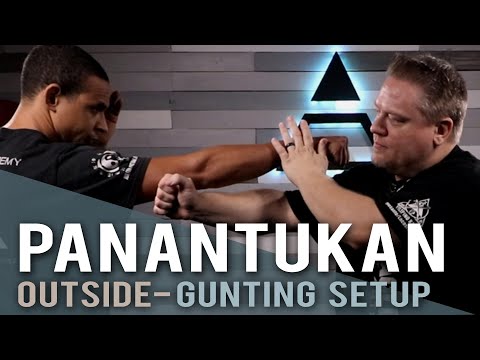
The backhand cut is a close-range offensive technique derived from Filipino martial arts (particularly Panantukan and Modern Arnis) and sword-fighting systems. According to Pinnacle Combat Arts, the backhand cut—or backhand gunting—is executed by retracting the arm and applying a cutting motion across an opponent's limb, typically targeting the bicep or tricep. It functions as both a defensive counter and offensive opening: when an opponent throws a punch and the defender's hand is already positioned on the outside sector of the opponent's arm (via parry or slip), the backhand cut can be deployed immediately to disrupt the opponent's limb and create follow-up opportunities. Sean Elders emphasizes the importance of sectoring (monitoring four positional zones around the opponent) and drilling with a partner who actively punches and slips. Black and Blue Video's Bruce Chiu, teaching from a stick-fighting tradition, demonstrates how backhand traps and locks transition into cuts and compressions against the opponent's arm and body, often combined with stick applications to the neck and collarbone. Just a Bug approaches cutting mechanics from a katana perspective, finding that at close range (5–8cm), speed and edge alignment are critical parameters—power alone causes the target to collapse without effective cutting, while speed combined with precise edge alignment enables the cut to work despite limited distance. All three instructors agree that close-range cutting requires proper body mechanics, regular drilling, and real-contact practice to achieve functional effectiveness.
Synthesized from 3 instructors
No instructional courses yet for this technique.
Sign in to suggest a course.
Risk of injury to the person this technique is applied to
Knives and short blades are the most common weapon in real-world assaults; high lethality
Skill level needed to execute this technique reliably
Whether this technique is allowed under major competition rule sets
Bubishi: The Classic Manual of Combat (Patrick McCarthy, 2008)
Alias sources — [1] Filipino Martial Arts (Wiley, 1994) [2] Hoplology (Burton, 1884) [3] Comprehensive Asian Fighting Arts (Draeger & Smith, 1969)
Effectiveness sources — [1] Classical Bujutsu (Draeger, 1973) [2] Classical Fighting Arts of Japan (Mol, 2001)
Mixed Japanese-Western terminology — combines traditional Japanese terms with katakana loanwords
Alias sources — [1] Filipino Martial Arts (Wiley, 1994) [2] Hoplology (Burton, 1884) [3] Comprehensive Asian Fighting Arts (Draeger & Smith, 1969)
Effectiveness sources — [1] Classical Bujutsu (Draeger, 1973) [2] Classical Fighting Arts of Japan (Mol, 2001)
wrist control for edge alignment, grip endurance, footwork precision
quick wrists, strong forearms, good posture
forearm extensors/flexors, deltoids, core, calves
Yes, you can execute a backhand cut against either punch. According to Sean Elders at Pinnacle Combat Arts, the key is understanding sectoring—dividing the space into four sectors—so that whenever your hand is positioned, it's already in place to respond to your opponent's incoming strike.
When your opponent slips your jab or cross, use the sectoring concept to immediately follow up. Sean Elders emphasizes that if your hand is already positioned in the right sector after the slip, you can come straight in with your backhand cut or palm strike without repositioning.
Keep your non-striking hand up and protected—don't leave it down. Sean Elders stresses that proper hand protection is essential when executing your backhand cut, and you may need to float back slightly depending on whether you want to continue attacking or reset.
Speed and edge alignment are more critical than raw power. Just a Bug explains that when cutting close, speed prevents an opponent from moving back far enough to avoid the technique, and improper edge alignment will cause excessive resistance that stops the cut completely.
The Backhand Cut is a knife cutting action delivered from the outside inward using the back of the hand to drive the blade edge across the target. In Filipino martial arts this corresponds to the even-numbered angles of attack (angles 2, 4, 6 in many systems), travelling from the practitioner's non-dominant side.
Backhand cutting patterns appear in virtually all Filipino martial arts knife curricula and are considered essential for developing ambidextrous flow in blade work. The technique is also found in Western knife-fighting systems derived from military combatives.
WEKAF: legal — Legal in padded stick competition; HEMA: legal — Legal in applicable weapon categories
Danger rating 9/10. Extreme — knives and short blades are the most common weapon in real-world assaults; high lethality
The standard setup chain: Ready Position → Distance Control → Execute Technique → Return to Guard.
Standard counters include: Parry (Absetzen) — deflect the incoming blade with a counter-displacement / Void (Step Back) — withdraw from measure to avoid the cutting arc / Counter-Cut (Nachreisen) — strike into the opponent's opening during their attack.
Common variants: Standard cut (primary cutting angle from the ready stance); Thrust (tsuki) (straight thrust targeting the throat, chest, or face); Rising cut (kiri-age) (upward diagonal cut from low to high); Diagonal cut (kesa-giri) (downward diagonal cut following the kimono line).
Backhand cuts are performed in tameshigiri competitions and koryū demonstrations.
Top errors to watch for: Generating insufficient power on the backhand — the backhand requires deliberate hip rotation to match forehand power / Not protecting the lead side during the backhand — the backhand motion opens the weapon-side to counter-attacks / Making the backhand too wide — keep the cutting arc tight and efficient to maintain speed / Not training the backhand equally with the forehand — the backhand should receive equal practice time.
The Backhand Cut is also known as Bakkuhando Kiri, Taga Revez, Reverse Slash, Backhand Slash.
![Cutting Up Close - Speed vs Power in the Cut [katana tameshigiri / sword talk]](https://img.youtube.com/vi/WVuLSxqPD-Y/hqdefault.jpg)