Close-Range Cutting Scenario
During high-intensity sparring, the instructor found himself with his katana positioned 5-8cm from his opponent's chest with no obstructing blade. Rather than drawing back to generate power—a move that would leave him vulnerable to counterattack—he executed a quick pull-through cut from this compromised distance. This scenario raises a critical question: what factors determine the effectiveness of cuts executed in extreme close quarters?
Standard Cutting Mechanics
Normal cutting technique relies on distance to build speed and power. The swordsman draws the blade back, creating separation from the target, then uses this gap to accelerate the blade and generate the velocity needed to cut cleanly through the target. In close-range situations where this distance is unavailable, the conventional approach becomes tactically impractical.
Power-Based Approach
The instructor's first experimental parameter tested whether raw power and body mass could compensate for minimal distance. Driving the blade forward with maximal force from the 5-8cm range, the cuts failed to penetrate the test medium effectively. The cutting stand repeatedly toppled without the blade achieving sufficient speed and velocity to sever cleanly through the target.
Speed Over Power
Shifting strategy, the instructor prioritized speed with minimal power input, executing quick pull-through cuts at shallow angles. This approach proved significantly more effective than the power-based method. The resulting cuts, while slightly sloped due to target material deformation, maintained enough cutting efficiency to overcome the medium's resistance without requiring the target to remain stationary.
Edge Alignment as Critical Variable
The instructor discovered that imperfect edge alignment created unexpected failures, with cuts stopping mid-penetration through the test material. This occurs because close-range pull-through cuts engage a longer section of the blade compared to traditional slicing cuts. When edge alignment deviates even slightly from perpendicular, the distributed resistive force along the extended blade contact becomes insurmountable.
Practical Application Against Opponents
The findings suggest that attempting to power through a close-range cut against a live opponent would result in pushing rather than cutting, minimizing actual damage. Conversely, a fast pull-through cut leaves an opponent insufficient time to lean back or create additional distance. For close-range cutting effectiveness, precise edge alignment and cutting speed are essential; power becomes counterproductive and actually reduces tactical utility.
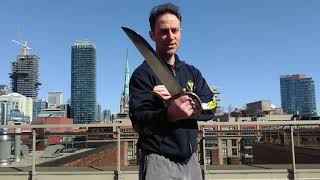
Cutting Up Close - Speed vs Power in the Cut [katana tameshigiri / sword talk]
Key Takeaways
- •Close-Range Cutting Scenario
- •Standard Cutting Mechanics
- •Power-Based Approach
- •Speed Over Power
Today we try some zero distance tameshigiri, where we cut from an incredibly close distance to the target with no drawing back of the sword. What parameters affect the cut? Is speed or power more important? And finally, would a cut like this actually do much damage to an opponent? We answer these questions in the video today. Swords-1095 Clay tempered katana 71cm blade length Tameshigiri targets -Pool noodles-these require good edge alignment or they will not cut, very little power required. Also pool noodles that have been bent or manhandled have their fibres break and become incredibly difficult to cut as they have a tendency to bend instead Always be aware of your surroundings and minimise harm to yourself, others and your environment. Never use weapons when intoxicated or upset or for any act of violence. If you would like to support the channel you can buy me a coffee here: https://www.buymeacoffee.com/justabug Thanks to everyone who has supported the channel, your coffees are much appreciated! Check out my Instagram at just_a_bug_swordsman for more content. For messages and reaching out to the channel email me at [email protected]
Related Techniques
Frequently Asked Questions
What does this video teach about backhand cut?
This video covers close-range cutting scenario, standard cutting mechanics, power-based approach. It provides detailed instruction from Just a Bug.
How long does it take to learn backhand cut?
The basic mechanics can be understood in a single session, but developing reliable execution requires consistent drilling over weeks of practice. This 6-part breakdown helps structure your training by isolating each phase of the technique.
What are the key details for finishing backhand cut?
The instructor discovered that imperfect edge alignment created unexpected failures, with cuts stopping mid-penetration through the test material. This occurs because close-range pull-through cuts engage a longer section of the blade compared to traditional slicing cuts. When edge alignment deviates even slightly from perpendicular, the distributed resistive force along the extended blade contact becomes insurmountable.
Related videos
Bruce Chiu Teaching Backhand Traps and Locks from Modern Arnis
Black and Blue Video
Panantukan - Backhand Gunting setup (Sean Elders)
PINNACLE COMBAT ARTS
3 Ways to Upper Cut
The Sword Lynx
Shihan Dana Abbott Sword Training: DAILY 4: Upward and Downward Cutting Angles
Learnthesword
Upward figure 8 pattern for Wing Chun Knife practice.
rykenfu