PUNYO DISARMING | Filipino Martial Arts
0
Standard Disarma·MATTI San Juan Official
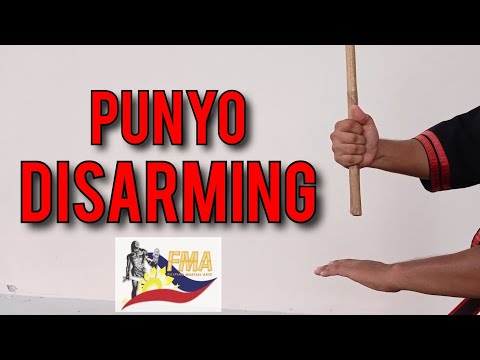
Punyo Disarming is close quarter movements that you need to hit the wrist or the hand of your opponent to release the st…
Translation: standard disarma
The Standard Disarma executes the fundamental disarming technique by controlling the opponent's weapon hand after a block, then applying leverage with the stick or free hand to strip the weapon away. [1] The basic method follows the sequence: block the incoming strike, check or trap the opponent's weapon hand with the live hand (free hand), and use the stick or a joint manipulation to peel the weapon free from the opponent's grip. [1],[2] Standard disarma techniques are drilled against each of the numbered angles of attack, so the practitioner has a disarming option regardless of the angle the opponent attacks from. [2],[3]
Disarming techniques (disarma) are a distinctive feature of Filipino martial arts, systematically developed to remove the opponent's weapon through leverage, trapping, and impact to the weapon hand. [1] FMA disarms are unique in their level of development — no other weapon system has codified as many weapon-removal techniques. [2]
Disarming is emphasised in virtually all FMA systems, with particularly systematic treatment in Modern Arnis (Remy Presas), which made tapi-tapi (trapping/disarming drills) a central training methodology. [1]
Standard FMA disarming techniques are demonstrated at FMA events and seminars worldwide. [1]
No images yet for this technique.
Sign in to suggest an image.
Punyo Disarming is close quarter movements that you need to hit the wrist or the hand of your opponent to release the st…
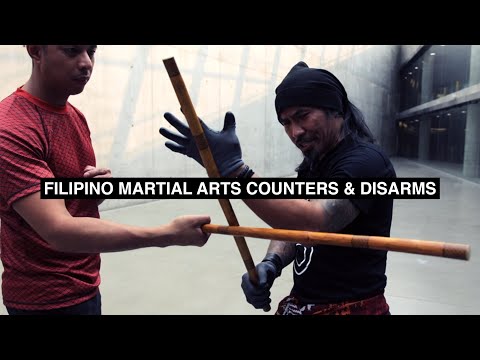
Learn More About The Filipino Martial Art Pintados: https://budobrothers.tv/pages/pintados The best defense is offense …
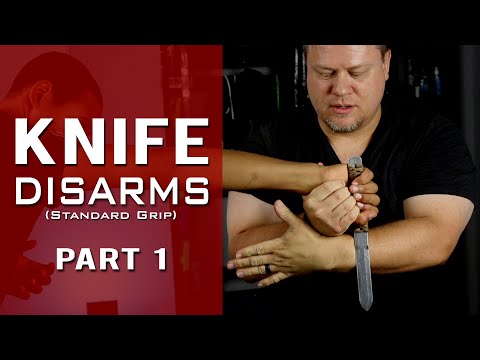
This is a comprehensive lesson on the technical method of a standard grip Knife disarm. We will explore the various type…
The standard disarma is a foundational disarming technique in Filipino martial arts applicable across multiple attack angles and weapon contexts. Budo Brothers emphasizes the importance of body mechanics and positional control, teaching that the disarm works from any of four cardinal angles—practitioners must understand their craft to recognize and exploit these entry points consistently. The technique relies on palming up the opponent's arm while maintaining control to prevent weapon withdrawal, followed by a snap motion or striking combination. Budo Brothers stresses weight transfer and footwork, noting that stepping backward while shifting body weight changes the defensive geometry. MATTI San Juan Official references the punyo (pommel) disarming variation but provides insufficient transcript detail for synthesis. Pinnacle Combat Arts (Sean Elders) extends the application to knife disarms from standard grip, detailing two primary methods: an ejection disarm achieved by striking the hand and passing the weapon away, and a peeling disarm executed by controlling the thumb and rolling the fingers down the blade to separate the weapon. Both instructors agree on the principle of controlling the weapon-bearing arm first, though Budo Brothers emphasizes universal applicability across strike angles while Pinnacle Combat Arts isolates specific directional responses. Both stress the importance of deliberate drilling before pressure testing, though Pinnacle Combat Arts more explicitly distinguishes between technical instruction and combat reality.
Synthesized from 3 instructors
No instructional courses yet for this technique.
Sign in to suggest a course.
Risk of injury to the person this technique is applied to
Arnis/Escrima/Kali stick and blade techniques; designed for close-range lethality
Skill level needed to execute this technique reliably
Whether this technique is allowed under major competition rule sets
The Filipino Martial Arts (Dan Inosanto, 1980)
Alias sources — [1] Filipino Martial Arts (Wiley, 1994) [2] Filipino Martial Arts (Wiley, 1994) [3] Filipino Martial Arts (Wiley, 1994)
Effectiveness sources — [1] Wiley, M., Filipino Martial Arts (Charles E. Tuttle, 1994) [2] Inosanto, D., The Filipino Martial Arts (Know Now Publishing, 1980)
Standard katakana transliteration of Western martial arts terminology (外来語) — used in Japanese MMA, boxing, and BJJ communities
Alias sources — [1] Filipino Martial Arts (Wiley, 1994) [2] Filipino Martial Arts (Wiley, 1994) [3] Filipino Martial Arts (Wiley, 1994)
Effectiveness sources — [1] Wiley, M., Filipino Martial Arts (Charles E. Tuttle, 1994) [2] Inosanto, D., The Filipino Martial Arts (Know Now Publishing, 1980)
wrist speed, hand coordination (especially double stick), cardiovascular endurance
quick hands, conditioned forearms, coordination
forearms, wrists, shoulders, core rotators
Run if you can. If running isn't an option, find an equalizer before attempting any technical disarm, according to Sean Elders at Pinnacle Combat Arts.
Start by using your pinky as the first contact point to peel the knife, then run your fingers down the blade while positioning your thumb on the back end of the attacker's hand. This allows you to control both the weapon and defend against countering punches, as demonstrated by Sean Elders.
You have two main options: eject the knife away from the attacker, or peel it while cutting the bicep to neutralize the threat, according to Sean Elders at Pinnacle Combat Arts.
No—these are technical pieces of a fight, not necessarily how actual combat will unfold. Understanding the technique is important, but it's one component among many in a real encounter.
The Standard Disarma executes the fundamental disarming technique by controlling the opponent's weapon hand after a block, then applying leverage with the stick or free hand to strip the weapon away. The basic method follows the sequence: block the incoming strike, check or trap the opponent's weapon hand with the live hand (free hand), and use the stick or a joint manipulation to peel the weapon free from the opponent's grip.
Standard disarma techniques are foundational skills in Filipino martial arts training, taught early in the curriculum because disarming represents one of the most decisive outcomes in weapon combat. The ability to disarm is considered a hallmark of advanced Filipino martial arts skill.
WEKAF: legal — Legal in padded stick competition; HEMA: legal — Legal in applicable weapon categories
Danger rating 8/10. Very High — Arnis/Escrima/Kali stick and blade techniques; designed for close-range lethality
The standard setup chain: Grip and Stance → Chamber → Strike → Recovery.
Standard counters include: Parry (Absetzen) — deflect the incoming blade with a counter-displacement / Void (Step Back) — withdraw from measure to avoid the cutting arc / Counter-Cut (Nachreisen) — strike into the opponent's opening during their attack.
Common variants: Angle 1 (forehand diagonal) (downward diagonal strike from the dominant side); Angle 2 (backhand diagonal) (downward diagonal strike from the off side); Angle 5 (thrust) (straight thrust with the tip of the stick); Redonda (continuous) (flowing circular strikes chaining multiple angles).
Standard FMA disarming techniques are demonstrated at FMA events and seminars worldwide.
Top errors to watch for: Placing the lever point too far from the opponent's hand — the closer to the grip, the better the mechanical advantage / Not maintaining the live-hand check on the wrist — if the wrist is free, the opponent can adjust and resist / Using a slow, grinding motion — the strip must be sharp and quick to overcome the opponent's grip before they can react / Trying to lever against the strong part of the grip (fingers side) — always work against the thumb.
The Standard Disarma is also known as Sutandādo Disaruma, Basic Disarm, Snake Disarm, Strip Technique.