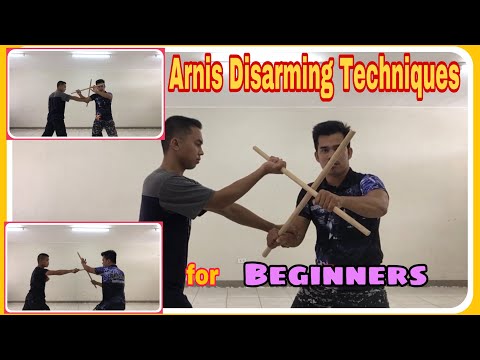
How to Disarm Arnis for Beginners
0
Disarma — Disarm·Maslee Official Vlog
Translation: disarma — disarm
The Disarma (Disarm) subfamily covers techniques designed to strip the weapon from the opponent's hand through leverage, joint manipulation, trapping, or impact to the weapon hand. [1] Disarming is a highly developed speciality of Filipino martial arts — the arts contain dozens of disarming techniques for each angle of attack, reflecting centuries of development in an environment where taking an opponent's weapon provided decisive tactical advantage. [1],[2] Disarming techniques include vine disarms (snaking the stick around the opponent's weapon hand), strip disarms (levering the weapon free), and impact disarms (striking the hand or wrist to force release). [2],[3]
Disarming techniques are among the most prized skills in Filipino martial arts, developed through centuries of weapon combat where removing an opponent's weapon effectively ended the fight. [1] The depth and variety of disarming methods in Filipino martial arts is unmatched in any other weapon-based fighting system. [2],[3]
FMA disarms strip the weapon from the opponent's hand using leverage, joint manipulation, or striking techniques, rendering the opponent unarmed. [1]
Disarming techniques are a distinctive feature of FMA, developed as practical responses to weapon-based combat in the Philippines. [1]
Disarms are demonstrated at FMA events and seminars, and are practised as a separate skill set within FMA training. [1]
No images yet for this technique.
Sign in to suggest an image.
No instructional courses yet for this technique.
Sign in to suggest a course.
Risk of injury to the person this technique is applied to
Arnis/Escrima/Kali stick and blade techniques; designed for close-range lethality
Skill level needed to execute this technique reliably
Whether this technique is allowed under major competition rule sets
The Filipino Martial Arts (Dan Inosanto, 1980)
Alias sources — [1] Filipino Martial Arts (Wiley, 1994) [2] The Filipino Martial Arts (Inosanto, 1980)
Effectiveness sources — [1] Filipino Martial Arts (Wiley, 1997)
Mixed Japanese-Western terminology — combines traditional Japanese terms with katakana loanwords
Alias sources — [1] Filipino Martial Arts (Wiley, 1994) [2] The Filipino Martial Arts (Inosanto, 1980)
Effectiveness sources — [1] Filipino Martial Arts (Wiley, 1997)
wrist speed, hand coordination (especially double stick), cardiovascular endurance
quick hands, conditioned forearms, coordination
forearms, wrists, shoulders, core rotators
Every move, in any martial art, shares a few universal traits. Mix and match below to pinpoint the right tool — or compare equivalents across styles.
The Disarma (Disarm) subfamily covers techniques designed to strip the weapon from the opponent's hand through leverage, joint manipulation, trapping, or impact to the weapon hand. Disarming is a highly developed speciality of Filipino martial arts — the arts contain dozens of disarming techniques for each angle of attack, reflecting centuries of development in an environment where taking an opponent's weapon provided decisive tactical advantage.
Disarming techniques are among the most prized skills in Filipino martial arts, developed through centuries of weapon combat where removing an opponent's weapon effectively ended the fight. The depth and variety of disarming methods in Filipino martial arts is unmatched in any other weapon-based fighting system.
WEKAF: legal — Legal in padded stick competition; HEMA: legal — Legal in applicable weapon categories
Danger rating 8/10. Very High — Arnis/Escrima/Kali stick and blade techniques; designed for close-range lethality
The standard setup chain: Grip and Stance → Chamber → Strike → Recovery.
Standard counters include: Umbrella Block — raise the stick overhead to intercept a downward strike / Cross Block — meet the incoming strike with a perpendicular block / Disarm — strip the opponent's weapon through leverage on the hand or wrist.
Common variants: Angle 1 (forehand diagonal) (downward diagonal strike from the dominant side); Angle 2 (backhand diagonal) (downward diagonal strike from the off side); Angle 5 (thrust) (straight thrust with the tip of the stick); Redonda (continuous) (flowing circular strikes chaining multiple angles).
Disarms are demonstrated at FMA events and seminars, and are practised as a separate skill set within FMA training.
Top errors to watch for: Attempting disarms without controlling the weapon arm first — the check is essential; disarming without control risks… / Using strength instead of leverage — disarms work through mechanical advantage, not brute force / Practising disarms only statically — realistic disarming requires training from live strikes, not cooperative static … / Not following through after the disarm — taking the weapon is not enough; immediately follow with a counter-strike or….
The Disarma — Disarm is also known as Disaruma / Buki-tori, Disarma, Quitar, Eskrima Disarm, Arnis Disarm.