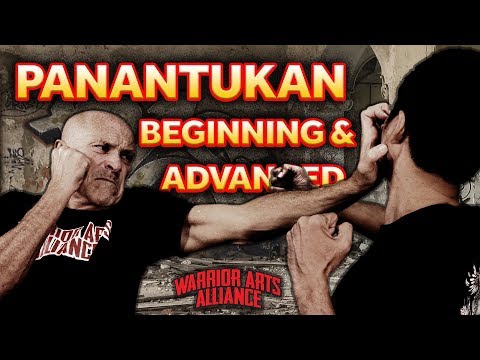
Panantukan Beginning to Advanced
0
Panantukan·Warrior Arts Alliance
Beginning Basics of Filipino Panantukan plus Advanced usage for skilled fighters. Panantukan Fundamentals to survive in …
Translation: panantukan
The Panantukan subfamily covers Filipino boxing (also called suntukan or dirty boxing), a striking system that uses the same angles of attack from stick fighting applied with the fists, forearms, elbows, and shoulders. [1] Panantukan is distinguished from Western boxing by its inclusion of limb destructions (gunting — striking the opponent's incoming limb to damage it), low-line strikes (hammer fists to the thighs, elbows to the biceps), and entry techniques that break the opponent's structure before delivering finishing strikes. [1],[2] The system emphasises close-range fighting, trapping hands, off-balancing, and the use of every part of the arm as a weapon — from the fist to the forearm to the elbow to the shoulder. [2],[3]
Panantukan evolved from the empty-hand component of Filipino martial arts, translating the angles and mechanics of stick fighting into unarmed combat. [1] The art gained modern popularity through Dan Inosanto's teaching and through its adoption by MMA fighters and self-defence systems that valued its aggressive, close-range striking methodology. [2],[3]
Panantukan (Filipino boxing) emphasises eye gouges, hammer fists, elbows, and destructions (limb attacks) alongside conventional punches, making it highly effective for close-range self-defence. [1]
Panantukan developed as the empty-hand striking component of FMA, influenced by both indigenous fighting and Western boxing introduced during American colonial rule. [1]
Panantukan is demonstrated at FMA events and its techniques appear in MMA competition through fighters with FMA training. [1]
No images yet for this technique.
Sign in to suggest an image.
Beginning Basics of Filipino Panantukan plus Advanced usage for skilled fighters. Panantukan Fundamentals to survive in …
No instructional courses yet for this technique.
Sign in to suggest a course.
Risk of injury to the person this technique is applied to
Arnis/Escrima/Kali stick and blade techniques; designed for close-range lethality
Skill level needed to execute this technique reliably
Whether this technique is allowed under major competition rule sets
Bubishi: The Classic Manual of Combat (Patrick McCarthy, 2008)
Alias sources — [1] Filipino Martial Arts (Wiley, 1994) [2] Comprehensive Asian Fighting Arts (Draeger & Smith, 1969) [3] Comprehensive Asian Fighting Arts (Draeger & Smith, 1969)
Effectiveness sources — [1] Filipino Martial Arts (Wiley, 1997)
Standard katakana transliteration of Western martial arts terminology (外来語) — used in Japanese MMA, boxing, and BJJ communities
Alias sources — [1] Filipino Martial Arts (Wiley, 1994) [2] Comprehensive Asian Fighting Arts (Draeger & Smith, 1969) [3] Comprehensive Asian Fighting Arts (Draeger & Smith, 1969)
Effectiveness sources — [1] Filipino Martial Arts (Wiley, 1997)
wrist speed, hand coordination (especially double stick), cardiovascular endurance
quick hands, conditioned forearms, coordination
forearms, wrists, shoulders, core rotators
Every move, in any martial art, shares a few universal traits. Mix and match below to pinpoint the right tool — or compare equivalents across styles.
Keep your elbow pointing to the floor when wedging with the claw. This positioning allows you to generate proper power for follow-up strikes like hooks and crosses.
After the claw wedge, follow up with your lead hook, rear cross, and finish with an inside low kick to complete the combination.
The Panantukan subfamily covers Filipino boxing (also called suntukan or dirty boxing), a striking system that uses the same angles of attack from stick fighting applied with the fists, forearms, elbows, and shoulders. Panantukan is distinguished from Western boxing by its inclusion of limb destructions (gunting — striking the opponent's incoming limb to damage it), low-line strikes (hammer fists to the thighs, elbows to the biceps), and entry techniques that break the opponent's structure before delivering finishing strikes.
Panantukan evolved from the empty-hand component of Filipino martial arts, translating the angles and mechanics of stick fighting into unarmed combat. The art gained modern popularity through Dan Inosanto's teaching and through its adoption by MMA fighters and self-defence systems that valued its aggressive, close-range striking methodology.
WEKAF: legal — Legal in padded stick competition; HEMA: legal — Legal in applicable weapon categories
Danger rating 8/10. Very High — Arnis/Escrima/Kali stick and blade techniques; designed for close-range lethality
The standard setup chain: Grip and Stance → Chamber → Strike → Recovery.
Standard counters include: Umbrella Block — raise the stick overhead to intercept a downward strike / Cross Block — meet the incoming strike with a perpendicular block / Disarm — strip the opponent's weapon through leverage on the hand or wrist.
Common variants: Angle 1 (forehand diagonal) (downward diagonal strike from the dominant side); Angle 2 (backhand diagonal) (downward diagonal strike from the off side); Angle 5 (thrust) (straight thrust with the tip of the stick); Redonda (continuous) (flowing circular strikes chaining multiple angles).
Panantukan is demonstrated at FMA events and its techniques appear in MMA competition through fighters with FMA training.
Top errors to watch for: Fighting like a Western boxer — panantukan has distinct mechanics and strategies; it is not boxing with different rules / Not using gunting (limb destructions) — without gunting, panantukan loses its primary tactical advantage / Ignoring trapping — trapping is essential to panantukan; without it, the system becomes incomplete / Staying at boxing range — panantukan works at trapping range, closer than standard boxing distance.
The Panantukan is also known as Panantukan, Filipino Boxing, Suntukan, Dirty Boxing — FMA.