TSV - Stand - und Bodentechniken im Ringen
0
Standard German Suplex·TSV Falkensee
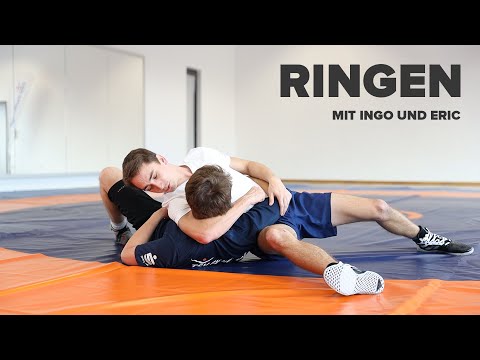
Hier kommt das zweite Video zum Thema Ringen. Beim letzten Mal haben wir euch einen kurzen Einblick in eine ringertypisc…
Translation: standard German suplex
Standard German Suplex is the classical rear waist lock suplex in which the wrestler secures a locked-hands grip around the opponent's waist from behind, lifts the opponent by extending the hips and legs, arches backward in a full bridge, and throws the opponent over their head to land on the mat behind them. [1],[2] The throw requires exceptional bridging strength and timing to prevent the opponent from blocking the lift by widening their base. [2],[3]
The German suplex is one of the most decisive throws in Greco-Roman wrestling, scoring maximum points (5) for a high-amplitude throw that exposes the opponent's back to the mat. [1] The explosive backward arch generates tremendous force, making it one of the most spectacular and effective techniques in wrestling. [2]
The German suplex (Rückwurf) originated in European Greco-Roman wrestling traditions, particularly in Germany and Scandinavia, where it was developed as a signature high-amplitude technique. [1] The technique was refined by Soviet and Eastern European wrestling programs during the 20th century into one of the most feared attacks in international competition. [2]
Alexander Karelin (RUS) made the suplex his signature technique, using it to win three consecutive Olympic gold medals (1988, 1992, 1996) and nine World Championship titles in Greco-Roman wrestling at 130 kg. [1] Karelin's reverse body lift suplex, where he lifted opponents weighing over 130 kg from the mat, became one of the most iconic moves in wrestling history. [2]
No images yet for this technique.
Sign in to suggest an image.
Hier kommt das zweite Video zum Thema Ringen. Beim letzten Mal haben wir euch einen kurzen Einblick in eine ringertypisc…
Here are 5 minutes of amazing greco-roman wrestling throws! Chek out the best throws by Victor Ciobanu, Zholaman Sharshe…
The provided transcripts offer insufficient instructional content to synthesize coherent technical guidance on the standard German suplex. United World Wrestling's transcript consists primarily of match commentary with musical interludes, capturing competitive execution during a Greco-Roman wrestling bout but providing no technical breakdown, setup details, or methodological instruction. The transcript references a throw executed in live competition without explaining mechanics, grip placement, hip positioning, or entry techniques. TSV Falkensee's transcript appears to be corrupted or poorly transcribed, consisting entirely of repetitive placeholder text with no discernible technical information. Neither source provides explicit instruction on stance, footwork, arm position, timing, or common variations of the German suplex. To properly document this technique at the genus level, instructional videos with clear technical exposition—including demonstrated setup, step-by-step execution, weight distribution, and safety considerations—would be required.
Synthesized from 2 instructors
No instructional courses yet for this technique.
Sign in to suggest a course.
Risk of injury to the person this technique is applied to
High-amplitude backward arch throw; severe head/neck injury risk (UWW injury data)
Skill level needed to execute this technique reliably
Whether this technique is allowed under major competition rule sets
Japanese pro wrestling (プロレス) terminology; Japanese amateur wrestling terminology
Japanese pro wrestling (プロレス) terminology; Japanese amateur wrestling terminology
Standard katakana transliteration of Western martial arts terminology (外来語) — used in Japanese MMA, boxing, and BJJ communities
Standard Japanese pro wrestling terminology
hip rotation speed, core strength, lower back stability
strong hips and core, good flexibility for turning entry
hip rotators, core, quadriceps, latissimus dorsi
Standard German Suplex is the classical rear waist lock suplex in which the wrestler secures a locked-hands grip around the opponent's waist from behind, lifts the opponent by extending the hips and legs, arches backward in a full bridge, and throws the opponent over their head to land on the mat behind them. The throw requires exceptional bridging strength and timing to prevent the opponent from blocking the lift by widening their base.
The standard German suplex has been a fundamental technique in Greco-Roman wrestling since the early 20th century and remains one of the most widely taught suplex variations in wrestling programs worldwide.
IJF: legal — Legal throwing technique; IBJJF: banned — Suplex throws prohibited — throwing opponent backwards onto head/neck; UWW: legal — Legal in both freestyle and Greco-Roman; Unified MMA: legal — Legal throwing technique; ADCC: legal — Legal; FIAS Sport Sambo: legal — Legal; FIAS Combat Sambo: legal — Legal
Danger rating 8/10. Very High — high-amplitude backward arch throw; severe head/neck injury risk (UWW injury data)
The standard setup chain: Grip Setup (Kumi-kata) → Off-Balance (Kuzushi) → Entry (Tsukuri) → Execution (Kake).
Standard counters include: Lower Centre of Gravity — bend knees and drop hips to make the throw harder to execute / Block the Hip — post hand on the thrower's hip to prevent loading / Step Around — circle away from the throw direction to avoid being loaded / Grip Break — deny the thrower their preferred gripping configuration.
Common variants: Standard hip throw (full turn-in with hip below the opponent's centre of gravity); No-gi hip throw (adapted without gi grips, using overhook and collar tie); Drop hip throw (dropping to one knee to lower the fulcrum point); Combination hip throw (chaining from a failed foot technique or hand technique).
Alexander Karelin (RUS) made the suplex his signature technique, using it to win three consecutive Olympic gold medals (1988, 1992, 1996) and nine World Championship titles in Greco-Roman wrestling at 130 kg. Karelin's reverse body lift suplex, where he lifted opponents weighing over 130 kg from the mat, became one of the most iconic moves in wrestling history.
Top errors to watch for: Clasping hands with interlaced fingers — they break under load; use a Gable grip / Not getting the hips low enough before popping — the upward drive requires a low starting position / Arching without the rotation — straight-back landing is dangerous for the opponent's head and neck / Lifting with the back instead of popping the hips — the hip thrust is the power source.
The Standard German Suplex is also known as Jāman Sūpurekkusu, Classical German Suplex, Standard Rear Waist Lock Suplex, Back Arch Suplex.