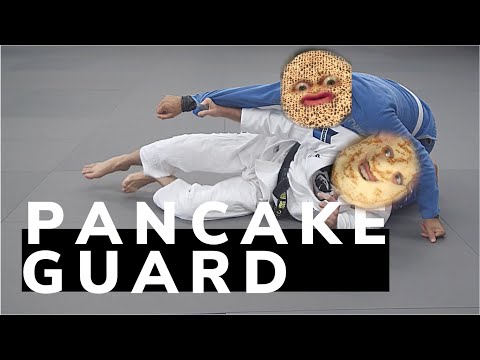
Introduction To Pancake Guard - A Minimal Effort Guard Retention Trick.
0
Standard Pancake·Keenan Cornelius·Added by Admin
An ancient relic of American Jiu-jitsu, The Pancake Guard was invented by Jimmy Harbison and utilized heavily by https:/…
Translation: standard pancake
Standard Pancake is the conventional execution in which the wrestler secures a headlock or front headlock, drives forward and downward with their chest pressure and arm control, and flattens the opponent directly to the mat face-down, ending in a top controlling position. [1],[2] The technique relies on superior pressure, positioning, and timing rather than the rotational mechanics used in full headlock throws. [2],[3]
The standard pancake is the fundamental version of this flattening technique. [1]
The pancake (also called pancake throw or pancake pin) is a technique primarily associated with American collegiate (folkstyle) wrestling, where it is used to flatten an opponent from the clinch position. [1]
Commonly used in NCAA folkstyle competition. [1]
No images yet for this technique.
Sign in to suggest an image.
An ancient relic of American Jiu-jitsu, The Pancake Guard was invented by Jimmy Harbison and utilized heavily by https:/…
No instructional courses yet for this technique.
Sign in to suggest a course.
Risk of injury to the person this technique is applied to
Headlock position adds neck strain risk; moderate throw amplitude
Skill level needed to execute this technique reliably
Whether this technique is allowed under major competition rule sets
Japanese amateur wrestling terminology
Japanese amateur wrestling terminology
Standard katakana transliteration of Western martial arts terminology (外来語) — used in Japanese MMA, boxing, and BJJ communities
Standard katakana transliteration used in Japanese wrestling (レスリング)
coordination, grip strength, hip and core power, balance
athletic build with strong hips and good proprioception
core, hips, legs, grip/forearms
According to Keenan Cornelius, you want to grip the correct lapel—not the top grip, which has too much give and doesn't help you pull yourself into your opponent. Instead, bring your hand on the inside and place it over your own wrist for better control.
Keenan Cornelius explains that it's called pancake guard because you end up fully pancaked out—flattened against your opponent with your arm brought up over your head.
Standard Pancake is the conventional execution in which the wrestler secures a headlock or front headlock, drives forward and downward with their chest pressure and arm control, and flattens the opponent directly to the mat face-down, ending in a top controlling position. The technique relies on superior pressure, positioning, and timing rather than the rotational mechanics used in full headlock throws.
The standard pancake has been a staple of American folkstyle wrestling technique for decades, commonly taught as a high-percentage finishing move from front headlock and snap-down positions.
IJF: legal — Legal throwing technique; IBJJF: legal — Legal at all belt levels; UWW: legal — Legal in both freestyle and Greco-Roman; Unified MMA: legal — Legal throwing technique; ADCC: legal — Legal; FIAS Sport Sambo: legal — Legal; FIAS Combat Sambo: legal — Legal
Danger rating 5/10. High — headlock position adds neck strain risk; moderate throw amplitude
The standard setup chain: Grip Setup (Kumi-kata) → Off-Balance (Kuzushi) → Entry (Tsukuri) → Execution (Kake).
Standard counters include: Lower Centre of Gravity — bend knees and drop hips to make the throw harder to execute / Grip Break — deny the thrower their preferred gripping configuration / Stiff-Arm — maintain distance with straight arms to prevent the entry.
Common variants: Standard technique (primary execution from standard grip and positioning); No-gi adaptation (modified without gi grips for submission grappling or MMA); Combination entry (entering from a failed attack or chain of techniques); Counter throw (applied as a direct counter to the opponent's throw or at…).
Commonly used in NCAA folkstyle competition.
Top errors to watch for: Not sprawling the legs — your hips must be low and heavy on the opponent / Trying to push the opponent flat with arms only — your body weight does the work / Not controlling both the head and the near arm — the opponent posts and resists / Driving down without driving forward — you need both directions simultaneously.
The Standard Pancake is also known as Pankēki, Classical Pancake, Standard Pancake Throw, Basic Pancake.