Manipulations in Sticky Boxing / Clinch #kungfu #shuaijiao #sanda #mma
0
Clinch Sanda Throw·The Wandering Warrior
Shuaijiao jacket +Sanda 跤衣散打 Dec2022 These kinesthetic skills for Contact 粘 Stick 黏 and Adhere 貼 from Praying Mantis B…
Translation: Sanda clinch throw
Clinch Sanda Throw encompasses the throwing techniques executed from the clinch position in sanda competition, where fighters close distance from striking range and use body locks, collar ties, underhooks, and overhooks to execute throws. [1],[2] These throws resemble Greco-Roman wrestling and judo clinch techniques but are adapted to the sanda scoring system, which awards points based on throwing amplitude and the thrower remaining standing. [2],[3] Common clinch sanda throws include hip throws, body-lock lifts, and trip-and-sweep combinations executed while both fighters are locked in close-range grappling. [3]
Clinch sanda throws execute takedowns from the standing clinch, using Muay Thai-influenced clinch control combined with wrestling and shuai jiao techniques. [1]
Clinch throws in sanda developed from the integration of shuai jiao wrestling with standing clinch work in Chinese military combatives. [1]
Clinch throws are frequently used in sanda competition under IWuF rules. [1]
No images yet for this technique.
Sign in to suggest an image.
Shuaijiao jacket +Sanda 跤衣散打 Dec2022 These kinesthetic skills for Contact 粘 Stick 黏 and Adhere 貼 from Praying Mantis B…
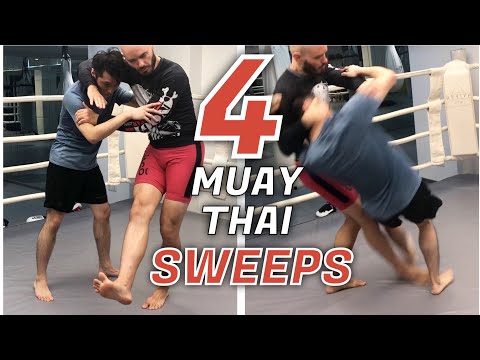
4 outside foot sweeps from the clinch for Muay Thai, sanda, and MMA fighting. Shanghai based MMA Coach and Kunlun Fight…
Clinch Sanda throws represent a family of takedown techniques executed from close-range clinch positions, unifying control principles derived from Chinese wrestling (shuai jiao), Mongolian grappling, and striking-to-clinch continua. The defining strategic context is the transition from striking range into dominance at close quarters, where upper-body control—particularly head and posture manipulation—becomes the primary driver of the technique rather than isolated limb mechanics. The Wandering Warrior emphasizes how clinch dominance stems from integrated praying mantis footwork, wrestling positioning, and sensitivity-based arm control, allowing a fighter to neutralize incoming strikes while building mechanical advantage for throws. Ramsey Dewey's four-sweep breakdown isolates the rotational principle common across variants: three of four sweeps rely on head control and upper-body rotation to unbalance the opponent, with the actual foot placement serving as a blocking mechanism rather than the power source. Both instructors stress that strategic selection among clinch-sanda variants hinges on the opponent's defensive posture, available limbs (head-and-arm control vs. collar-tie position), and whether the opponent initiates a knee strike or escape attempt—each triggering different sweep angles and rotational mechanics. The family is characterized by close-range pressure, posture-breaking control, and the conversion of defensive reactions into throwing opportunities.
Synthesized from 2 instructors
No instructional courses yet for this technique.
Sign in to suggest a course.
Risk of injury to the person this technique is applied to
Sanda/Sanshou throws emphasize speed and catching strikes into throws
Skill level needed to execute this technique reliably
Whether this technique is allowed under major competition rule sets
Japanese Sanda/Sanshou terminology
Japanese Sanda/Sanshou terminology
Original Chinese martial arts term used in Japanese context
Katakana transliteration used in Japanese Sanda (散打)
hip rotation speed, core strength, lower back stability
strong hips and core, good flexibility for turning entry
hip rotators, core, quadriceps, latissimus dorsi
Every move, in any martial art, shares a few universal traits. Mix and match below to pinpoint the right tool — or compare equivalents across styles.
The sweeping foot acts primarily to block your opponent's foot so they cannot step and balance themselves, making them vulnerable to the throw.
When your opponent throws a knee in response to your knee strike, catch it with your bicep on that side, which gives you control to execute the throw.
The clinch Sanda throw can be used as a counter when your opponent has a tight collar tie, allowing you to take them down despite their grip.
Clinch Sanda Throw encompasses the throwing techniques executed from the clinch position in sanda competition, where fighters close distance from striking range and use body locks, collar ties, underhooks, and overhooks to execute throws. These throws resemble Greco-Roman wrestling and judo clinch techniques but are adapted to the sanda scoring system, which awards points based on throwing amplitude and the thrower remaining standing.
Clinch throwing in sanda draws from the Chinese wrestling tradition of shuai jiao, where jacket-grip clinch fighting is the primary competitive format, adapted for the no-jacket environment of modern sanda.
IJF: legal — Legal throwing technique; IBJJF: legal — Legal at all belt levels; UWW: legal — Legal in both freestyle and Greco-Roman; Unified MMA: legal — Legal throwing technique; ADCC: legal — Legal; FIAS Sport Sambo: legal — Legal; FIAS Combat Sambo: legal — Legal
Danger rating 6/10. High — Sanda/Sanshou throws emphasize speed and catching strikes into throws
The standard setup chain: Grip Setup (Kumi-kata) → Off-Balance (Kuzushi) → Entry (Tsukuri) → Execution (Kake).
Standard counters include: Lower Centre of Gravity — bend knees and drop hips to make the throw harder to execute / Block the Hip — post hand on the thrower's hip to prevent loading / Step Around — circle away from the throw direction to avoid being loaded / Grip Break — deny the thrower their preferred gripping configuration.
Common variants: Standard hip throw (full turn-in with hip below the opponent's centre of gravity); No-gi hip throw (adapted without gi grips, using overhook and collar tie); Drop hip throw (dropping to one knee to lower the fulcrum point); Combination hip throw (chaining from a failed foot technique or hand technique).
Clinch throws are frequently used in sanda competition under IWuF rules.
Top errors to watch for: Staying in the clinch too long — sanda referees break within seconds; throw immediately or exit / Trying to execute judo-style throws with boxing gloves — the grip mechanics are completely different / Not setting up the clinch with strikes — walking into the clinch without a punch setup gets you hit / Attempting throws that require sleeve or collar grips — you're wearing gloves, not a gi.
The Clinch Sanda Throw is also known as Sanda Kurinchi Nage, Sanda Clinch Throw, Sǎn Dǎ Shuāi Fǎ (散打摔法), Sanshou Throw.