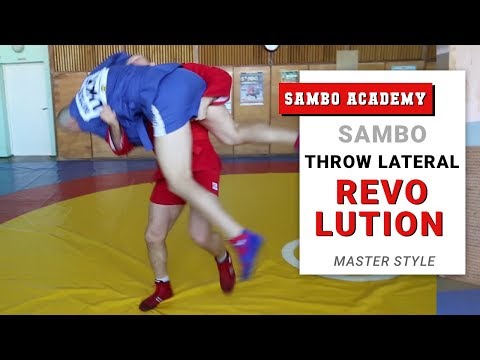
Throw lateral revolution (Te-Guruma) for everyone \ sambo academy
0
Standard Sambo Throw·IVAN VASYLCHUK. SILA PARTERA
Lateral revolution in judo Te-Guruma. Different gyms call call this throw different names. https://goo.gl/fgFSqG - Тhro…
Translation: standard Sambo throw
Standard Sambo Throw represents the core throwing techniques taught as fundamental sambo curriculum, including hip throws with belt grip, leg-grab takedowns, and sacrifice throws adapted for the sambo kurtka. [1],[2] These throws are characterised by their pragmatic approach — sambo athletes are trained to grip wherever possible and to transition seamlessly between throwing, leg attacks, and ground submissions. [2],[3] The standard sambo throwing repertoire prioritises explosive entry, tight body control, and high-amplitude finishes. [3]
Standard sambo throws are the baseline throwing techniques taught in sambo curricula, combining judo nage-waza with wrestling and folk wrestling methods. [1]
Standard sambo throws derive from the systematisation work of Oshchepkov and Spiridonov in the Soviet Union. [1]
Standard sambo throws are scored in FIAS competition at all levels. [1]
No images yet for this technique.
Sign in to suggest an image.
Lateral revolution in judo Te-Guruma. Different gyms call call this throw different names. https://goo.gl/fgFSqG - Тhro…
No instructional courses yet for this technique.
Sign in to suggest a course.
Risk of injury to the person this technique is applied to
Sambo throws combine judo and wrestling mechanics (Kolychev 1988)
Skill level needed to execute this technique reliably
Whether this technique is allowed under major competition rule sets
Japanese Sambo Federation terminology
Japanese Sambo Federation terminology
Mixed Japanese-Western terminology — combines traditional Japanese terms with katakana loanwords
Katakana transliteration used in Japanese Sambo (サンボ)
hip rotation speed, core strength, lower back stability
strong hips and core, good flexibility for turning entry
hip rotators, core, quadriceps, latissimus dorsi
Every move, in any martial art, shares a few universal traits. Mix and match below to pinpoint the right tool — or compare equivalents across styles.
You must duck under your opponent's arm—this is critical because if their arm is positioned high, you won't be able to get underneath. Ivan Vasylchuk emphasizes that you can control the arm by propping it down or controlling the wrist before ducking in.
Your feet should be positioned between your opponent's legs, and when you duck under, step in with your near leg—not your far leg, which creates multiple counters. Ivan Vasylchuk stresses that stepping with the wrong leg often results in being caught with a grape pine throw.
Your hand should go deep, and the opponent's leg should be placed in the crook of your bicep where their leg ends, giving you a better lever when you lift. This positioning is key to executing the throw with proper mechanical advantage.
Synchronize your arms, legs, and body in one quick, precise motion rather than separating the movement into multiple phases. Ivan Vasylchuk describes the sequence as: lift with your grip, step in, pop your hip to lay the opponent on it, and dump them over.
Standard Sambo Throw represents the core throwing techniques taught as fundamental sambo curriculum, including hip throws with belt grip, leg-grab takedowns, and sacrifice throws adapted for the sambo kurtka. These throws are characterised by their pragmatic approach — sambo athletes are trained to grip wherever possible and to transition seamlessly between throwing, leg attacks, and ground submissions.
The standard sambo throwing curriculum was established in Soviet military and athletic institutions during the 1930s and 1940s, drawing on the combined expertise of judo-trained and folk-wrestling-trained coaches.
IJF: legal — Legal throwing technique; IBJJF: legal — Legal at all belt levels; UWW: legal — Legal in both freestyle and Greco-Roman; Unified MMA: legal — Legal throwing technique; ADCC: legal — Legal; FIAS Sport Sambo: legal — Legal; FIAS Combat Sambo: legal — Legal
Danger rating 6/10. High — Sambo throws combine judo and wrestling mechanics (Kolychev 1988)
The standard setup chain: Grip Setup (Kumi-kata) → Off-Balance (Kuzushi) → Entry (Tsukuri) → Execution (Kake) → Fall (Sutemi).
Standard counters include: Lower Centre of Gravity — bend knees and drop hips to make the throw harder to execute / Block the Hip — post hand on the thrower's hip to prevent loading / Step Around — circle away from the throw direction to avoid being loaded / Grip Break — deny the thrower their preferred gripping configuration.
Common variants: Standard hip throw (full turn-in with hip below the opponent's centre of gravity); No-gi hip throw (adapted without gi grips, using overhook and collar tie); Drop hip throw (dropping to one knee to lower the fulcrum point); Combination hip throw (chaining from a failed foot technique or hand technique).
Standard sambo throws are scored in FIAS competition at all levels.
Top errors to watch for: Using only one grip configuration — sambo allows and encourages switching between multiple grip styles / Attempting throws from a static position — sambo rewards movement and dynamic entries / Not using the kurtka's shorter sleeves effectively — grip the cuff or wrist area, not mid-forearm / Ignoring leg-grab combinations — sambo's bread-and-butter is combining upper control with lower-body attacks.
The Standard Sambo Throw is also known as Sanbo Nage-waza, Sambo Brosok (самбо бросок), Standard Combat Sambo Throw, FIAS Throw.