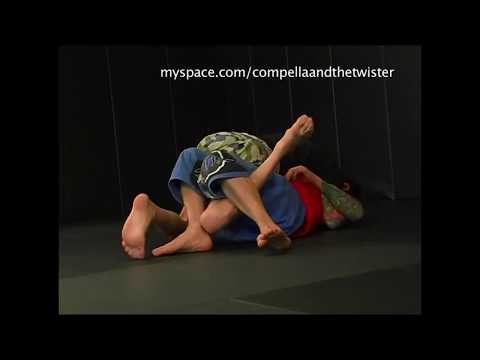
The Godfather Sweep
0
The Godfather Sweep·Apotheke
Translation: The Godfather sweep — named in Eddie Bravo's pop-culture naming style, referencing the 'offer you can't refuse' quality of the sweep when the opponent achieves double underhooks from inside the guard
The Godfather Sweep is a 10th Planet Jiu-Jitsu technique executed from The Stomp Position — a specific guard configuration entered when the opponent achieves double underhooks from inside the practitioner's closed or half guard. [1] When an opponent secures double underhooks from inside the guard, conventional BJJ wisdom considers this a critical defensive failure for the guard player: double underhooks give the top player enormous passing leverage and control. [1] The Godfather Sweep turns this apparent disaster into an offensive opportunity: from The Stomp Position, the bottom player uses a hip bump combined with a leg hook on the opponent's far leg to roll them over the top, sweeping to dominant side control position. [1] The name 'Godfather' — consistent with Eddie Bravo's pop-culture naming convention — references the idea that the sweep is an 'offer the opponent can't refuse': they thought they achieved a dominant double-underhook position, but the sweep makes them regret it. [1] The mechanical execution uses the opponent's commitment against them: when the top player has double underhooks, their weight is driven forward into the guard player's chest (to flatten them for the pass). [1] The Godfather exploits this forward weight commitment by redirecting it laterally — the hip bump lifts the opponent's centre of gravity while the far-leg hook removes their base on one side, and their own forward pressure tips them over the pivot point. [1] This 'using the opponent's pressure against them' principle is central to the 10th Planet Jiu-Jitsu system, which consistently develops techniques that convert the opponent's strong positions into the attacker's offensive opportunities. [1]
The Godfather Sweep was developed by Eddie Bravo as part of the 10th Planet Jiu-Jitsu system, specifically as the offensive solution to the 'failed double underhooks' problem — one of the most common emergency situations in no-gi grappling. [1] The technique is documented in Mastering the Rubber Guard (2006) as part of the 'Failed Double Underhooks' section, which includes The Stomp, Super Stomp, New Stomp, and The Godfather as a family of techniques for converting the opponent's double underhooks from a passing advantage into a sweeping opportunity. [1] The technique reflects Bravo's broader philosophy of converting defensive situations into offensive opportunities: rather than simply trying to prevent the pass (a reactive, defensive mindset), the system encourages the guard player to ALLOW certain opponent actions that create predictable sweeping and submission opportunities. [1]
The Godfather Sweep is highly effective because it exploits a universal grappling truth: double underhooks from inside the guard commit both of the top player's arms under the body, removing their ability to post against lateral sweeps. [1] This makes the sweep reliable against opponents who aggressively drive for double underhooks — the stronger they commit, the more easily they are swept, creating a paradox where the opponent's best passing position becomes their worst sweeping vulnerability. [1] In EBI and ADCC competition, the concept of weaponising the bottom player's response to double underhooks has gained traction beyond the 10th Planet system, with grapplers from various backgrounds adopting similar strategies. [1] In MMA, double underhooks are one of the most common grappling grips, making the Godfather situation frequent and the sweep high-percentage when drilled. [1]
Eddie Bravo → 10th Planet Jiu-Jitsu → The Stomp family of techniques → The Godfather Sweep documented in Mastering the Rubber Guard (2006) → core guard recovery/sweep technique for 10th Planet practitioners worldwide. [1]
Used in EBI (Eddie Bravo Invitational) and ADCC competition by 10th Planet practitioners. The concept of weaponising double underhooks from bottom guard has influenced modern no-gi grappling competition broadly. In MMA, sweeps from double-underhook situations (functionally similar to the Godfather) are common in UFC competition.
No images yet for this technique.
Sign in to suggest an image.
No instructional courses yet for this technique.
Sign in to suggest a course.
Risk of injury to the person this technique is applied to
The Godfather Sweep is a positional reversal with minimal injury risk to either participant. The opponent is rolled to their back, not struck or submitted.
Skill level needed to execute this technique reliably
Whether this technique is allowed under major competition rule sets
Mastering the Rubber Guard (Bravo, 2006)
description: [1] Bravo 2006 Failed Double Underhooks section
Standard katakana transliteration of Western martial arts terminology (外来語) — used in Japanese MMA, boxing, and BJJ communities
description: [1] Bravo 2006 Failed Double Underhooks section
Explosive hip bridge (glutes and hamstrings) for the bump
Leg dexterity for hooking the opponent's far leg while maintaining guard structure
Core strength for the rolling motion
Does NOT require rubber guard flexibility (the Godfather operates from The Stomp Position, not from high guard)
Accessible to practitioners who cannot execute rubber guard techniques due to hip flexibility limitations
The Godfather Sweep is a named sweep technique — likely from the 10th Planet system or a specific instructor's curriculum. Named sweeps carry their creator's identity. (BJJ instructional lineage)
The Godfather Sweep is a 10th Planet Jiu-Jitsu technique executed from The Stomp Position — a specific guard configuration entered when the opponent achieves double underhooks from inside the practitioner's closed or half guard. When an opponent secures double underhooks from inside the guard, conventional BJJ wisdom considers this a critical defensive failure for the guard player: double underhooks give the top player enormous passing leverage and control.
The Godfather Sweep was developed by Eddie Bravo as part of the 10th Planet Jiu-Jitsu system, specifically as the offensive solution to the 'failed double underhooks' problem — one of the most common emergency situations in no-gi grappling. The technique is documented in Mastering the Rubber Guard (2006) as part of the 'Failed Double Underhooks' section, which includes The Stomp, Super Stomp, New Stomp, and The Godfather as a family of techniques for converting the opponent's double underhooks from a passing advantage into a sweeping opportunity.
IJF: legal — Legal throwing technique; IBJJF: legal — Legal at all belt levels; UWW: restricted — Legal in freestyle, banned in Greco-Roman (no leg attacks below waist); Unified MMA: legal — Legal throwing technique; ADCC: legal — Legal; FIAS Sport Sambo: legal — Legal; FIAS Combat Sambo: legal — Legal
Danger rating 2/10. The Godfather Sweep is a positional reversal with minimal injury risk to either participant. The opponent is rolled to their back, not struck or submitted.
The standard setup chain: Opponent achieves double underhooks from inside guard → Rather than panicking, transition to The Stomp Position (specific guard recovery configuration) → Hook the opponent's far leg with your outside foot (instep behind their knee) → Wait for the opponent to drive their weight forward (which they will, because double underhooks encourage forward pressure) → EXPLOSIVE hip bump upward and toward the hooked-leg side → Opponent's forward pressure + your bump + their removed base = they roll diagonally over their baselessly side → Follow the roll to top position → Establish side control or mount → If the sweep is defended → transition to Super Stomp or New Stomp alternatives.
Standard counters include: Remove the far-leg hook — if the bottom player hooks the far leg, immediately retract it to deny the sweep's base-rem… / Backstep — stepping backward during the hip bump creates distance and prevents the roll / Post with the head — if the hands are committed to double underhooks, pressing the forehead to the mat provides a thi… / Release one underhook — sacrificing one underhook to post with a hand prevents the sweep (but also abandons the doubl….
Common variants: Standard Godfather (hip bump with far-leg hook, sweeping to side control); Godfather to mount (continuing the roll past side control directly to mount); Godfather to back take (if the opponent turns away during the sweep, following to…); Godfather from half guard (using the lockdown to control the near leg while hooking …); Quick Godfather (a shortened version using a small hip bump for opponents …).
Used in EBI (Eddie Bravo Invitational) and ADCC competition by 10th Planet practitioners. The concept of weaponising double underhooks from bottom guard has influenced modern no-gi grappling competition broadly.
Top errors to watch for: No far-leg hook — attempting the sweep without hooking the opponent's far leg allows them to post and resist; the hoo… / Gradual hip bump — a slow, gradual lift gives the opponent time to adjust; the bump must be explosive / Bumping straight up instead of diagonally — the hip bump must have a lateral component (toward the hooked-leg side); … / Not controlling the upper body during the roll — releasing the opponent during the sweep allows them to scramble rath….
The The Godfather Sweep is also known as Goddofāzā Suīpu, Godfather, Stomp Sweep, Failed Double Underhook Sweep, Double Under Recovery Sweep.