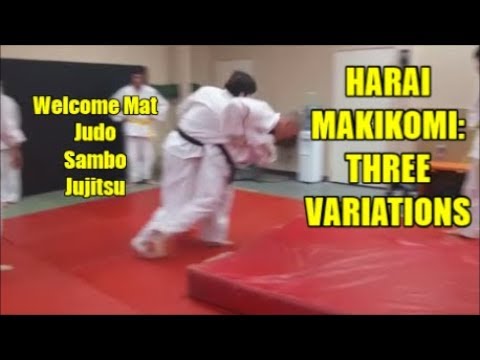
HARAI MAKIKOMI THREE VARIATIONS
0
Harai Makikomi·welcomematstevescott
Harai Makikomi (Sweeping Winding Throw) is a powerful and popular throwing technique. In this video, we show three appli…
Translation: sweeping wraparound
Harai Makikomi is a rolling sacrifice variation of harai goshi (sweeping hip throw) in which tori executes the sweeping hip action but continues to roll through, wrapping uke tightly and using tori's entire body weight to drive the throw to completion. [1],[2] The winding motion of tori's arm traps uke's upper body, and the combined sweeping leg action with the rolling momentum produces a devastating, high-amplitude throw. [2],[3] Harai makikomi is classified as a yoko sutemi waza in some references due to the lateral rolling finish. [3]
Harai makikomi is part of the Kodokan judo yoko-sutemi-waza syllabus. [1]
Harai makikomi is a high-frequency technique in IJF competition, particularly in middle and heavy weight categories. [1]
No images yet for this technique.
Sign in to suggest an image.
Harai Makikomi (Sweeping Winding Throw) is a powerful and popular throwing technique. In this video, we show three appli…
No instructional courses yet for this technique.
Sign in to suggest a course.
Risk of injury to the person this technique is applied to
Rolling sacrifice adds rotational momentum; uncontrolled landing risk
Skill level needed to execute this technique reliably
Whether this technique is allowed under major competition rule sets
Kodokan Judo — Official Nage-waza Classification
Traditional Judo throwing technique terminology (Kodokan Institute)
Official Kodokan ground technique classification system
Standard Japanese martial arts terminology (kanji/hiragana)
Established Japanese martial arts naming convention — native Japanese term (和語/漢語)
Traditional Judo throwing technique terminology (Kodokan Institute)
hip rotation speed, core strength, lower back stability
strong hips and core, good flexibility for turning entry
hip rotators, core, quadriceps, latissimus dorsi
Every move, in any martial art, shares a few universal traits. Mix and match below to pinpoint the right tool — or compare equivalents across styles.
According to Steve Scott, a weak grip is where a lot of guys lose the throw—you need to maintain solid control rather than letting your grip slip during the technique.
Steve Scott explains that as soon as you crush the grip in, turn your hips and execute the throw—the timing of the hip rotation combined with the grip pressure is what makes the technique work effectively.
Yes, Steve Scott demonstrates a variation where instead of maintaining an arm grip, you crush the shoulder and come down hard on it, then switch and lead with your hips to break balance—the fundamental mechanics stay the same even without the continuous arm grip.
Harai Makikomi is a rolling sacrifice variation of harai goshi (sweeping hip throw) in which tori executes the sweeping hip action but continues to roll through, wrapping uke tightly and using tori's entire body weight to drive the throw to completion. The winding motion of tori's arm traps uke's upper body, and the combined sweeping leg action with the rolling momentum produces a devastating, high-amplitude throw.
Harai makikomi evolved as a power variation of harai goshi, developed by judoka who found that committing their full body weight through a roll made the throw nearly impossible to block. The technique became a staple of heavyweight judo competitors from the 1960s onward.
IJF: legal — Legal throwing technique; IBJJF: legal — Legal at all belt levels; UWW: legal — Legal in both freestyle and Greco-Roman; Unified MMA: legal — Legal throwing technique; ADCC: legal — Legal; FIAS Sport Sambo: legal — Legal; FIAS Combat Sambo: legal — Legal
Danger rating 6/10. High — rolling sacrifice adds rotational momentum; uncontrolled landing risk
The standard setup chain: Grip Setup (Kumi-kata) → Off-Balance (Kuzushi) → Entry (Tsukuri) → Execution (Kake) → Fall (Sutemi).
Standard counters include: Lower Centre of Gravity — bend knees and drop hips to make the throw harder to execute / Block the Hip — post hand on the thrower's hip to prevent loading / Step Around — circle away from the throw direction to avoid being loaded / Grip Break — deny the thrower their preferred gripping configuration.
Common variants: Standard hip throw (full turn-in with hip below the opponent's centre of gravity); No-gi hip throw (adapted without gi grips, using overhook and collar tie); Drop hip throw (dropping to one knee to lower the fulcrum point); Combination hip throw (chaining from a failed foot technique or hand technique).
Harai makikomi is a high-frequency technique in IJF competition, particularly in middle and heavy weight categories.
Top errors to watch for: Abandoning the leg sweep when initiating the roll — both the sweep and the roll must continue simultaneously / Not wrapping uke's arm — without the arm trap, uke can post and prevent the throw / Rolling sideways instead of diagonally forward — the rolling direction follows the original harai goshi line / Hesitating between harai goshi and the makikomi transition — it must be seamless.
The Harai Makikomi is also known as Sweeping Winding Throw, Hip Sweep Wrap-Around, Harai Makikomi, Sweeping Rolling Throw.