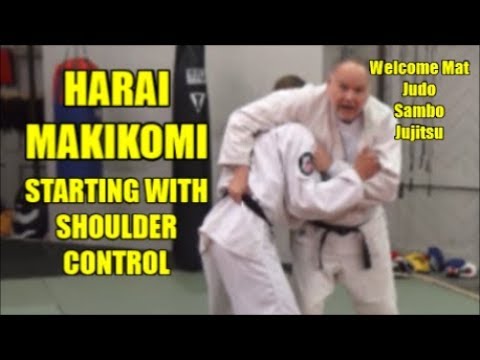
HARAI MAKIKOMI Starting With Shoulder Control
0
Standard Harai Makikomi·welcomematstevescott·Added by Admin
Controlling an opponent's shoulders is important and in this video, we examine using shoulder control to set an opponent…
Translation: sweeping wraparound
Standard Harai Makikomi is the classical form in which tori enters as for harai goshi — turning in, sweeping uke's leg — but instead of staying upright, tori wraps their throwing arm tightly around uke and commits to a forward roll, carrying uke along in the rotation and landing with uke trapped underneath. [1],[2] The throw generates significant force and typically scores ippon when completed cleanly. [2],[3]
Harai makikomi is a powerful sacrifice variation of harai goshi that adds the thrower's body weight to the throwing force by rolling into the opponent during the sweep. [1] The rolling action makes it extremely difficult to defend against once the entry is committed, though it carries risk of the thrower being trapped underneath. [2]
Harai makikomi is classified in the Kodokan system as a yoko-sutemi-waza (side sacrifice technique), combining the harai goshi sweeping mechanics with a makikomi (winding) sacrifice entry. [1]
Makikomi techniques are frequently scored at IJF events, particularly by heavier-weight competitors who can use their body mass to amplify the rolling action. [1]
No images yet for this technique.
Sign in to suggest an image.
Controlling an opponent's shoulders is important and in this video, we examine using shoulder control to set an opponent…
No instructional courses yet for this technique.
Sign in to suggest a course.
Risk of injury to the person this technique is applied to
Rolling sacrifice adds rotational momentum; uncontrolled landing risk
Skill level needed to execute this technique reliably
Whether this technique is allowed under major competition rule sets
Kodokan Judo — Official Nage-waza Classification
Traditional Judo throwing technique terminology (Kodokan Institute)
Official Kodokan ground technique classification system
Standard Japanese martial arts terminology (kanji/hiragana)
Established Japanese martial arts naming convention — native Japanese term (和語/漢語)
Traditional Judo throwing technique terminology (Kodokan Institute)
precise timing, ankle coordination, upper body kuzushi ability
excellent balance and quick reflexes
tibialis anterior, calves, hip rotators, forearms (grip)
Slide around your opponent and trap their shoulder into your armpit while controlling their lapel or belt. This isolation of their shoulder prevents them from defending effectively, as noted by Steve Scott, who emphasizes that controlling the shoulder creates a stuck position for the entire side of their body.
Harai makikomi works well when your opponent is bent over, according to Steve Scott's instruction on the technique from shoulder control.
Standard Harai Makikomi is the classical form in which tori enters as for harai goshi — turning in, sweeping uke's leg — but instead of staying upright, tori wraps their throwing arm tightly around uke and commits to a forward roll, carrying uke along in the rotation and landing with uke trapped underneath. The throw generates significant force and typically scores ippon when completed cleanly.
The standard harai makikomi has been practised in Kodokan judo since the mid-20th century and is recognised as one of the sixty-seven throws in the revised Kodokan classification.
IJF: legal — Legal throwing technique; IBJJF: legal — Legal at all belt levels; UWW: legal — Legal in both freestyle and Greco-Roman; Unified MMA: legal — Legal throwing technique; ADCC: legal — Legal; FIAS Sport Sambo: legal — Legal; FIAS Combat Sambo: legal — Legal
Danger rating 6/10. High — rolling sacrifice adds rotational momentum; uncontrolled landing risk
The standard setup chain: Grip Setup (Kumi-kata) → Off-Balance (Kuzushi) → Entry (Tsukuri) → Execution (Kake).
Standard counters include: Lower Centre of Gravity — bend knees and drop hips to make the throw harder to execute / Lift the Targeted Leg — raise the foot being attacked above the sweeping action / Counter-Throw — exploit the attacker's committed weight to throw them instead / Grip Break — deny the thrower their preferred gripping configuration.
Common variants: Forward sweep (sweeping the foot in the direction the opponent is stepping); Rear sweep (sweeping the foot backward as the opponent retreats); Combination sweep (chaining sweeps to both feet); Counter sweep (timing the sweep as the opponent initiates their own attack).
Makikomi techniques are frequently scored at IJF events, particularly by heavier-weight competitors who can use their body mass to amplify the rolling action.
Top errors to watch for: Not establishing a real harai goshi first — the makikomi only works off a genuine throw attempt / Wrapping the arm but not continuing the sweep — both elements are needed / Rolling over uke's body instead of pulling them into the roll — they must roll with you / Landing flat on uke — roll to the side for a controlled finish.
The Standard Harai Makikomi is also known as Harai Makikomi, Classical Sweeping Winding Throw, Standard Hip Sweep Wrap-Around.