Strike & defenceLocksClose rangeFighting multiple people
Distance
CloseMiddleLong
Overview
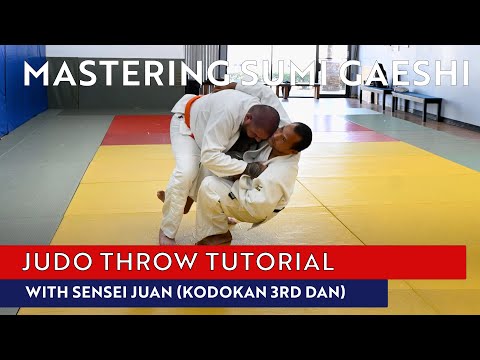
Standard Sumi Gaeshi is the classical execution of the corner reversal throw in which tori secures a standard sleeve-and-lapel grip, steps in close, places the sole of one foot against the inside of uke's thigh, and falls directly backward while lifting with the planted foot and pulling with the arms to roll uke overhead. [1],[2] The throw finishes with uke landing on their back and tori following through into a mounted or side-control position. [2],[3]
The standard form of sumi gaeshi has been taught at the Kodokan since the early 20th century and appears in the gokyo no waza as a foundational rear sacrifice technique. [1],[2]
Country of origin· shown in random order
🇯🇵Japan隅返し(Sumi Gaeshi)Judo, BJJ
🇧🇷BrazilBJJ
🇷🇺RussiaSambo
Effectiveness
Sumi gaeshi (corner reversal) is effective because the sacrifice entry draws the opponent forward and down while the butterfly hook on the inner thigh provides a powerful lifting mechanism to flip the opponent over. [1] It is particularly effective when the opponent is pushing forward aggressively, as their own momentum amplifies the throw. [2]
Lineage
Sumi gaeshi was included in the Kodokan gokyo no waza as a ma-sutemi-waza (rear sacrifice technique). [1] The technique has been widely adopted in BJJ as a sweep from butterfly guard and in sambo competition. [2]
Competition Record
Sumi gaeshi is frequently scored at IJF events, particularly by European competitors who favour unorthodox sacrifice attacks. [1]
Images
No images yet for this technique.
Sign in to suggest an image.
Biomechanical Mechanism
Primary Action — Pulling and lifting with the arms to load the opponent over the shoulder or upper back
Joints Involved — Attacker's shoulders (loading point), elbows (pulling action), hips (turning under the opponent)
Force Vector — Forward and downward rotation — the pulling arm creates circular momentum while the body turns underneath
Kuzushi (Off-balancing) — Forward — breaking the opponent's balance forward over their toes allows the turning entry
Position & Entry
From judo grip — Break opponent's balance in the intended direction, place foot on their hip or thigh, fall backward while pulling them over
From clinch — During a grip exchange, sacrifice balance by falling deliberately while using body weight to project the opponent
Variants
Rear sacrifice — falling backward while pulling the opponent over
Side sacrifice — falling to the side to project the opponent laterally
Rolling sacrifice — combining a roll with the sacrifice throw for rotation
Counter sacrifice — using the opponent's forward pressure as the driving force
Standard Japanese martial arts terminology (kanji/hiragana)
4OtherJapanese Martial Arts Standard Terminology (武道用語)
Established Japanese martial arts naming convention — native Japanese term (和語/漢語)
5CitationKodokan Judo — Official Nage-waza Classification
Traditional Judo throwing technique terminology (Kodokan Institute)
Community
Athletics
Requires
commitment, timing, body weight manipulation, falling skill
Favours
heavier build (body weight drives the throw), good ukemi
Key muscles
core rotators, hip flexors, abdominals
Frequently Asked Questions
Should I try to break my opponent's grip directly when setting up Sumi Gaeshi?
No—avoid wasting energy struggling against a strong uphill grip. Instead, move to your opponent's left side to weaken that arm, then reach under and grab the sleeve. Sensei Juan (3rd Dan Kodokan) emphasizes this positioning strategy makes the grip much easier to control.
What should I grab on my opponent's back during the throw?
Reach across the back and grab as much material as you can; if you can reach the belt, that's an excellent grip. However, remember the belt can move, so your ability to secure it depends partly on height differences. Sensei Juan notes that grabbing the sleeve and pinning it is also super important for control.
How do I know if I've truly mastered Sumi Gaeshi?
You can control the technique from beginning to end—choosing whether you land on top, roll to the side, or execute a back roll, and maintaining control throughout. Sensei Juan explains that the ability to control where you end up is the mark of real mastery.
What positions and submissions can I attack from after landing Sumi Gaeshi?
Sumi Gaeshi is an entry into mount or side control, from which you can attack with submissions like the paper cutter, triangle, or cross choke. Sensei Juan emphasizes keeping the opponent's sleeve pinned to prevent them from defending against these follow-up techniques.
How does the Standard Sumi Gaeshi work?
Standard Sumi Gaeshi is the classical execution of the corner reversal throw in which tori secures a standard sleeve-and-lapel grip, steps in close, places the sole of one foot against the inside of uke's thigh, and falls directly backward while lifting with the planted foot and pulling with the arms to roll uke overhead. The throw finishes with uke landing on their back and tori following through into a mounted or side-control position.
Where does the Standard Sumi Gaeshi come from?
The standard form of sumi gaeshi has been taught at the Kodokan since the early 20th century and appears in the gokyo no waza as a foundational rear sacrifice technique.
Is the Standard Sumi Gaeshi legal in competition?
IJF: legal — Legal throwing technique; IBJJF: legal — Legal at all belt levels; UWW: legal — Legal in both freestyle and Greco-Roman; Unified MMA: legal — Legal throwing technique; ADCC: legal — Legal; FIAS Sport Sambo: legal — Legal; FIAS Combat Sambo: legal — Legal
How dangerous is the Standard Sumi Gaeshi?
Danger rating 6/10. High — Ma-Sutemi-Waza; tori falls backward pulling uke over; spinal compression risk
How do I set up the Standard Sumi Gaeshi?
The standard setup chain: Grip Setup (Kumi-kata) → Off-Balance (Kuzushi) → Entry (Tsukuri) → Execution (Kake).
How do I defend against the Standard Sumi Gaeshi?
Standard counters include: Lower Centre of Gravity — bend knees and drop hips to make the throw harder to execute / Grip Break — deny the thrower their preferred gripping configuration / Stiff-Arm — maintain distance with straight arms to prevent the entry.
What are the variants of the Standard Sumi Gaeshi?
Common variants: Rear sacrifice (falling backward while pulling the opponent over); Side sacrifice (falling to the side to project the opponent laterally); Rolling sacrifice (combining a roll with the sacrifice throw for rotation); Counter sacrifice (using the opponent's forward pressure as the driving force).
How effective is the Standard Sumi Gaeshi in competition?
Sumi gaeshi is frequently scored at IJF events, particularly by European competitors who favour unorthodox sacrifice attacks.
What are common mistakes when doing the Standard Sumi Gaeshi?
Top errors to watch for: Hooking on the outside of uke's thigh instead of the inner thigh — the hook must be between the legs / Not gripping the belt deeply enough — a shallow grip slips during the roll / Falling straight back instead of diagonally — you'll miss the throw angle / Not extending the hooking leg during the throw — it must elevate uke, not just trip them.
What are other names for the Standard Sumi Gaeshi?
The Standard Sumi Gaeshi is also known as Sumi Gaeshi, Classical Corner Reversal, Standard Corner Throw, Kihon Sumi Gaeshi.