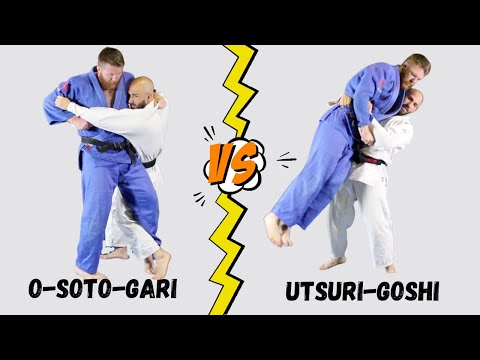
O-Soto-Gari vs Utsuri-Goshi || Is This The Best Throw To Use Against Taller Fighters?
0
Utsuri Goshi·The Judo Way of Life
What is the best throw to do on "taller" fighters? And by that same token, what is the best throw to do on "shorter" ad…
Translation: changing hip
Utsuri Goshi is a judo hip technique where the attacker counters an opponent's hip throw attempt by lifting them and switching hips to throw them in the opposite direction. [1] When the opponent attempts a hip throw, the attacker blocks the attempt, lifts the opponent's body, and shifts their hips to execute a throw in the reverse direction. [1] It is one of the most advanced counter-throws in judo, requiring exceptional timing and strength. [1]
Classified in the Kodokan Judo syllabus. [1]
Kodokan judo lineage: Jigoro Kano (1860–1938) systematized this technique as part of the Kodokan judo curriculum. Transmitted through the Kodokan instructor system to judo federations worldwide. Adopted into BJJ through Mitsuyo Maeda → Carlos Gracie → the Gracie family lineage. [1]
Recognized Kodokan judo technique but rarely seen in modern IJF competition due to rule changes favoring forward-throwing techniques. Occasionally appears in kata demonstrations and regional tournaments. [1]
No images yet for this technique.
Sign in to suggest an image.
What is the best throw to do on "taller" fighters? And by that same token, what is the best throw to do on "shorter" ad…
No instructional courses yet for this technique.
Sign in to suggest a course.
Risk of injury to the person this technique is applied to
The opponent is lifted and thrown from height.
Skill level needed to execute this technique reliably
Whether this technique is allowed under major competition rule sets
Kano, J. Kodokan Judo. Kodansha International.
[1] Kano, J. Kodokan Judo. Kodansha International.
Official Kodokan ground technique classification system
Standard Japanese martial arts terminology (kanji/hiragana)
Established Japanese martial arts naming convention — native Japanese term (和語/漢語)
[1] Kano, J. Kodokan Judo. Kodansha International.
exceptional lower body and back strength for the lift, explosive hip rotation, timing
quadriceps, gluteus maximus, erector spinae (lift), core obliques (hip switch)
Utsuri goshi (changing hip throw) is a counter-throw — the defender blocks an incoming hip throw and converts it by lifting and switching to their own hip throw. One of the most advanced koshi-waza, requiring perfect timing. (Kano, Kodokan Judo)
Start by taking the lapel grip, which invites your opponent to grab your sleeve. Once they commit to the sleeve grip, that's when you make your attack. The Judo Way of Life emphasizes that controlling when your opponent takes the grip gives you the timing to execute the throw.
After stepping in with your leg, focus on breaking your partner's posture by pulling down on their head and arms, then shift their weight onto one leg before sweeping. The Judo Way of Life stresses that once the legs are positioned correctly, the upper body control—pulling with the thumb down and driving weight onto the target leg—is equally important.
Yes, shorter fighters can execute the throw by working from the lapel grip and pushing the head over while creating the same weight-shifting position on the target leg. The Judo Way of Life notes that height isn't a limiting factor—experimentation and adjusting your entry point are what matter.
If you're getting crushed close and can't get your hand in position, take a deep grip around the back of the neck and rely on lifting from the hip. The Judo Way of Life explains that the key to this variation is getting maximum height on the initial lift, which makes the rest of the throw easier.
Utsuri Goshi is a judo hip technique where the attacker counters an opponent's hip throw attempt by lifting them and switching hips to throw them in the opposite direction. When the opponent attempts a hip throw, the attacker blocks the attempt, lifts the opponent's body, and shifts their hips to execute a throw in the reverse direction.
Classified in the Kodokan Judo syllabus.
IJF Judo: Legal: legal — Kodokan classified technique; IBJJF: Legal {src:IBJJF Rules Book v6.0, June 2024|/sources/IBJJF: legal — Rules-v6.0-June-2024.pdf}; Unified MMA: Legal {src:Unified Rules of MMA, August 2025|/sources/Unified: legal — MMA-Rules-August-2025.pdf}; FIAS Sambo: Legal {src:FIAS International Sambo Competition Rules|/sources/FIAS: legal — Sambo-Rules.pdf}
Danger rating 7/10. High — the opponent is lifted and thrown from height.
The standard setup chain: Opponent attempts Harai Goshi → block and lift → switch hips → throw → Opponent attempts O Goshi → absorb → Utsuri Goshi → Bait a hip throw by showing weak defense → counter with Utsuri Goshi.
Standard counters include: Let go and drop when being lifted — remove the weight / Hook the attacker's leg — prevent the hip switch / Widen stance — make lifting more difficult.
Common variants: High lift Utsuri Goshi (lifting the opponent completely off the ground); Low Utsuri Goshi (minimal lift with more hip switch); Counter to counter (using Utsuri Goshi against an Utsuri Goshi attempt).
Recognized Kodokan judo technique but rarely seen in modern IJF competition due to rule changes favoring forward-throwing techniques. Occasionally appears in kata demonstrations and regional tournaments.
Top errors to watch for: Attempting the lift too late — after the opponent's throw is already in motion / Using only arm strength to lift — must use legs and hips / Not switching hips decisively — half-switches leave both fighters off balance / Losing grip during the lift — the opponent escapes.
The Utsuri Goshi is also known as Utsuri Goshi, Utsuri-Goshi, Changing Hip Throw, Utsurigoshi, Hip Transfer Throw.