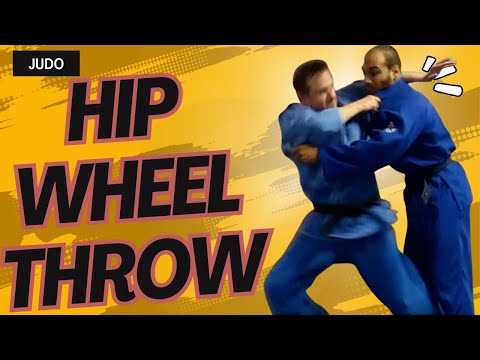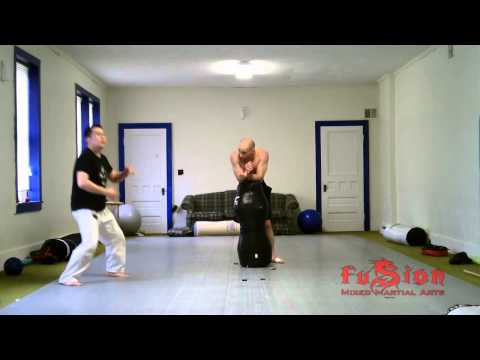
Te Guruma (Hand Wheel) throw for MMA Drill
0
Wheel Throw (Guruma)·Mong Phu
In this video Sensei Phu teaches how to use Te Guruma for MMA Drill using the punching bag Te-guruma is a member of the…
Not yet documented
The Wheel Throw (Guruma, 車) family covers judo hand technique throws that use a wheeling motion to rotate the opponent around the thrower's body — named for the wheel-like circular arc the opponent travels during the throw. [1] The most famous guruma technique is kata guruma (shoulder wheel, also known as the fireman's carry) where the thrower loads the opponent across the shoulders and wheels them over, plus other variations like ushiro guruma (rear wheel). [1],[2] Kata guruma was historically one of judo's most popular and spectacular throws, but its usage in judo competition has changed dramatically since the IJF banned grabbing below the waist in standing (2013), forcing judoka to modify the technique for the modern ruleset. [2],[3]
Kata guruma is one of the original Kodokan judo throws, classified under te waza (hand techniques). [1] It has been a staple of both judo and wrestling (as the fireman's carry) for over a century. [1],[2] The IJF's 2013 ban on leg grabbing significantly reduced kata guruma's usage in judo competition, though modified versions persist. [2],[3]
No images yet for this technique.
Sign in to suggest an image.
In this video Sensei Phu teaches how to use Te Guruma for MMA Drill using the punching bag Te-guruma is a member of the…
DOWNLOAD (FREE) EBOOK: THE WINNING EDGE: https://mindcoach-system.groovepages.com/thewinningedge/ 🥋This is a judo tech…
No instructional courses yet for this technique.
Sign in to suggest a course.
Risk of injury to the person this technique is applied to
Guruma throws involve high-amplitude lifting and wheeling; the opponent travels a significant distance from standing to the mat; shoulder and neck injuries can occur from landing impact
Skill level needed to execute this technique reliably
Whether this technique is allowed under major competition rule sets
Kodokan Judo (Jigoro Kano, 1986)
Description sources — [1] Kodokan Judo (Kano, 1986) [2] IJF rule changes 2013 [3] Wrestling fireman's carry tradition
Official Kodokan ground technique classification system
Standard katakana transliteration of Western martial arts terminology (外来語) — used in Japanese MMA, boxing, and BJJ communities
Description sources — [1] Kodokan Judo (Kano, 1986) [2] IJF rule changes 2013 [3] Wrestling fireman's carry tradition
strong legs (loading and standing with the opponent), shoulder stability (bearing the weight), explosive entry (duck-under speed)
strong legs, low centre of gravity, shoulder strength
quadriceps (squatting and standing), shoulders (bearing weight), core (rotation), grip (maintaining control)
Every move, in any martial art, shares a few universal traits. Mix and match below to pinpoint the right tool — or compare equivalents across styles.
Wheel throws appear in 20 passages across 8 books. Guruma (wheel) throws use a circular wheeling action over a fulcrum — the opponent is rotated over the attacker's leg, hip, or shoulder like a wheel over an axle. (8 books; Kano, Kodokan Judo)
According to Mong Phu, when picking up your opponent, use your hip more while kicking your knee harder and timing your hip motion with the knee lift. Then use your body to crack the slam down, ensuring every motion works together for power.
DadBod Judo explains that people often try to lift their opponent while bending down with poor posture—shoulders out, hands positioned inefficiently. Instead, you should get low enough to wheel them smoothly over your hip for a super efficient throw.
DadBod Judo emphasizes the importance of locking your opponent in close to your body, especially if they're positioned on either side of you, so they can't post their arm out to break the throw.
The Wheel Throw (Guruma, 車) family covers judo hand technique throws that use a wheeling motion to rotate the opponent around the thrower's body — named for the wheel-like circular arc the opponent travels during the throw. The most famous guruma technique is kata guruma (shoulder wheel, also known as the fireman's carry) where the thrower loads the opponent across the shoulders and wheels them over, plus other variations like ushiro guruma (rear wheel).
Kata guruma is one of the original Kodokan judo throws, classified under te waza (hand techniques). It has been a staple of both judo and wrestling (as the fireman's carry) for over a century.
IJF: legal — Legal throwing technique; IBJJF: legal — Legal at all belt levels; UWW: legal — Legal in both freestyle and Greco-Roman; Unified MMA: legal — Legal throwing technique; ADCC: legal — Legal; FIAS Sport Sambo: legal — Legal; FIAS Combat Sambo: legal — Legal
Danger rating 7/10. High — guruma throws involve high-amplitude lifting and wheeling; the opponent travels a significant distance from standing to the mat; shoulder and neck injuries can occur from landing impact
The standard setup chain: Set Up Entry → Duck Under → Load → Lift → Wheel → Follow Through.
Standard counters include: Sprawl — dropping hips to prevent the duck-under / Block the hip — preventing the thrower from getting underneath / Counter-roll — rolling with the throw to prevent being pinned / Whizzer — overhook to prevent the loading.
Common variants: Kata guruma (shoulder wheel) (loading the opponent across the shoulders and wheeling th…); Drop kata guruma (dropping to the knees while performing the shoulder wheel…); Ushiro guruma (rear wheel) (wheeling the opponent backward); Sukui nage (scooping throw) (related throw that scoops the opponent's legs); Te guruma (hand wheel) (lifting and wheeling with the hands rather than loading o…).
Kata guruma has been used at Olympic and World Championship level in both judo and wrestling. Usage in judo declined after the 2013 leg-grab ban.
Top errors to watch for: Not squatting deep enough — the thrower must get fully under the opponent's centre of gravity / Losing grip during the wheel — the arms must maintain control throughout the rotation / Attempting kata guruma without the entry angle — the duck-under must create the correct angle / Grabbing the leg in IJF competition (illegal since 2013).
The Wheel Throw (Guruma) is also known as Guruma Waza, Wheel Technique, Rotational Throw.