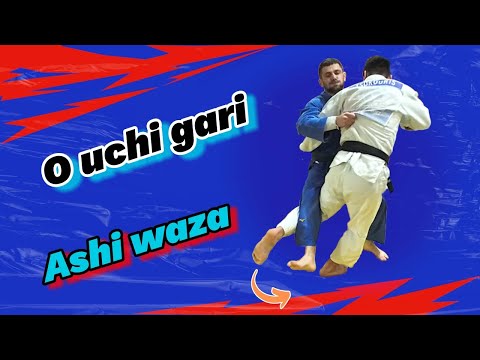
O - uchi - gari . Variations and Combinations
0
O Uchi Gari·Aris judo Club
O uchi gari is an effective technique in judo for several reasons. Firstly, it capitalizes on the opponent's natural mov…
Translation: major inner reap
O Uchi Gari (major inner reap) is a judo ashi-waza technique in which the thrower drives the leg between the opponent's legs and reaps the far leg from the inside, sweeping it backward while pushing the opponent's upper body in the same rearward direction. [1] The 'o' (major) designation indicates that the technique targets the far leg with a large, powerful reaping action, creating a diagonal throwing line. [1],[2] The thrower typically steps deep between the opponent's feet, hooks or reaps the far leg's inner calf or ankle with the foot or shin, and drives forward to topple the opponent backward over the reaped leg. [2],[3]
O uchi gari was included in the Kodokan gokyo from its earliest form, classified in the second set as a fundamental attacking technique. [1] The throw is one of the most frequently attempted techniques in judo competition and serves as both a primary attack and a critical setup for combination sequences. [2],[3]
O uchi gari is a high-frequency technique in IJF competition, commonly used in combination with seoi nage and uchi mata. [1]
No images yet for this technique.
Sign in to suggest an image.
O uchi gari is an effective technique in judo for several reasons. Firstly, it capitalizes on the opponent's natural mov…
No instructional courses yet for this technique.
Sign in to suggest a course.
Risk of injury to the person this technique is applied to
O-Uchi-Gari and variants; backward fall risk with head impact (Kano 1986)
Skill level needed to execute this technique reliably
Whether this technique is allowed under major competition rule sets
Kodokan Judo — Official Nage-waza Classification
Traditional Judo throwing technique terminology (Kodokan Institute)
Official Kodokan ground technique classification system
Standard Japanese martial arts terminology (kanji/hiragana)
Established Japanese martial arts naming convention — native Japanese term (和語/漢語)
Traditional Judo throwing technique terminology (Kodokan Institute)
precise timing, ankle coordination, upper body kuzushi ability
excellent balance and quick reflexes
tibialis anterior, calves, hip rotators, forearms (grip)
Every move, in any martial art, shares a few universal traits. Mix and match below to pinpoint the right tool — or compare equivalents across styles.
O uchi gari appears in 12 passages across 9 books. The most common setup throw in competitive judo — used to drive opponents backward before switching to a forward throw. Often chained with o-soto-gari or uchi-mata. (9 books in corpus; Kano, Kodokan Judo)
O Uchi Gari (major inner reap) is a judo ashi-waza technique in which the thrower drives the leg between the opponent's legs and reaps the far leg from the inside, sweeping it backward while pushing the opponent's upper body in the same rearward direction. The 'o' (major) designation indicates that the technique targets the far leg with a large, powerful reaping action, creating a diagonal throwing line.
O uchi gari was included in the Kodokan gokyo from its earliest form, classified in the second set as a fundamental attacking technique. The throw is one of the most frequently attempted techniques in judo competition and serves as both a primary attack and a critical setup for combination sequences.
IJF: legal — Legal throwing technique; IBJJF: legal — Legal at all belt levels; UWW: restricted — Legal in freestyle, banned in Greco-Roman (no leg attacks below waist); Unified MMA: legal — Legal throwing technique; ADCC: legal — Legal; FIAS Sport Sambo: legal — Legal; FIAS Combat Sambo: legal — Legal
Danger rating 6/10. High — O-Uchi-Gari and variants; backward fall risk with head impact (Kano 1986)
The standard setup chain: Grip Setup (Kumi-kata) → Off-Balance (Kuzushi) → Entry (Tsukuri) → Execution (Kake).
Standard counters include: Lower Centre of Gravity — bend knees and drop hips to make the throw harder to execute / Lift the Targeted Leg — raise the foot being attacked above the sweeping action / Counter-Throw — exploit the attacker's committed weight to throw them instead / Grip Break — deny the thrower their preferred gripping configuration.
Common variants: Forward sweep (sweeping the foot in the direction the opponent is stepping); Rear sweep (sweeping the foot backward as the opponent retreats); Combination sweep (chaining sweeps to both feet); Counter sweep (timing the sweep as the opponent initiates their own attack).
O uchi gari is a high-frequency technique in IJF competition, commonly used in combination with seoi nage and uchi mata.
Top errors to watch for: Reaping the near leg instead of reaching between the legs for the far leg — the major version targets the far leg / Not stepping between the opponent's legs before reaping — you must close distance to reach the target / Pushing backward without actually reaping — the push and reap must be simultaneous / Reaping too gently — the leg action must be a committed, sweeping reap that dislodges the foot.
The O Uchi Gari is also known as O Uchi Gari, Major Inner Reaping Throw, Large Inner Reap, Inside Leg Reap, Perednyaya Podnozhka (передняя подножка).