Okuri-ashi-barai with Modified Grip | Takedowns for Jiu-jitsu
0
Standard Okuri Ashi Barai·Takedowns For Jiu-jitsu
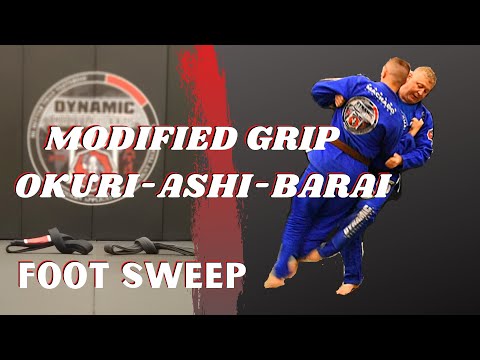
#kumikata #okuriashiharai #footsweep In this video, we demonstrate an armpit grip that will improve your Kuzushi (off b…
Translation: sliding foot sweep
Standard Okuri Ashi Barai executes the classical following foot sweep where the thrower guides the opponent into lateral movement, then sweeps the trailing foot into the lead foot with the sole as both feet come together. [1] The sweep must be timed to catch the trailing foot at the exact moment it is moving to join the lead foot, while the hands maintain strong lateral direction to amplify the sweeping force. [1],[2] The result is a dramatic throw where the opponent's feet are swept out from under them in the direction they were already moving. [2],[3]
Okuri ashi barai, when executed with correct timing during lateral movement, produces some of the most spectacular and clean ippon throws in judo, as both of the opponent's feet leave the ground simultaneously. [1] Inokuma and Sato describe it as a high-reward technique that requires precise timing of the sweep to coincide with the moment both feet are close together. [2]
The standard okuri ashi barai is scored regularly in IJF competition. [1]
No images yet for this technique.
Sign in to suggest an image.
#kumikata #okuriashiharai #footsweep In this video, we demonstrate an armpit grip that will improve your Kuzushi (off b…
This video shows how to apply Okuri Ashi Barai (Sliding Foot Sweep) using Taisabaki (Body Management in a Circular Patte…
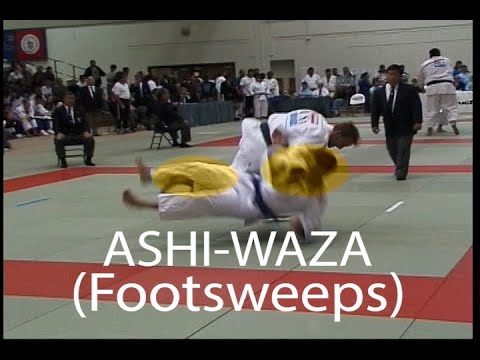
Buy DVD or Video Download at: https://em3video.com/judo-vol-25-ashi-waza-footsweeps/ JUDO - Vol-25 ASHI-WAZA (Footsweep…
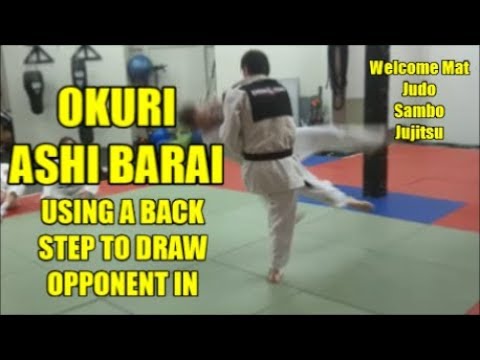
Standard okuri ashi barai is a lateral foot sweep throw executed through coordinated footwork and body mechanics. Takedowns For Jiu-jitsu emphasizes that the technique involves a shuffling side-to-side motion (or circular movement in live grappling) where the sweeping leg slides one opponent foot into the other, creating a collision effect that destabilizes and throws the opponent. A critical element across instructors is off-balancing: Takedowns For Jiu-jitsu advocates gripping underneath the opponent's armpit rather than the lapel to generate maximum body tilt with minimal hand movement, creating better mechanical advantage. welcomematstevescott demonstrates the draw-in footwork pattern using a back step to invite the opponent forward, establishing rhythm and timing through a step-back-turn-sweep sequence that synchronizes the tilt with the sweep execution. MastersMagazine illustrates various grip configurations and continuous driving actions, emphasizing the integration of leg hooks, shoulder pressure, and elbow control while maintaining forward momentum through the throw. The core mechanics remain consistent across instructors: proper grip application, body angle manipulation, synchronized footwork timing, and controlled follow-through. Takedowns For Jiu-jitsu and welcomematstevescott both recommend drilling the movement pattern independently to develop the precise timing and rhythm essential for successful execution.
Synthesized from 4 instructors
No instructional courses yet for this technique.
Sign in to suggest a course.
Risk of injury to the person this technique is applied to
Foot sweeps use timing over force; lower impact but head strike risk remains
Skill level needed to execute this technique reliably
Whether this technique is allowed under major competition rule sets
Kodokan Judo — Official Nage-waza Classification
Traditional Judo throwing technique terminology (Kodokan Institute)
Official Kodokan ground technique classification system
Standard Japanese martial arts terminology (kanji/hiragana)
Established Japanese martial arts naming convention — native Japanese term (和語/漢語)
Traditional Judo throwing technique terminology (Kodokan Institute)
precise timing, ankle coordination, upper body kuzushi ability
excellent balance and quick reflexes
tibialis anterior, calves, hip rotators, forearms (grip)
The standard Okuri Ashi Barai uses a lateral, side-to-side shuffling motion, followed by executing the sweep with your foot against your opponent's foot.
Instead of grabbing the lapel, reach underneath and grab under the armpit—this modified grip gives you more control and more twist on your opponent's body, allowing you to control the throw and bring them down gently or forcefully as needed.
Time the tilt of your opponent's body with your sweep by pulling them in a circular motion around you, then sweep your foot across as they step, causing their foot to sweep into their other foot and bringing them down to the ground.
Standard Okuri Ashi Barai executes the classical following foot sweep where the thrower guides the opponent into lateral movement, then sweeps the trailing foot into the lead foot with the sole as both feet come together. The sweep must be timed to catch the trailing foot at the exact moment it is moving to join the lead foot, while the hands maintain strong lateral direction to amplify the sweeping force.
The standard form of okuri ashi barai is one of the foundational Kodokan judo throws, included in the first set of the gokyo since 1895. It is one of the most visually spectacular sweeps when executed with perfect timing in competition.
IJF: legal — Legal throwing technique; IBJJF: legal — Legal at all belt levels; UWW: restricted — Legal in freestyle, banned in Greco-Roman (no leg attacks below waist); Unified MMA: legal — Legal throwing technique; ADCC: legal — Legal; FIAS Sport Sambo: legal — Legal; FIAS Combat Sambo: legal — Legal
Danger rating 4/10. Moderate — foot sweeps use timing over force; lower impact but head strike risk remains
The standard setup chain: Grip Setup (Kumi-kata) → Off-Balance (Kuzushi) → Entry (Tsukuri) → Execution (Kake).
Standard counters include: Lower Centre of Gravity — bend knees and drop hips to make the throw harder to execute / Lift the Targeted Leg — raise the foot being attacked above the sweeping action / Counter-Throw — exploit the attacker's committed weight to throw them instead / Grip Break — deny the thrower their preferred gripping configuration.
Common variants: Forward sweep (sweeping the foot in the direction the opponent is stepping); Rear sweep (sweeping the foot backward as the opponent retreats); Combination sweep (chaining sweeps to both feet); Counter sweep (timing the sweep as the opponent initiates their own attack).
The standard okuri ashi barai is scored regularly in IJF competition.
Top errors to watch for: Not moving the opponent sideways before sweeping — there must be lateral motion to create the floating moment / Sweeping against the direction of movement instead of with it / Timing the sweep to the wrong foot — it must be the trailing foot, not the lead / Stopping your own lateral movement and trying to sweep from a stationary position.
The Standard Okuri Ashi Barai is also known as Okuri Ashi Barai, Classical Sliding Foot Sweep, Standard Following Foot Sweep.