Initial Setup and Stance
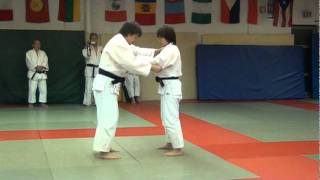
The instructor begins by establishing proper stance positioning. The practitioner steps back with control while maintaining an alert posture, preparing to execute the technique from a neutral distance.
Body Alignment and Positioning
The instructor emphasizes creating a triangular body position that facilitates smooth weight transfer. This alignment is critical for maintaining balance while executing the backward stepping motion.
The Backward Step and Pivot
The fundamental movement involves stepping backward deliberately while executing a controlled pivot turn. This combination creates the drawing motion that entices the opponent to follow forward.
Repetition and Rhythm Development
Consistent practice of the step-back-and-turn sequence builds muscle memory and timing. The instructor recommends multiple repetitions to internalize the choreography of the technique.
Integrating the Sweep
Once the opponent is drawn in through the backward step and pivot, the sweeping motion is executed. The combination of pulling the opponent inward and extending the leg creates the finishing action.
Solo Drilling Without Opposition
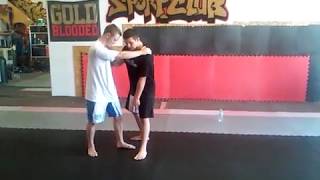
The instructor recommends practicing the technique alone with standard grip positioning to develop comfort with the movement pattern. This foundational drill removes the complexity of partner reaction and allows focus on technique execution.
Three-Step Drill Progression
Practitioners should execute the sequence in three distinct phases: step back, execute the turn, and complete the sweep. Repeating this pattern builds consistency in timing and movement flow.
Practice Method and Refinement
Solo training of this movement pattern—stepping back, turning, and sweeping in continuous repetition—develops the rhythm and timing necessary for application. This isolated practice creates muscle memory that translates directly to partner drills.
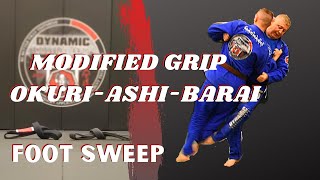
OKURI ASHI BARAI USING A BACK STEP TO DRAW OPPONENT IN
Key Takeaways
- •Initial Setup and Stance
- •Body Alignment and Positioning
- •The Backward Step and Pivot
- •Repetition and Rhythm Development
This video shows how to apply Okuri Ashi Barai (Sliding Foot Sweep) using Taisabaki (Body Management in a Circular Pattern). Go to www.amazon.com or www.ymaa.com to get Steve Scott's books THE JUDO ADVANTAGE, SAMBO ENCYCLOPEDIA and JUJI GATAME ENCYCLOPEDIA. Our channel was started in 2010 as an extension of our program at Welcome Mat. Welcome Mat was founded in 1969 by Steve Scott in Kansas City, Missouri, USA and has produced thousands of successful students, athletes and coaches in a variety of grappling sports. View over a thousand videos on the subjects of judo, freestyle judo, Shingitai Jujitsu, sambo, submission grappling and sport jujitsu are on our Youtube channel. Browse through our playlists to see what we have on our channel. If a video is listed as "private" is it because that video is still in development or scheduled for later viewing. You can subscribe for free to our channel at http://youtube.com/user/welcomematstevescott. We strive to provide fundamentally sound and technically innovative skills and information on a variety of grappling sports. We appreciate your support! Please tell others about our channel. You can help support our channel by going to our online store and purchasing items. Go to http://www.WelcomeMatStore.com. We have a variety of books, shirts and other items for sale. Music for the Freestyle Judo show provided by YouTube Copyright Free Audio featuring "Fiend" by Sting and performed by the Jingle Punks and "All This Down Time" by Sting and performed by the Jingle Punks. Visit our club web site at http://www.WelcomeMatJudoClub. For information on the Judo Black Belt Association, go to http://www.judoblackbelt.com. Thank you for watching our video. Please tell others about our channel. Our videos are all original material and are copyrighted. Reproduction or showing these videos without the specific permission of Steve Scott is prohibited. #okuriashibarai #taisabaki #ashiwaza
Frequently Asked Questions
What does this video teach about standard okuri ashi barai?
This video covers initial setup and stance, body alignment and positioning, the backward step and pivot. It provides detailed instruction from welcomematstevescott.
How long does it take to learn standard okuri ashi barai?
The basic mechanics can be understood in a single session, but developing reliable execution requires consistent drilling over weeks of practice. This 8-part breakdown helps structure your training by isolating each phase of the technique.
What are the key details for finishing standard okuri ashi barai?
Practitioners should execute the sequence in three distinct phases: step back, execute the turn, and complete the sweep. Repeating this pattern builds consistency in timing and movement flow.